

326
Y. Shi et al.
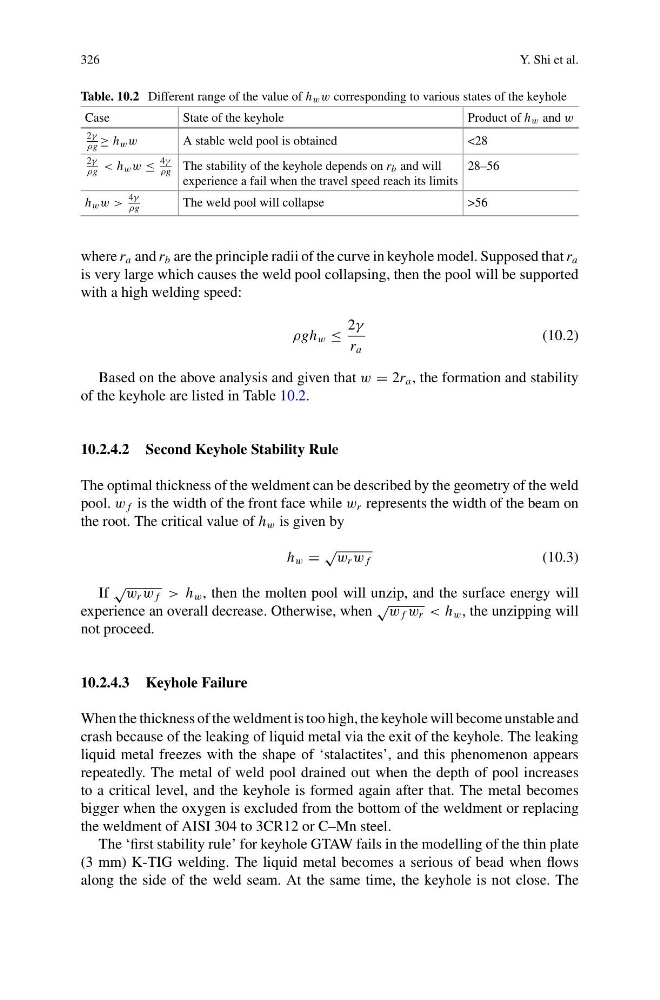
Table. 10.2 Different range of the value of h w w corresponding to various states of the keyhole
Case
State of the keyhole
Product of h w and w
2γ
ρg ≥ h w w
A stable weld pool is obtained
<28
2γ
ρg < h w w ≤
4γ
ρg The stability of the keyhole depends on r b and will
experience a fail when the travel speed reach its limits
28–56
h w w >
4γ
ρg
The weld pool will collapse
>56
where r a and r b are the principle radii of the curve in keyhole model. Supposed that r a
is very large which causes the weld pool collapsing, then the pool will be supported
with a high welding speed:
ρgh w ≤
2γ
r a
(10.2)
Based on the above analysis and given that w = 2r a , the formation and stability
of the keyhole are listed in Table 10.2.
10.2.4.2 Second Keyhole Stability Rule
The optimal thickness of the weldment can be described by the geometry of the weld
pool. w f is the width of the front face while w r represents the width of the beam on
the root. The critical value of h w is given by
h w =
√ w r w f
(10.3)
If
√
w r w f > h w , then the molten pool will unzip, and the surface energy will
experience an overall decrease. Otherwise, when
√
w f w r < h w , the unzipping will
not proceed.
10.2.4.3 Keyhole Failure
When the thickness of the weldment is too high, the keyhole will become unstable and
crash because of the leaking of liquid metal via the exit of the keyhole. The leaking
liquid metal freezes with the shape of ‘stalactites’, and this phenomenon appears
repeatedly. The metal of weld pool drained out when the depth of pool increases
to a critical level, and the keyhole is formed again after that. The metal becomes
bigger when the oxygen is excluded from the bottom of the weldment or replacing
the weldment of AISI 304 to 3CR12 or C–Mn steel.
The ‘first stability rule’ for keyhole GTAW fails in the modelling of the thin plate
(3 mm) K-TIG welding. The liquid metal becomes a serious of bead when flows
along the side of the weld seam. At the same time, the keyhole is not close. The
Y. Shi et al.
Table. 10.2 Different range of the value of h w w corresponding to various states of the keyhole
Case
State of the keyhole
Product of h w and w
2γ
ρg ≥ h w w
A stable weld pool is obtained
<28
2γ
ρg < h w w ≤
4γ
ρg The stability of the keyhole depends on r b and will
experience a fail when the travel speed reach its limits
28–56
h w w >
4γ
ρg
The weld pool will collapse
>56
where r a and r b are the principle radii of the curve in keyhole model. Supposed that r a
is very large which causes the weld pool collapsing, then the pool will be supported
with a high welding speed:
ρgh w ≤
2γ
r a
(10.2)
Based on the above analysis and given that w = 2r a , the formation and stability
of the keyhole are listed in Table 10.2.
10.2.4.2 Second Keyhole Stability Rule
The optimal thickness of the weldment can be described by the geometry of the weld
pool. w f is the width of the front face while w r represents the width of the beam on
the root. The critical value of h w is given by
h w =
√ w r w f
(10.3)
If
√
w r w f > h w , then the molten pool will unzip, and the surface energy will
experience an overall decrease. Otherwise, when
√
w f w r < h w , the unzipping will
not proceed.
10.2.4.3 Keyhole Failure
When the thickness of the weldment is too high, the keyhole will become unstable and
crash because of the leaking of liquid metal via the exit of the keyhole. The leaking
liquid metal freezes with the shape of ‘stalactites’, and this phenomenon appears
repeatedly. The metal of weld pool drained out when the depth of pool increases
to a critical level, and the keyhole is formed again after that. The metal becomes
bigger when the oxygen is excluded from the bottom of the weldment or replacing
the weldment of AISI 304 to 3CR12 or C–Mn steel.
The ‘first stability rule’ for keyhole GTAW fails in the modelling of the thin plate
(3 mm) K-TIG welding. The liquid metal becomes a serious of bead when flows
along the side of the weld seam. At the same time, the keyhole is not close. The