

324
Y. Shi et al.
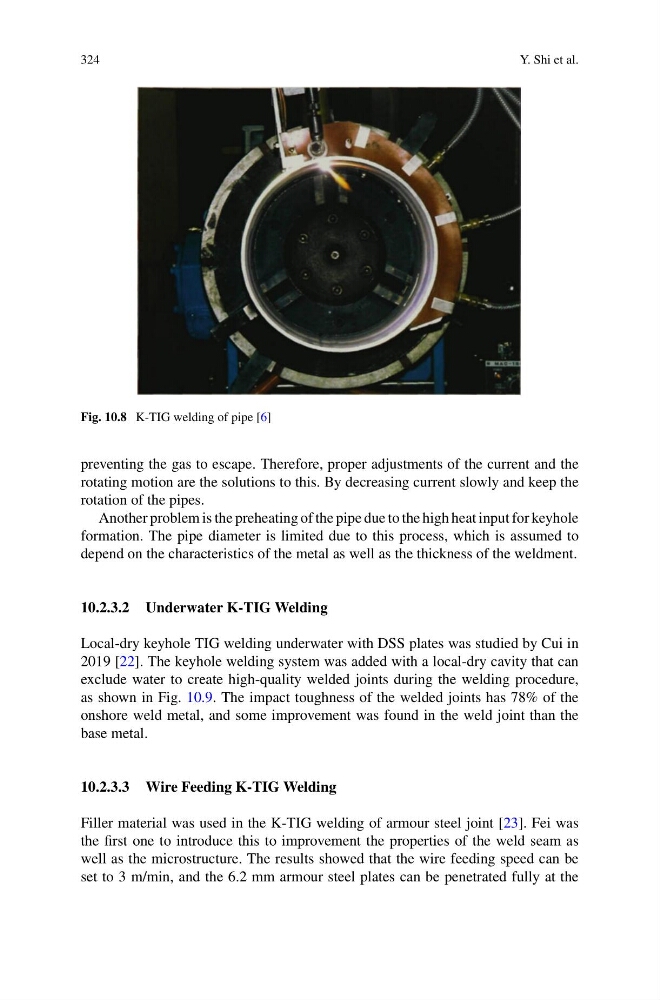
Fig. 10.8 K-TIG welding of pipe [6]
preventing the gas to escape. Therefore, proper adjustments of the current and the
rotating motion are the solutions to this. By decreasing current slowly and keep the
rotation of the pipes.
Another problem is the preheating of the pipe due to the high heat input for keyhole
formation. The pipe diameter is limited due to this process, which is assumed to
depend on the characteristics of the metal as well as the thickness of the weldment.
10.2.3.2 Underwater K-TIG Welding
Local-dry keyhole TIG welding underwater with DSS plates was studied by Cui in
2019 [22]. The keyhole welding system was added with a local-dry cavity that can
exclude water to create high-quality welded joints during the welding procedure,
as shown in Fig. 10.9. The impact toughness of the welded joints has 78% of the
onshore weld metal, and some improvement was found in the weld joint than the
base metal.
10.2.3.3 Wire Feeding K-TIG Welding
Filler material was used in the K-TIG welding of armour steel joint [23]. Fei was
the first one to introduce this to improvement the properties of the weld seam as
well as the microstructure. The results showed that the wire feeding speed can be
set to 3 m/min, and the 6.2 mm armour steel plates can be penetrated fully at the
Y. Shi et al.
Fig. 10.8 K-TIG welding of pipe [6]
preventing the gas to escape. Therefore, proper adjustments of the current and the
rotating motion are the solutions to this. By decreasing current slowly and keep the
rotation of the pipes.
Another problem is the preheating of the pipe due to the high heat input for keyhole
formation. The pipe diameter is limited due to this process, which is assumed to
depend on the characteristics of the metal as well as the thickness of the weldment.
10.2.3.2 Underwater K-TIG Welding
Local-dry keyhole TIG welding underwater with DSS plates was studied by Cui in
2019 [22]. The keyhole welding system was added with a local-dry cavity that can
exclude water to create high-quality welded joints during the welding procedure,
as shown in Fig. 10.9. The impact toughness of the welded joints has 78% of the
onshore weld metal, and some improvement was found in the weld joint than the
base metal.
10.2.3.3 Wire Feeding K-TIG Welding
Filler material was used in the K-TIG welding of armour steel joint [23]. Fei was
the first one to introduce this to improvement the properties of the weld seam as
well as the microstructure. The results showed that the wire feeding speed can be
set to 3 m/min, and the 6.2 mm armour steel plates can be penetrated fully at the