

310
J. M. Sánchez-Amaya and C. Churiaque
Table 9.3 Results obtained from tensile tests performed on base metal (BM) and laser welds
(WELD) of the three titanium alloys indicated
Sample identification
YS (MPa)
UTS
(MPa)
1 (%)
Fracture
Zone
Fulfil
regulations
CpTi-BM (reference)
588
683
27
Base Metal Yes
CpTi-WELD
630
693
23
Base Metal Yes
Ti 6 Al 4 V-BM (reference)
941
983
13
Base Metal Yes
Ti 6 Al 4 V-WELD
979
1029
8
Weld
Yes
Ti 5 Al 5 V 5 Mo 3 Cr-BM
(reference)
1028
1053
12
Base Metal Yes
Ti 5 Al 5 V5Mo 3 Cr-WELD
816
818
4
Weld
No
Table reports the Ultimate Tensile Strength (UTS), Yield Strength (YS), Ductility ( 1), fracture zone,
and indication of regulations accomplishment
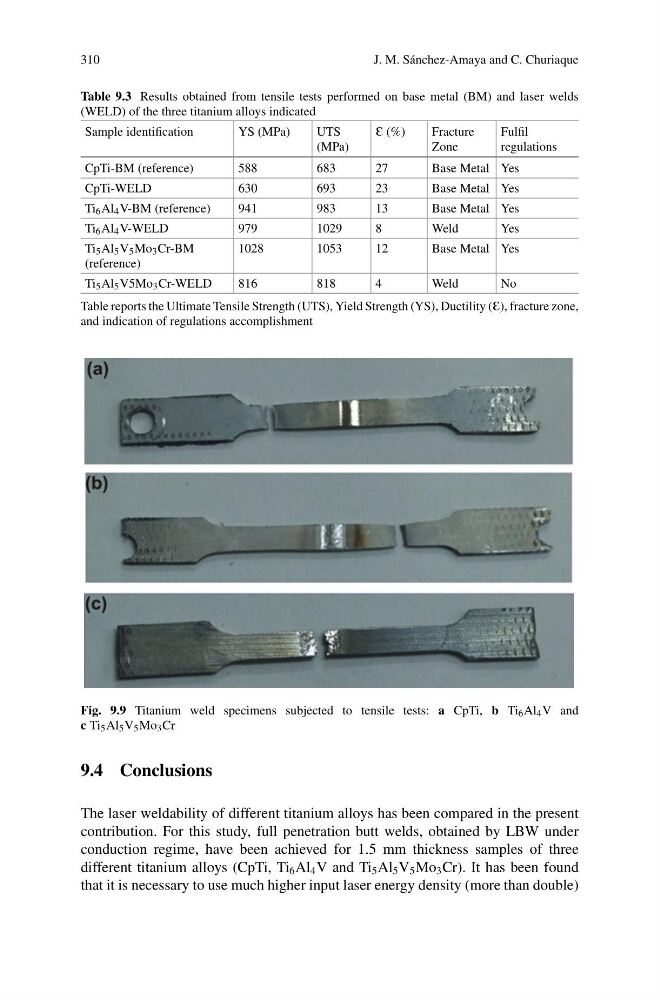
Fig. 9.9 Titanium weld specimens subjected to tensile tests: a CpTi, b Ti 6 Al 4 V and
c Ti 5 Al 5 V 5 Mo 3 Cr
9.4 Conclusions
The laser weldability of different titanium alloys has been compared in the present
contribution. For this study, full penetration butt welds, obtained by LBW under
conduction regime, have been achieved for 1.5 mm thickness samples of three
different titanium alloys (CpTi, Ti 6 Al 4 V and Ti 5 Al 5 V 5 Mo 3 Cr). It has been found
that it is necessary to use much higher input laser energy density (more than double)
J. M. Sánchez-Amaya and C. Churiaque
Table 9.3 Results obtained from tensile tests performed on base metal (BM) and laser welds
(WELD) of the three titanium alloys indicated
Sample identification
YS (MPa)
UTS
(MPa)
1 (%)
Fracture
Zone
Fulfil
regulations
CpTi-BM (reference)
588
683
27
Base Metal Yes
CpTi-WELD
630
693
23
Base Metal Yes
Ti 6 Al 4 V-BM (reference)
941
983
13
Base Metal Yes
Ti 6 Al 4 V-WELD
979
1029
8
Weld
Yes
Ti 5 Al 5 V 5 Mo 3 Cr-BM
(reference)
1028
1053
12
Base Metal Yes
Ti 5 Al 5 V5Mo 3 Cr-WELD
816
818
4
Weld
No
Table reports the Ultimate Tensile Strength (UTS), Yield Strength (YS), Ductility ( 1), fracture zone,
and indication of regulations accomplishment
Fig. 9.9 Titanium weld specimens subjected to tensile tests: a CpTi, b Ti 6 Al 4 V and
c Ti 5 Al 5 V 5 Mo 3 Cr
9.4 Conclusions
The laser weldability of different titanium alloys has been compared in the present
contribution. For this study, full penetration butt welds, obtained by LBW under
conduction regime, have been achieved for 1.5 mm thickness samples of three
different titanium alloys (CpTi, Ti 6 Al 4 V and Ti 5 Al 5 V 5 Mo 3 Cr). It has been found
that it is necessary to use much higher input laser energy density (more than double)