

304
J. M. Sánchez-Amaya and C. Churiaque
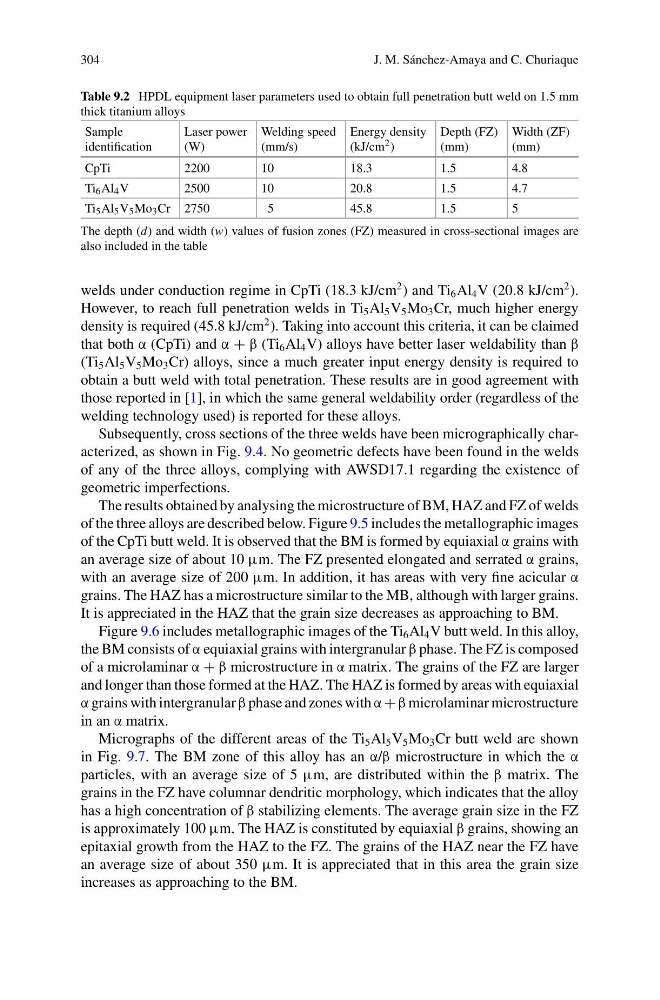
Table 9.2 HPDL equipment laser parameters used to obtain full penetration butt weld on 1.5 mm
thick titanium alloys
Sample
identification
Laser power
(W)
Welding speed
(mm/s)
Energy density
(kJ/cm 2 )
Depth (FZ)
(mm)
Width (ZF)
(mm)
CpTi
2200
10
18.3
1.5
4.8
Ti 6 Al 4 V
2500
10
20.8
1.5
4.7
Ti 5 Al 5 V 5 Mo 3 Cr 2750
5
45.8
1.5
5
The depth (d) and width (w) values of fusion zones (FZ) measured in cross-sectional images are
also included in the table
welds under conduction regime in CpTi (18.3 kJ/cm
2 ) and Ti 6 Al 4 V (20.8 kJ/cm
2 ).
However, to reach full penetration welds in Ti 5 Al 5 V 5 Mo 3 Cr, much higher energy
density is required (45.8 kJ/cm
2 ). Taking into account this criteria, it can be claimed
that both α (CpTi) and α + β (Ti 6 Al 4 V) alloys have better laser weldability than β
(Ti 5 Al 5 V 5 Mo 3 Cr) alloys, since a much greater input energy density is required to
obtain a butt weld with total penetration. These results are in good agreement with
those reported in [1], in which the same general weldability order (regardless of the
welding technology used) is reported for these alloys.
Subsequently, cross sections of the three welds have been micrographically characterized, as shown in Fig. 9.4. No geometric defects have been found in the welds
of any of the three alloys, complying with AWSD17.1 regarding the existence of
geometric imperfections.
The results obtained by analysing the microstructure of BM, HAZ and FZ of welds
of the three alloys are described below. Figure 9.5 includes the metallographic images
of the CpTi butt weld. It is observed that the BM is formed by equiaxial α grains with
an average size of about 10 μm. The FZ presented elongated and serrated α grains,
with an average size of 200 μm. In addition, it has areas with very fine acicular α
grains. The HAZ has a microstructure similar to the MB, although with larger grains.
It is appreciated in the HAZ that the grain size decreases as approaching to BM.
Figure 9.6 includes metallographic images of the Ti 6 Al 4 V butt weld. In this alloy,
the BM consists of α equiaxial grains with intergranular β phase. The FZ is composed
of a microlaminar α + β microstructure in α matrix. The grains of the FZ are larger
and longer than those formed at the HAZ. The HAZ is formed by areas with equiaxial
α grains with intergranular β phase and zones with α + β microlaminar microstructure
in an α matrix.
Micrographs of the different areas of the Ti 5 Al 5 V 5 Mo 3 Cr butt weld are shown
in Fig. 9.7. The BM zone of this alloy has an α/β microstructure in which the α
particles, with an average size of 5 μm, are distributed within the β matrix. The
grains in the FZ have columnar dendritic morphology, which indicates that the alloy
has a high concentration of β stabilizing elements. The average grain size in the FZ
is approximately 100 μm. The HAZ is constituted by equiaxial β grains, showing an
epitaxial growth from the HAZ to the FZ. The grains of the HAZ near the FZ have
an average size of about 350 μm. It is appreciated that in this area the grain size
increases as approaching to the BM.
J. M. Sánchez-Amaya and C. Churiaque
Table 9.2 HPDL equipment laser parameters used to obtain full penetration butt weld on 1.5 mm
thick titanium alloys
Sample
identification
Laser power
(W)
Welding speed
(mm/s)
Energy density
(kJ/cm 2 )
Depth (FZ)
(mm)
Width (ZF)
(mm)
CpTi
2200
10
18.3
1.5
4.8
Ti 6 Al 4 V
2500
10
20.8
1.5
4.7
Ti 5 Al 5 V 5 Mo 3 Cr 2750
5
45.8
1.5
5
The depth (d) and width (w) values of fusion zones (FZ) measured in cross-sectional images are
also included in the table
welds under conduction regime in CpTi (18.3 kJ/cm
2 ) and Ti 6 Al 4 V (20.8 kJ/cm
2 ).
However, to reach full penetration welds in Ti 5 Al 5 V 5 Mo 3 Cr, much higher energy
density is required (45.8 kJ/cm
2 ). Taking into account this criteria, it can be claimed
that both α (CpTi) and α + β (Ti 6 Al 4 V) alloys have better laser weldability than β
(Ti 5 Al 5 V 5 Mo 3 Cr) alloys, since a much greater input energy density is required to
obtain a butt weld with total penetration. These results are in good agreement with
those reported in [1], in which the same general weldability order (regardless of the
welding technology used) is reported for these alloys.
Subsequently, cross sections of the three welds have been micrographically characterized, as shown in Fig. 9.4. No geometric defects have been found in the welds
of any of the three alloys, complying with AWSD17.1 regarding the existence of
geometric imperfections.
The results obtained by analysing the microstructure of BM, HAZ and FZ of welds
of the three alloys are described below. Figure 9.5 includes the metallographic images
of the CpTi butt weld. It is observed that the BM is formed by equiaxial α grains with
an average size of about 10 μm. The FZ presented elongated and serrated α grains,
with an average size of 200 μm. In addition, it has areas with very fine acicular α
grains. The HAZ has a microstructure similar to the MB, although with larger grains.
It is appreciated in the HAZ that the grain size decreases as approaching to BM.
Figure 9.6 includes metallographic images of the Ti 6 Al 4 V butt weld. In this alloy,
the BM consists of α equiaxial grains with intergranular β phase. The FZ is composed
of a microlaminar α + β microstructure in α matrix. The grains of the FZ are larger
and longer than those formed at the HAZ. The HAZ is formed by areas with equiaxial
α grains with intergranular β phase and zones with α + β microlaminar microstructure
in an α matrix.
Micrographs of the different areas of the Ti 5 Al 5 V 5 Mo 3 Cr butt weld are shown
in Fig. 9.7. The BM zone of this alloy has an α/β microstructure in which the α
particles, with an average size of 5 μm, are distributed within the β matrix. The
grains in the FZ have columnar dendritic morphology, which indicates that the alloy
has a high concentration of β stabilizing elements. The average grain size in the FZ
is approximately 100 μm. The HAZ is constituted by equiaxial β grains, showing an
epitaxial growth from the HAZ to the FZ. The grains of the HAZ near the FZ have
an average size of about 350 μm. It is appreciated that in this area the grain size
increases as approaching to the BM.