

1 Friction Stir Welding
19
Table 1.5 FSW of various titanium alloys using different tool material, spindle speed and welding
speed
Workpiece materialtool
Tool material
Spindle speed
(rpm)
Welding speed
(mm/min)
Reference
Ti–6Al–4V
Mo-based tool
300–600
60
[72]
Ti–6Al–4V
PCBN
200
50
[73]
Ti–6Al–4V
W-25%Re
150
100
[48]
Ti–6Al–4V
W-La 2 O 3
150
100
[11]
Timetal 21S
W-25%Re
200
50–300
[54]
post-welding the joint requires heat treatment which lengthens process step and
increases production costs. FSW can eliminate this requirement of post-weld heat
treatment in titanium alloys. Little information is available on FSW of titanium alloys.
Researchers have suggested that during FSW of Ti alloys, peak temperature in the
nugget zone exceeds 1000 °C which is above the β-transus temperature of 995 °C.
In general, it has been mentioned that the peak temperature in the heat-affected zone
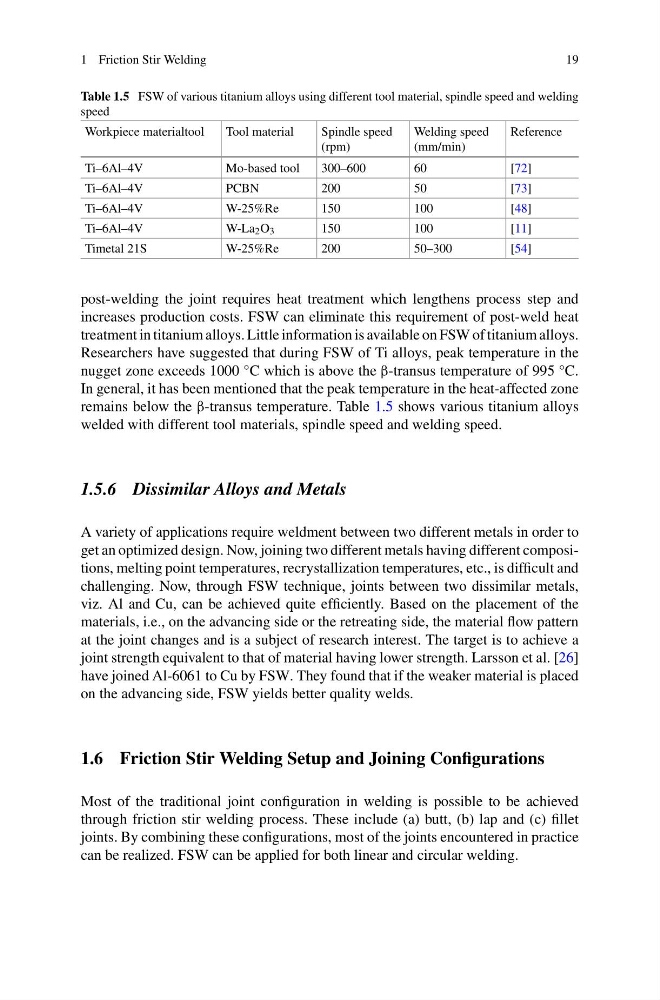
remains below the β-transus temperature. Table 1.5 shows various titanium alloys
welded with different tool materials, spindle speed and welding speed.
1.5.6 Dissimilar Alloys and Metals
A variety of applications require weldment between two different metals in order to
get an optimized design. Now, joining two different metals having different compositions, melting point temperatures, recrystallization temperatures, etc., is difficult and
challenging. Now, through FSW technique, joints between two dissimilar metals,
viz. Al and Cu, can be achieved quite efficiently. Based on the placement of the
materials, i.e., on the advancing side or the retreating side, the material flow pattern
at the joint changes and is a subject of research interest. The target is to achieve a
joint strength equivalent to that of material having lower strength. Larsson et al. [26]
have joined Al-6061 to Cu by FSW. They found that if the weaker material is placed
on the advancing side, FSW yields better quality welds.
1.6 Friction Stir Welding Setup and Joining Configurations
Most of the traditional joint configuration in welding is possible to be achieved
through friction stir welding process. These include (a) butt, (b) lap and (c) fillet
joints. By combining these configurations, most of the joints encountered in practice
can be realized. FSW can be applied for both linear and circular welding.
19
Table 1.5 FSW of various titanium alloys using different tool material, spindle speed and welding
speed
Workpiece materialtool
Tool material
Spindle speed
(rpm)
Welding speed
(mm/min)
Reference
Ti–6Al–4V
Mo-based tool
300–600
60
[72]
Ti–6Al–4V
PCBN
200
50
[73]
Ti–6Al–4V
W-25%Re
150
100
[48]
Ti–6Al–4V
W-La 2 O 3
150
100
[11]
Timetal 21S
W-25%Re
200
50–300
[54]
post-welding the joint requires heat treatment which lengthens process step and
increases production costs. FSW can eliminate this requirement of post-weld heat
treatment in titanium alloys. Little information is available on FSW of titanium alloys.
Researchers have suggested that during FSW of Ti alloys, peak temperature in the
nugget zone exceeds 1000 °C which is above the β-transus temperature of 995 °C.
In general, it has been mentioned that the peak temperature in the heat-affected zone
remains below the β-transus temperature. Table 1.5 shows various titanium alloys
welded with different tool materials, spindle speed and welding speed.
1.5.6 Dissimilar Alloys and Metals
A variety of applications require weldment between two different metals in order to
get an optimized design. Now, joining two different metals having different compositions, melting point temperatures, recrystallization temperatures, etc., is difficult and
challenging. Now, through FSW technique, joints between two dissimilar metals,
viz. Al and Cu, can be achieved quite efficiently. Based on the placement of the
materials, i.e., on the advancing side or the retreating side, the material flow pattern
at the joint changes and is a subject of research interest. The target is to achieve a
joint strength equivalent to that of material having lower strength. Larsson et al. [26]
have joined Al-6061 to Cu by FSW. They found that if the weaker material is placed
on the advancing side, FSW yields better quality welds.
1.6 Friction Stir Welding Setup and Joining Configurations
Most of the traditional joint configuration in welding is possible to be achieved
through friction stir welding process. These include (a) butt, (b) lap and (c) fillet
joints. By combining these configurations, most of the joints encountered in practice
can be realized. FSW can be applied for both linear and circular welding.