

8 Industry 4.0 in Welding
277
8.3.4.4 Virtualization
This principle aims at creation of virtual model for running real-time simulation of
the physical processes. This virtual model exists and operates through sensors’ information collected from the physical process in real time [94, 95]. One utility of this
principle is to understand various phenomena that could occur during a manufacturing process by dealing with the virtual environment. For welding, a virtual model
can help in understanding the response of the process to a wide range of parameters.
For instance, in case of the spot welding technique, the life of the electrode can be
simulated by considering influence of various parameters. Similarly, the life of the
tool in FSW technique can be assessed for a wide range of materials. The other utility
of this principle is the creation of “virtual machines” for different physical systems of
a manufacturing shop floor in a single platform. This will help in integrating multiple
operations on a single server and reduce the expense on hardware.
8.3.5 Digital Tools of Industry 4.0
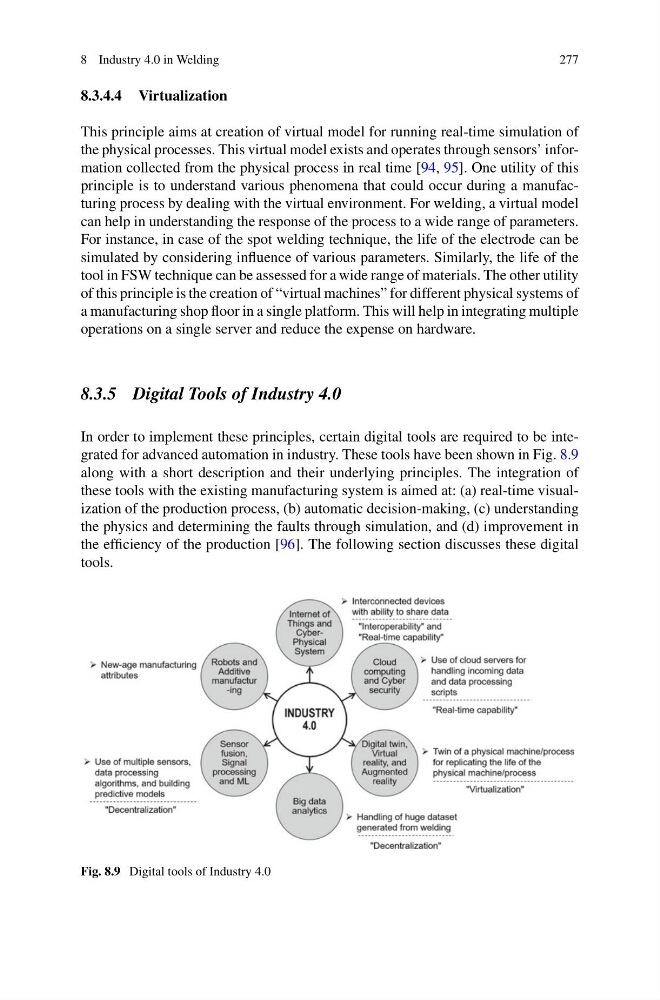
In order to implement these principles, certain digital tools are required to be integrated for advanced automation in industry. These tools have been shown in Fig. 8.9
along with a short description and their underlying principles. The integration of
these tools with the existing manufacturing system is aimed at: (a) real-time visualization of the production process, (b) automatic decision-making, (c) understanding
the physics and determining the faults through simulation, and (d) improvement in
the efficiency of the production [96]. The following section discusses these digital
tools.
Fig. 8.9 Digital tools of Industry 4.0
277
8.3.4.4 Virtualization
This principle aims at creation of virtual model for running real-time simulation of
the physical processes. This virtual model exists and operates through sensors’ information collected from the physical process in real time [94, 95]. One utility of this
principle is to understand various phenomena that could occur during a manufacturing process by dealing with the virtual environment. For welding, a virtual model
can help in understanding the response of the process to a wide range of parameters.
For instance, in case of the spot welding technique, the life of the electrode can be
simulated by considering influence of various parameters. Similarly, the life of the
tool in FSW technique can be assessed for a wide range of materials. The other utility
of this principle is the creation of “virtual machines” for different physical systems of
a manufacturing shop floor in a single platform. This will help in integrating multiple
operations on a single server and reduce the expense on hardware.
8.3.5 Digital Tools of Industry 4.0
In order to implement these principles, certain digital tools are required to be integrated for advanced automation in industry. These tools have been shown in Fig. 8.9
along with a short description and their underlying principles. The integration of
these tools with the existing manufacturing system is aimed at: (a) real-time visualization of the production process, (b) automatic decision-making, (c) understanding
the physics and determining the faults through simulation, and (d) improvement in
the efficiency of the production [96]. The following section discusses these digital
tools.
Fig. 8.9 Digital tools of Industry 4.0