

8 Industry 4.0 in Welding
265
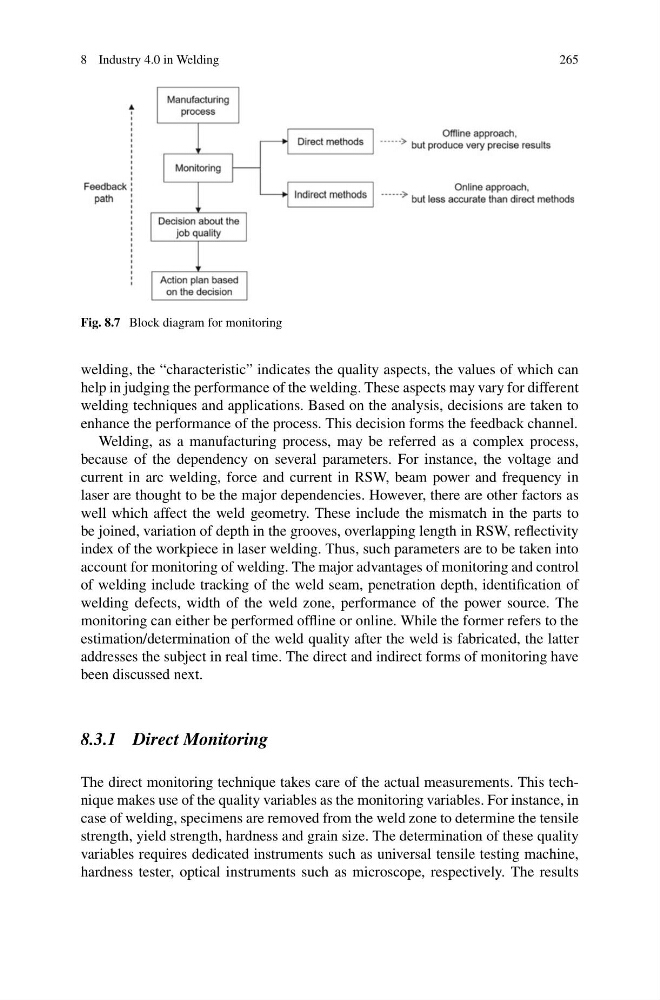
Fig. 8.7 Block diagram for monitoring
welding, the “characteristic” indicates the quality aspects, the values of which can
help in judging the performance of the welding. These aspects may vary for different
welding techniques and applications. Based on the analysis, decisions are taken to
enhance the performance of the process. This decision forms the feedback channel.
Welding, as a manufacturing process, may be referred as a complex process,
because of the dependency on several parameters. For instance, the voltage and
current in arc welding, force and current in RSW, beam power and frequency in
laser are thought to be the major dependencies. However, there are other factors as
well which affect the weld geometry. These include the mismatch in the parts to
be joined, variation of depth in the grooves, overlapping length in RSW, reflectivity
index of the workpiece in laser welding. Thus, such parameters are to be taken into
account for monitoring of welding. The major advantages of monitoring and control
of welding include tracking of the weld seam, penetration depth, identification of
welding defects, width of the weld zone, performance of the power source. The
monitoring can either be performed offline or online. While the former refers to the
estimation/determination of the weld quality after the weld is fabricated, the latter
addresses the subject in real time. The direct and indirect forms of monitoring have
been discussed next.
8.3.1 Direct Monitoring
The direct monitoring technique takes care of the actual measurements. This technique makes use of the quality variables as the monitoring variables. For instance, in
case of welding, specimens are removed from the weld zone to determine the tensile
strength, yield strength, hardness and grain size. The determination of these quality
variables requires dedicated instruments such as universal tensile testing machine,
hardness tester, optical instruments such as microscope, respectively. The results
265
Fig. 8.7 Block diagram for monitoring
welding, the “characteristic” indicates the quality aspects, the values of which can
help in judging the performance of the welding. These aspects may vary for different
welding techniques and applications. Based on the analysis, decisions are taken to
enhance the performance of the process. This decision forms the feedback channel.
Welding, as a manufacturing process, may be referred as a complex process,
because of the dependency on several parameters. For instance, the voltage and
current in arc welding, force and current in RSW, beam power and frequency in
laser are thought to be the major dependencies. However, there are other factors as
well which affect the weld geometry. These include the mismatch in the parts to
be joined, variation of depth in the grooves, overlapping length in RSW, reflectivity
index of the workpiece in laser welding. Thus, such parameters are to be taken into
account for monitoring of welding. The major advantages of monitoring and control
of welding include tracking of the weld seam, penetration depth, identification of
welding defects, width of the weld zone, performance of the power source. The
monitoring can either be performed offline or online. While the former refers to the
estimation/determination of the weld quality after the weld is fabricated, the latter
addresses the subject in real time. The direct and indirect forms of monitoring have
been discussed next.
8.3.1 Direct Monitoring
The direct monitoring technique takes care of the actual measurements. This technique makes use of the quality variables as the monitoring variables. For instance, in
case of welding, specimens are removed from the weld zone to determine the tensile
strength, yield strength, hardness and grain size. The determination of these quality
variables requires dedicated instruments such as universal tensile testing machine,
hardness tester, optical instruments such as microscope, respectively. The results