

260
D. Mishra et al.
the context of manufacturing. The IoT refers to various interconnected devices with
an ability to transfer the data among them remotely, i.e. over a network by using
some suitable communication protocol. The CPS refers to the system enabling the
control of physical objects through computer and software. Thus, the production
machines need to be equipped with several sensors which will aid in data acquisition
of the manufacturing process. This data would help to derive inferences about the
process in real time which will provide an idea on different activities and would
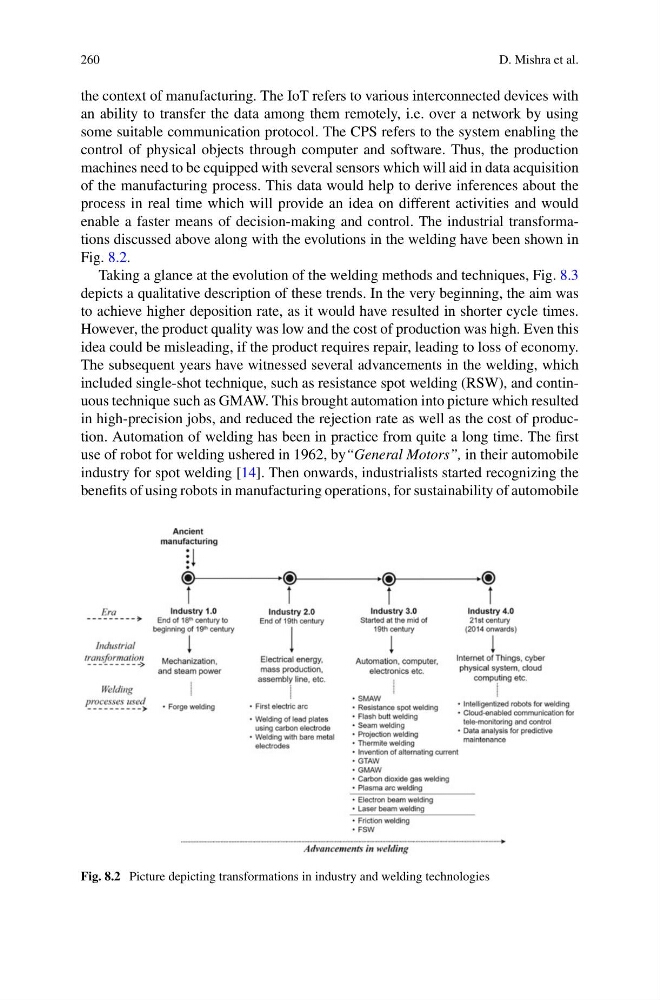
enable a faster means of decision-making and control. The industrial transformations discussed above along with the evolutions in the welding have been shown in
Fig. 8.2.
Taking a glance at the evolution of the welding methods and techniques, Fig. 8.3
depicts a qualitative description of these trends. In the very beginning, the aim was
to achieve higher deposition rate, as it would have resulted in shorter cycle times.
However, the product quality was low and the cost of production was high. Even this
idea could be misleading, if the product requires repair, leading to loss of economy.
The subsequent years have witnessed several advancements in the welding, which
included single-shot technique, such as resistance spot welding (RSW), and continuous technique such as GMAW. This brought automation into picture which resulted
in high-precision jobs, and reduced the rejection rate as well as the cost of production. Automation of welding has been in practice from quite a long time. The first
use of robot for welding ushered in 1962, by“General Motors”, in their automobile
industry for spot welding [14]. Then onwards, industrialists started recognizing the
benefits of using robots in manufacturing operations, for sustainability of automobile
Fig. 8.2 Picture depicting transformations in industry and welding technologies
D. Mishra et al.
the context of manufacturing. The IoT refers to various interconnected devices with
an ability to transfer the data among them remotely, i.e. over a network by using
some suitable communication protocol. The CPS refers to the system enabling the
control of physical objects through computer and software. Thus, the production
machines need to be equipped with several sensors which will aid in data acquisition
of the manufacturing process. This data would help to derive inferences about the
process in real time which will provide an idea on different activities and would
enable a faster means of decision-making and control. The industrial transformations discussed above along with the evolutions in the welding have been shown in
Fig. 8.2.
Taking a glance at the evolution of the welding methods and techniques, Fig. 8.3
depicts a qualitative description of these trends. In the very beginning, the aim was
to achieve higher deposition rate, as it would have resulted in shorter cycle times.
However, the product quality was low and the cost of production was high. Even this
idea could be misleading, if the product requires repair, leading to loss of economy.
The subsequent years have witnessed several advancements in the welding, which
included single-shot technique, such as resistance spot welding (RSW), and continuous technique such as GMAW. This brought automation into picture which resulted
in high-precision jobs, and reduced the rejection rate as well as the cost of production. Automation of welding has been in practice from quite a long time. The first
use of robot for welding ushered in 1962, by“General Motors”, in their automobile
industry for spot welding [14]. Then onwards, industrialists started recognizing the
benefits of using robots in manufacturing operations, for sustainability of automobile
Fig. 8.2 Picture depicting transformations in industry and welding technologies