

238
D. Sen et al.
is being widely used because of yielding near-seamless finish, excellent properties,
and most importantly of an energy-efficient process in tube fabrication [39]. A brief
explanation of this process is mentioned in the section given below. The detailed
description of FSW, in general, has already been mentioned in the previous chapter.
7.3 Potential of FSW in Fabrication of Tubes
FSW was invented by TWI with the advent of joining materials having low melting
temperature, such as copper, brass and aluminium in flat plates or sheets as described
in previous chapters. This process offers good mechanical properties, flexibility
and ease for automation; hence, it can be applied in manufacturing high-quality
welded tubular structures. Not only metals, these days even polymeric pipes are
being produced by FSW process [40]. Unlike conventional welding, FSW can be
used to weld thicker tubes in a single pass. Similarly, thin-walled tubes can also be
welded easily by FSW process. The thickness of the tube which can be welded in a
single pass ranges from 1 to 12 mm [41, 42].
The FSW can be done circumferentially, as well as longitudinally, in tubular
structures. The circumferential FSW tubes are used to join two seamless cylindrical
tubes, whereas longitudinal FSW process is used to fabricate the seamed tube. The
circumferential FSW process has not been discussed in details, as this book chapter
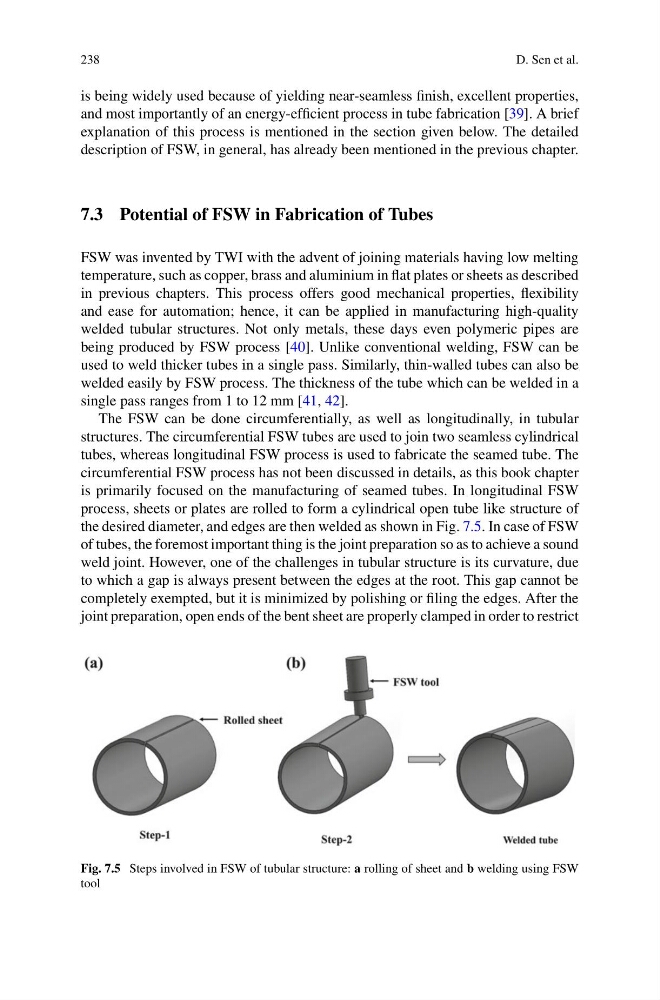
is primarily focused on the manufacturing of seamed tubes. In longitudinal FSW
process, sheets or plates are rolled to form a cylindrical open tube like structure of
the desired diameter, and edges are then welded as shown in Fig. 7.5. In case of FSW
of tubes, the foremost important thing is the joint preparation so as to achieve a sound
weld joint. However, one of the challenges in tubular structure is its curvature, due
to which a gap is always present between the edges at the root. This gap cannot be
completely exempted, but it is minimized by polishing or filing the edges. After the
joint preparation, open ends of the bent sheet are properly clamped in order to restrict
Fig. 7.5 Steps involved in FSW of tubular structure: a rolling of sheet and b welding using FSW
tool
D. Sen et al.
is being widely used because of yielding near-seamless finish, excellent properties,
and most importantly of an energy-efficient process in tube fabrication [39]. A brief
explanation of this process is mentioned in the section given below. The detailed
description of FSW, in general, has already been mentioned in the previous chapter.
7.3 Potential of FSW in Fabrication of Tubes
FSW was invented by TWI with the advent of joining materials having low melting
temperature, such as copper, brass and aluminium in flat plates or sheets as described
in previous chapters. This process offers good mechanical properties, flexibility
and ease for automation; hence, it can be applied in manufacturing high-quality
welded tubular structures. Not only metals, these days even polymeric pipes are
being produced by FSW process [40]. Unlike conventional welding, FSW can be
used to weld thicker tubes in a single pass. Similarly, thin-walled tubes can also be
welded easily by FSW process. The thickness of the tube which can be welded in a
single pass ranges from 1 to 12 mm [41, 42].
The FSW can be done circumferentially, as well as longitudinally, in tubular
structures. The circumferential FSW tubes are used to join two seamless cylindrical
tubes, whereas longitudinal FSW process is used to fabricate the seamed tube. The
circumferential FSW process has not been discussed in details, as this book chapter
is primarily focused on the manufacturing of seamed tubes. In longitudinal FSW
process, sheets or plates are rolled to form a cylindrical open tube like structure of
the desired diameter, and edges are then welded as shown in Fig. 7.5. In case of FSW
of tubes, the foremost important thing is the joint preparation so as to achieve a sound
weld joint. However, one of the challenges in tubular structure is its curvature, due
to which a gap is always present between the edges at the root. This gap cannot be
completely exempted, but it is minimized by polishing or filing the edges. After the
joint preparation, open ends of the bent sheet are properly clamped in order to restrict
Fig. 7.5 Steps involved in FSW of tubular structure: a rolling of sheet and b welding using FSW
tool