

222
S. S. Nayak et al.
Table 6.1 Texture components and their intensity at the different FSWed zones
Texture
components
Relative intensity
at
HAZ
Relative intensity
at TMAZ
Relative intensity
at SZ
Texture types
Cube {001}
<100>
Significant
Weak
Not found
Recrystallized
Cube ND {001}
<310>
Significant
Significant
Not found
Recrystallized
Cube RD {013}
<100>
Significant
Not found
Not found
Recrystallized
Goss {011}
<100>
Significant
Significant
Significant
Recrystallized
Brass {011}
<211>
Significant
Weak
Not found
Deformed
Cu {112} <111> Weak
Weak
Weak
Deformed
S {123} <634>
Weak
Weak
Not found
Deformed
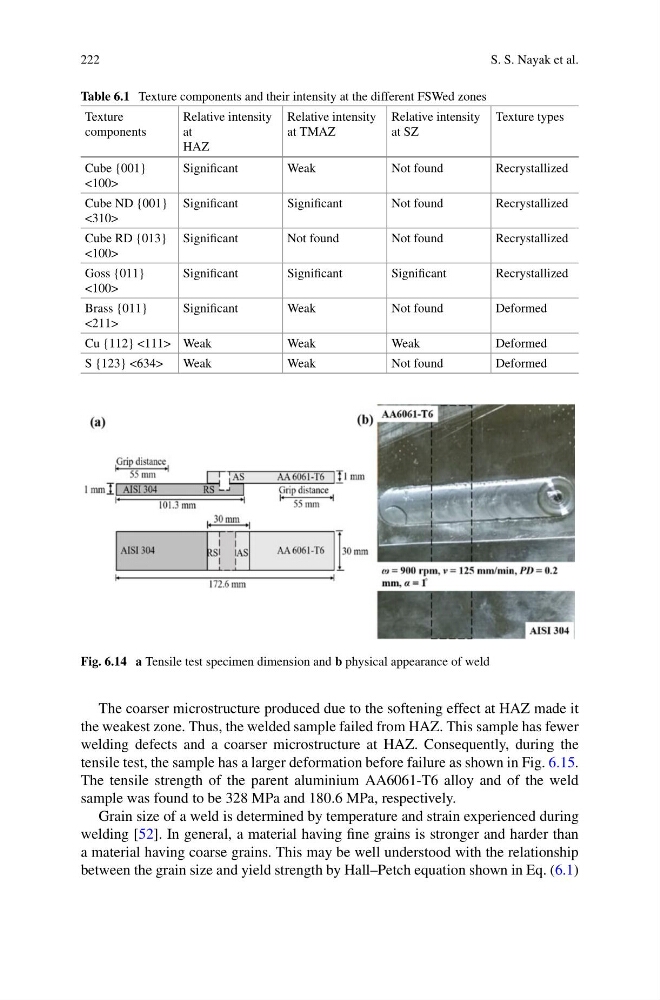
Fig. 6.14 a Tensile test specimen dimension and b physical appearance of weld
The coarser microstructure produced due to the softening effect at HAZ made it
the weakest zone. Thus, the welded sample failed from HAZ. This sample has fewer
welding defects and a coarser microstructure at HAZ. Consequently, during the
tensile test, the sample has a larger deformation before failure as shown in Fig. 6.15.
The tensile strength of the parent aluminium AA6061-T6 alloy and of the weld
sample was found to be 328 MPa and 180.6 MPa, respectively.
Grain size of a weld is determined by temperature and strain experienced during
welding [52]. In general, a material having fine grains is stronger and harder than
a material having coarse grains. This may be well understood with the relationship
between the grain size and yield strength by Hall–Petch equation shown in Eq. (6.1)
S. S. Nayak et al.
Table 6.1 Texture components and their intensity at the different FSWed zones
Texture
components
Relative intensity
at
HAZ
Relative intensity
at TMAZ
Relative intensity
at SZ
Texture types
Cube {001}
<100>
Significant
Weak
Not found
Recrystallized
Cube ND {001}
<310>
Significant
Significant
Not found
Recrystallized
Cube RD {013}
<100>
Significant
Not found
Not found
Recrystallized
Goss {011}
<100>
Significant
Significant
Significant
Recrystallized
Brass {011}
<211>
Significant
Weak
Not found
Deformed
Cu {112} <111> Weak
Weak
Weak
Deformed
S {123} <634>
Weak
Weak
Not found
Deformed
Fig. 6.14 a Tensile test specimen dimension and b physical appearance of weld
The coarser microstructure produced due to the softening effect at HAZ made it
the weakest zone. Thus, the welded sample failed from HAZ. This sample has fewer
welding defects and a coarser microstructure at HAZ. Consequently, during the
tensile test, the sample has a larger deformation before failure as shown in Fig. 6.15.
The tensile strength of the parent aluminium AA6061-T6 alloy and of the weld
sample was found to be 328 MPa and 180.6 MPa, respectively.
Grain size of a weld is determined by temperature and strain experienced during
welding [52]. In general, a material having fine grains is stronger and harder than
a material having coarse grains. This may be well understood with the relationship
between the grain size and yield strength by Hall–Petch equation shown in Eq. (6.1)