

218
S. S. Nayak et al.
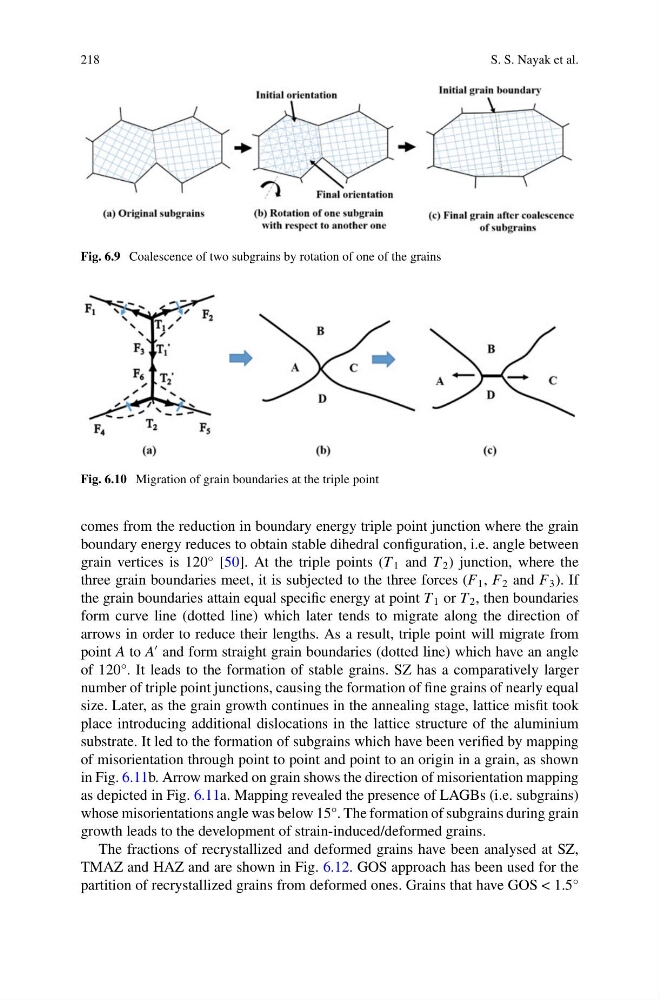
Fig. 6.9 Coalescence of two subgrains by rotation of one of the grains
Fig. 6.10 Migration of grain boundaries at the triple point
comes from the reduction in boundary energy triple point junction where the grain
boundary energy reduces to obtain stable dihedral configuration, i.e. angle between
grain vertices is 120° [50]. At the triple points (T 1 and T 2 ) junction, where the
three grain boundaries meet, it is subjected to the three forces (F 1 , F 2 and F 3 ). If
the grain boundaries attain equal specific energy at point T 1 or T 2 , then boundaries
form curve line (dotted line) which later tends to migrate along the direction of
arrows in order to reduce their lengths. As a result, triple point will migrate from
point A to A
and form straight grain boundaries (dotted line) which have an angle
of 120°. It leads to the formation of stable grains. SZ has a comparatively larger
number of triple point junctions, causing the formation of fine grains of nearly equal
size. Later, as the grain growth continues in the annealing stage, lattice misfit took
place introducing additional dislocations in the lattice structure of the aluminium
substrate. It led to the formation of subgrains which have been verified by mapping
of misorientation through point to point and point to an origin in a grain, as shown
in Fig. 6.11b. Arrow marked on grain shows the direction of misorientation mapping
as depicted in Fig. 6.11a. Mapping revealed the presence of LAGBs (i.e. subgrains)
whose misorientations angle was below 15°. The formation of subgrains during grain
growth leads to the development of strain-induced/deformed grains.
The fractions of recrystallized and deformed grains have been analysed at SZ,
TMAZ and HAZ and are shown in Fig. 6.12. GOS approach has been used for the
partition of recrystallized grains from deformed ones. Grains that have GOS < 1.5°
S. S. Nayak et al.
Fig. 6.9 Coalescence of two subgrains by rotation of one of the grains
Fig. 6.10 Migration of grain boundaries at the triple point
comes from the reduction in boundary energy triple point junction where the grain
boundary energy reduces to obtain stable dihedral configuration, i.e. angle between
grain vertices is 120° [50]. At the triple points (T 1 and T 2 ) junction, where the
three grain boundaries meet, it is subjected to the three forces (F 1 , F 2 and F 3 ). If
the grain boundaries attain equal specific energy at point T 1 or T 2 , then boundaries
form curve line (dotted line) which later tends to migrate along the direction of
arrows in order to reduce their lengths. As a result, triple point will migrate from
point A to A
and form straight grain boundaries (dotted line) which have an angle
of 120°. It leads to the formation of stable grains. SZ has a comparatively larger
number of triple point junctions, causing the formation of fine grains of nearly equal
size. Later, as the grain growth continues in the annealing stage, lattice misfit took
place introducing additional dislocations in the lattice structure of the aluminium
substrate. It led to the formation of subgrains which have been verified by mapping
of misorientation through point to point and point to an origin in a grain, as shown
in Fig. 6.11b. Arrow marked on grain shows the direction of misorientation mapping
as depicted in Fig. 6.11a. Mapping revealed the presence of LAGBs (i.e. subgrains)
whose misorientations angle was below 15°. The formation of subgrains during grain
growth leads to the development of strain-induced/deformed grains.
The fractions of recrystallized and deformed grains have been analysed at SZ,
TMAZ and HAZ and are shown in Fig. 6.12. GOS approach has been used for the
partition of recrystallized grains from deformed ones. Grains that have GOS < 1.5°