

6 Microstructure and Texture in Welding: A Case Study on Friction Stir Welding
217
in aluminium alloys, grain growth and recrystallization occur through two mechanisms [45, 46]: (a) strain-induced boundary migration (SIBM) and (b) subgrain
rotation and coalesce (SRC). SIBM is a recrystallization mechanism which occurs
in polycrystalline materials deformed to a strain less than around 0.2. It occurs at
the original grain boundary. In SIBM, the new grain boundary occurs which moves
to next crystal and then recrystallized area expands. SIBM has been identified in the
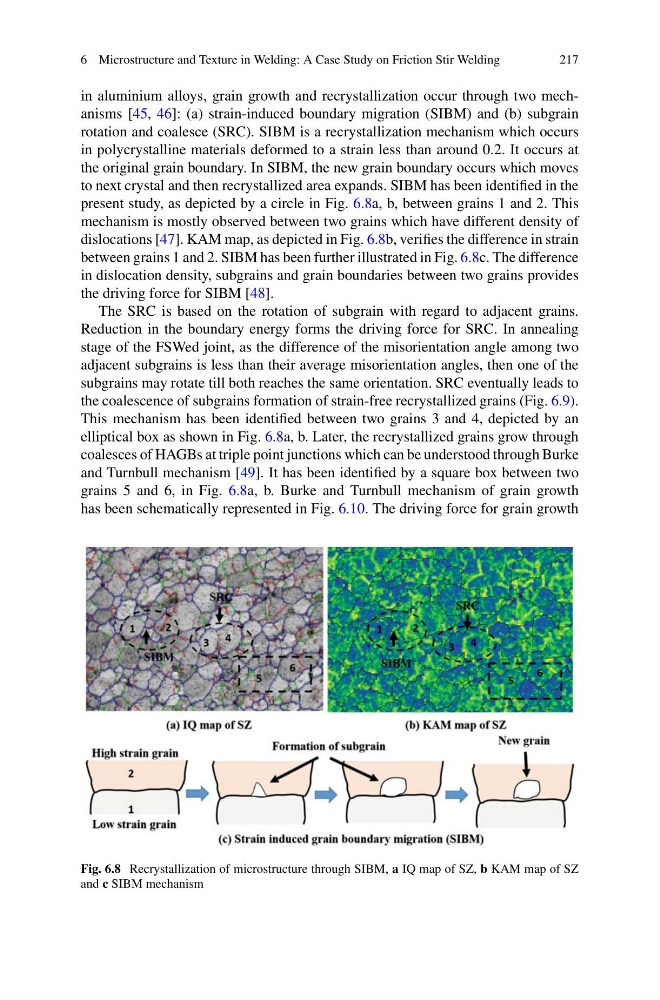
present study, as depicted by a circle in Fig. 6.8a, b, between grains 1 and 2. This
mechanism is mostly observed between two grains which have different density of
dislocations [47]. KAM map, as depicted in Fig. 6.8b, verifies the difference in strain
between grains 1 and 2. SIBM has been further illustrated in Fig. 6.8c. The difference
in dislocation density, subgrains and grain boundaries between two grains provides
the driving force for SIBM [48].
The SRC is based on the rotation of subgrain with regard to adjacent grains.
Reduction in the boundary energy forms the driving force for SRC. In annealing
stage of the FSWed joint, as the difference of the misorientation angle among two
adjacent subgrains is less than their average misorientation angles, then one of the
subgrains may rotate till both reaches the same orientation. SRC eventually leads to
the coalescence of subgrains formation of strain-free recrystallized grains (Fig. 6.9).
This mechanism has been identified between two grains 3 and 4, depicted by an
elliptical box as shown in Fig. 6.8a, b. Later, the recrystallized grains grow through
coalesces of HAGBs at triple point junctions which can be understood through Burke
and Turnbull mechanism [49]. It has been identified by a square box between two
grains 5 and 6, in Fig. 6.8a, b. Burke and Turnbull mechanism of grain growth
has been schematically represented in Fig. 6.10. The driving force for grain growth
Fig. 6.8 Recrystallization of microstructure through SIBM, a IQ map of SZ, b KAM map of SZ
and c SIBM mechanism
217
in aluminium alloys, grain growth and recrystallization occur through two mechanisms [45, 46]: (a) strain-induced boundary migration (SIBM) and (b) subgrain
rotation and coalesce (SRC). SIBM is a recrystallization mechanism which occurs
in polycrystalline materials deformed to a strain less than around 0.2. It occurs at
the original grain boundary. In SIBM, the new grain boundary occurs which moves
to next crystal and then recrystallized area expands. SIBM has been identified in the
present study, as depicted by a circle in Fig. 6.8a, b, between grains 1 and 2. This
mechanism is mostly observed between two grains which have different density of
dislocations [47]. KAM map, as depicted in Fig. 6.8b, verifies the difference in strain
between grains 1 and 2. SIBM has been further illustrated in Fig. 6.8c. The difference
in dislocation density, subgrains and grain boundaries between two grains provides
the driving force for SIBM [48].
The SRC is based on the rotation of subgrain with regard to adjacent grains.
Reduction in the boundary energy forms the driving force for SRC. In annealing
stage of the FSWed joint, as the difference of the misorientation angle among two
adjacent subgrains is less than their average misorientation angles, then one of the
subgrains may rotate till both reaches the same orientation. SRC eventually leads to
the coalescence of subgrains formation of strain-free recrystallized grains (Fig. 6.9).
This mechanism has been identified between two grains 3 and 4, depicted by an
elliptical box as shown in Fig. 6.8a, b. Later, the recrystallized grains grow through
coalesces of HAGBs at triple point junctions which can be understood through Burke
and Turnbull mechanism [49]. It has been identified by a square box between two
grains 5 and 6, in Fig. 6.8a, b. Burke and Turnbull mechanism of grain growth
has been schematically represented in Fig. 6.10. The driving force for grain growth
Fig. 6.8 Recrystallization of microstructure through SIBM, a IQ map of SZ, b KAM map of SZ
and c SIBM mechanism