

5 Welding of Dissimilar Metals—Challenges and a Way Forward …
189
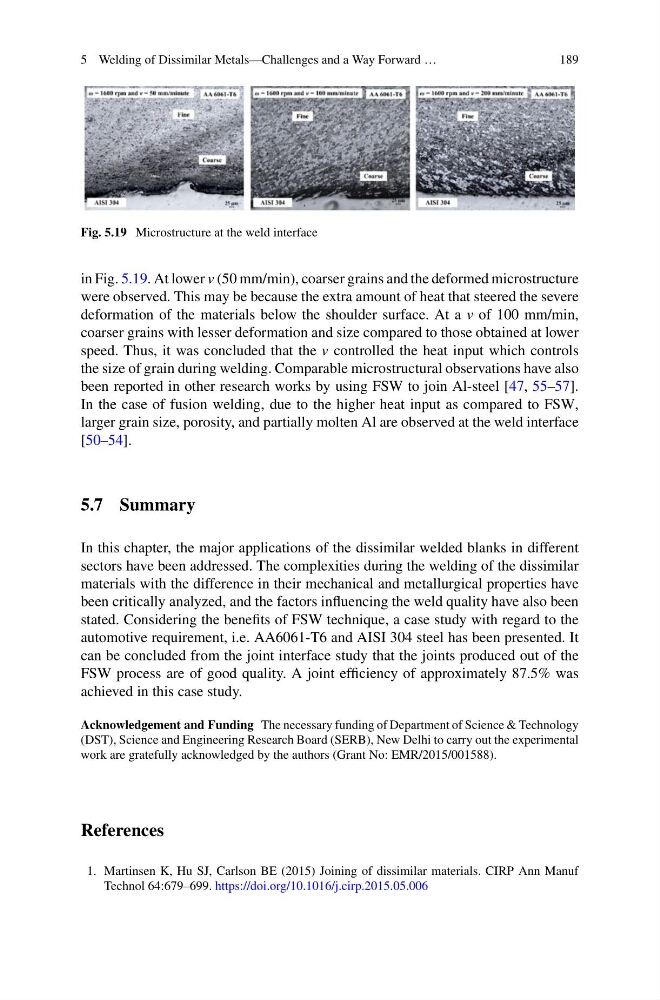
Fig. 5.19 Microstructure at the weld interface
in Fig. 5.19. At lower v (50 mm/min), coarser grains and the deformed microstructure
were observed. This may be because the extra amount of heat that steered the severe
deformation of the materials below the shoulder surface. At a v of 100 mm/min,
coarser grains with lesser deformation and size compared to those obtained at lower
speed. Thus, it was concluded that the v controlled the heat input which controls
the size of grain during welding. Comparable microstructural observations have also
been reported in other research works by using FSW to join Al-steel [47, 55–57].
In the case of fusion welding, due to the higher heat input as compared to FSW,
larger grain size, porosity, and partially molten Al are observed at the weld interface
[50–54].
5.7 Summary
In this chapter, the major applications of the dissimilar welded blanks in different
sectors have been addressed. The complexities during the welding of the dissimilar
materials with the difference in their mechanical and metallurgical properties have
been critically analyzed, and the factors influencing the weld quality have also been
stated. Considering the benefits of FSW technique, a case study with regard to the
automotive requirement, i.e. AA6061-T6 and AISI 304 steel has been presented. It
can be concluded from the joint interface study that the joints produced out of the
FSW process are of good quality. A joint efficiency of approximately 87.5% was
achieved in this case study.
Acknowledgement and Funding The necessary funding of Department of Science & Technology
(DST), Science and Engineering Research Board (SERB), New Delhi to carry out the experimental
work are gratefully acknowledged by the authors (Grant No: EMR/2015/001588).
References
1. Martinsen K, Hu SJ, Carlson BE (2015) Joining of dissimilar materials. CIRP Ann Manuf
Technol 64:679–699. https://doi.org/10.1016/j.cirp.2015.05.006
189
Fig. 5.19 Microstructure at the weld interface
in Fig. 5.19. At lower v (50 mm/min), coarser grains and the deformed microstructure
were observed. This may be because the extra amount of heat that steered the severe
deformation of the materials below the shoulder surface. At a v of 100 mm/min,
coarser grains with lesser deformation and size compared to those obtained at lower
speed. Thus, it was concluded that the v controlled the heat input which controls
the size of grain during welding. Comparable microstructural observations have also
been reported in other research works by using FSW to join Al-steel [47, 55–57].
In the case of fusion welding, due to the higher heat input as compared to FSW,
larger grain size, porosity, and partially molten Al are observed at the weld interface
[50–54].
5.7 Summary
In this chapter, the major applications of the dissimilar welded blanks in different
sectors have been addressed. The complexities during the welding of the dissimilar
materials with the difference in their mechanical and metallurgical properties have
been critically analyzed, and the factors influencing the weld quality have also been
stated. Considering the benefits of FSW technique, a case study with regard to the
automotive requirement, i.e. AA6061-T6 and AISI 304 steel has been presented. It
can be concluded from the joint interface study that the joints produced out of the
FSW process are of good quality. A joint efficiency of approximately 87.5% was
achieved in this case study.
Acknowledgement and Funding The necessary funding of Department of Science & Technology
(DST), Science and Engineering Research Board (SERB), New Delhi to carry out the experimental
work are gratefully acknowledged by the authors (Grant No: EMR/2015/001588).
References
1. Martinsen K, Hu SJ, Carlson BE (2015) Joining of dissimilar materials. CIRP Ann Manuf
Technol 64:679–699. https://doi.org/10.1016/j.cirp.2015.05.006