

5 Welding of Dissimilar Metals—Challenges and a Way Forward …
187
dimples, microvoids, and tearing edges, indicating ductile fracture characteristics
which is significantly lower as compared to fusion welding processes [9, 10].
5.6.2 IMCs
The formation of IMCs depends on the temperature during welding. Process parameters highly affect the heat generation, which leads to formation of IMCs. With
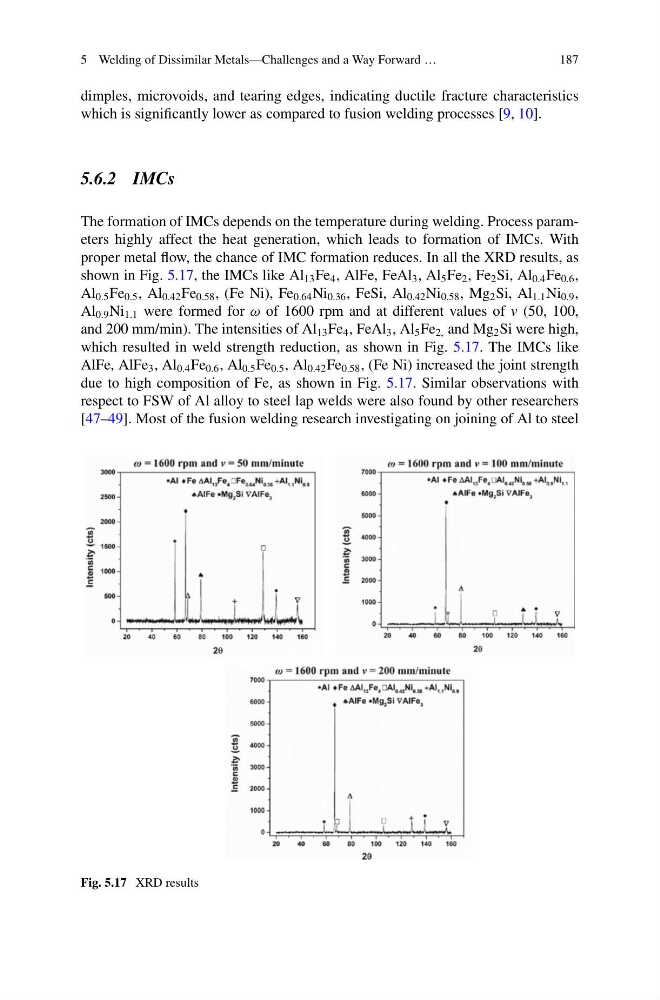
proper metal flow, the chance of IMC formation reduces. In all the XRD results, as
shown in Fig. 5.17, the IMCs like Al 13 Fe 4 , AlFe, FeAl 3 , Al 5 Fe 2 , Fe 2 Si, Al 0.4 Fe 0.6 ,
Al 0.5 Fe 0.5 , Al 0.42 Fe 0.58 , (Fe Ni), Fe 0.64 Ni 0.36 , FeSi, Al 0.42 Ni 0.58 , Mg 2 Si, Al 1.1 Ni 0.9 ,
Al 0.9 Ni 1.1 were formed for ω of 1600 rpm and at different values of v (50, 100,
and 200 mm/min). The intensities of Al 13 Fe 4 , FeAl 3 , Al 5 Fe 2, and Mg 2 Si were high,
which resulted in weld strength reduction, as shown in Fig. 5.17. The IMCs like
AlFe, AlFe 3 , Al 0.4 Fe 0.6 , Al 0.5 Fe 0.5 , Al 0.42 Fe 0.58 , (Fe Ni) increased the joint strength
due to high composition of Fe, as shown in Fig. 5.17. Similar observations with
respect to FSW of Al alloy to steel lap welds were also found by other researchers
[47–49]. Most of the fusion welding research investigating on joining of Al to steel
Fig. 5.17 XRD results
187
dimples, microvoids, and tearing edges, indicating ductile fracture characteristics
which is significantly lower as compared to fusion welding processes [9, 10].
5.6.2 IMCs
The formation of IMCs depends on the temperature during welding. Process parameters highly affect the heat generation, which leads to formation of IMCs. With
proper metal flow, the chance of IMC formation reduces. In all the XRD results, as
shown in Fig. 5.17, the IMCs like Al 13 Fe 4 , AlFe, FeAl 3 , Al 5 Fe 2 , Fe 2 Si, Al 0.4 Fe 0.6 ,
Al 0.5 Fe 0.5 , Al 0.42 Fe 0.58 , (Fe Ni), Fe 0.64 Ni 0.36 , FeSi, Al 0.42 Ni 0.58 , Mg 2 Si, Al 1.1 Ni 0.9 ,
Al 0.9 Ni 1.1 were formed for ω of 1600 rpm and at different values of v (50, 100,
and 200 mm/min). The intensities of Al 13 Fe 4 , FeAl 3 , Al 5 Fe 2, and Mg 2 Si were high,
which resulted in weld strength reduction, as shown in Fig. 5.17. The IMCs like
AlFe, AlFe 3 , Al 0.4 Fe 0.6 , Al 0.5 Fe 0.5 , Al 0.42 Fe 0.58 , (Fe Ni) increased the joint strength
due to high composition of Fe, as shown in Fig. 5.17. Similar observations with
respect to FSW of Al alloy to steel lap welds were also found by other researchers
[47–49]. Most of the fusion welding research investigating on joining of Al to steel
Fig. 5.17 XRD results