

5 Welding of Dissimilar Metals—Challenges and a Way Forward …
173
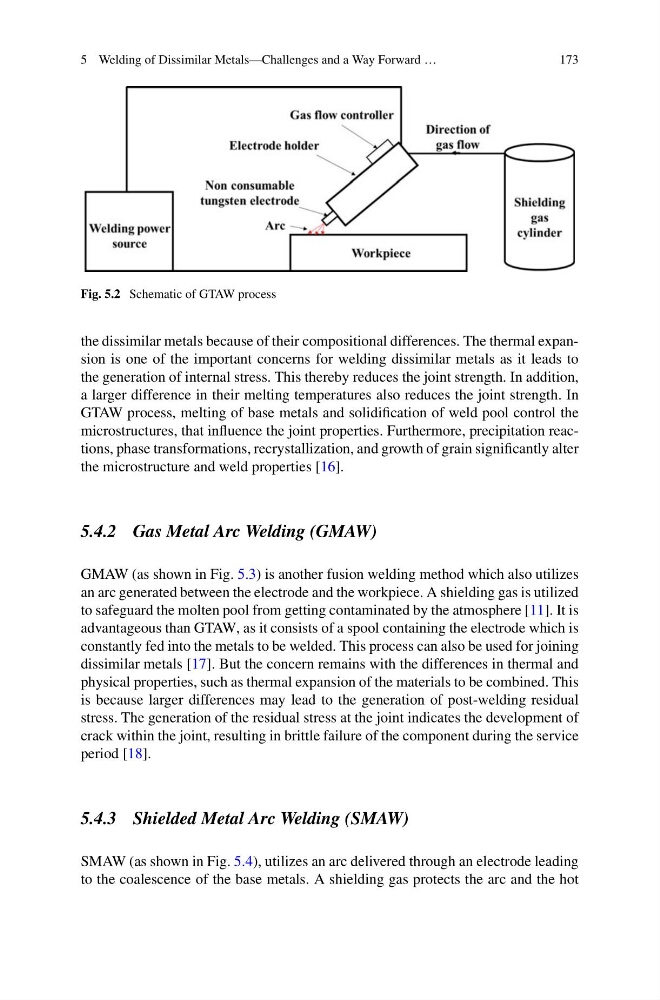
Fig. 5.2 Schematic of GTAW process
the dissimilar metals because of their compositional differences. The thermal expansion is one of the important concerns for welding dissimilar metals as it leads to
the generation of internal stress. This thereby reduces the joint strength. In addition,
a larger difference in their melting temperatures also reduces the joint strength. In
GTAW process, melting of base metals and solidification of weld pool control the
microstructures, that influence the joint properties. Furthermore, precipitation reactions, phase transformations, recrystallization, and growth of grain significantly alter
the microstructure and weld properties [16].
5.4.2 Gas Metal Arc Welding (GMAW)
GMAW (as shown in Fig. 5.3) is another fusion welding method which also utilizes
an arc generated between the electrode and the workpiece. A shielding gas is utilized
to safeguard the molten pool from getting contaminated by the atmosphere [11]. It is
advantageous than GTAW, as it consists of a spool containing the electrode which is
constantly fed into the metals to be welded. This process can also be used for joining
dissimilar metals [17]. But the concern remains with the differences in thermal and
physical properties, such as thermal expansion of the materials to be combined. This
is because larger differences may lead to the generation of post-welding residual
stress. The generation of the residual stress at the joint indicates the development of
crack within the joint, resulting in brittle failure of the component during the service
period [18].
5.4.3 Shielded Metal Arc Welding (SMAW)
SMAW (as shown in Fig. 5.4), utilizes an arc delivered through an electrode leading
to the coalescence of the base metals. A shielding gas protects the arc and the hot
173
Fig. 5.2 Schematic of GTAW process
the dissimilar metals because of their compositional differences. The thermal expansion is one of the important concerns for welding dissimilar metals as it leads to
the generation of internal stress. This thereby reduces the joint strength. In addition,
a larger difference in their melting temperatures also reduces the joint strength. In
GTAW process, melting of base metals and solidification of weld pool control the
microstructures, that influence the joint properties. Furthermore, precipitation reactions, phase transformations, recrystallization, and growth of grain significantly alter
the microstructure and weld properties [16].
5.4.2 Gas Metal Arc Welding (GMAW)
GMAW (as shown in Fig. 5.3) is another fusion welding method which also utilizes
an arc generated between the electrode and the workpiece. A shielding gas is utilized
to safeguard the molten pool from getting contaminated by the atmosphere [11]. It is
advantageous than GTAW, as it consists of a spool containing the electrode which is
constantly fed into the metals to be welded. This process can also be used for joining
dissimilar metals [17]. But the concern remains with the differences in thermal and
physical properties, such as thermal expansion of the materials to be combined. This
is because larger differences may lead to the generation of post-welding residual
stress. The generation of the residual stress at the joint indicates the development of
crack within the joint, resulting in brittle failure of the component during the service
period [18].
5.4.3 Shielded Metal Arc Welding (SMAW)
SMAW (as shown in Fig. 5.4), utilizes an arc delivered through an electrode leading
to the coalescence of the base metals. A shielding gas protects the arc and the hot