

160
P. Sarkar et al.
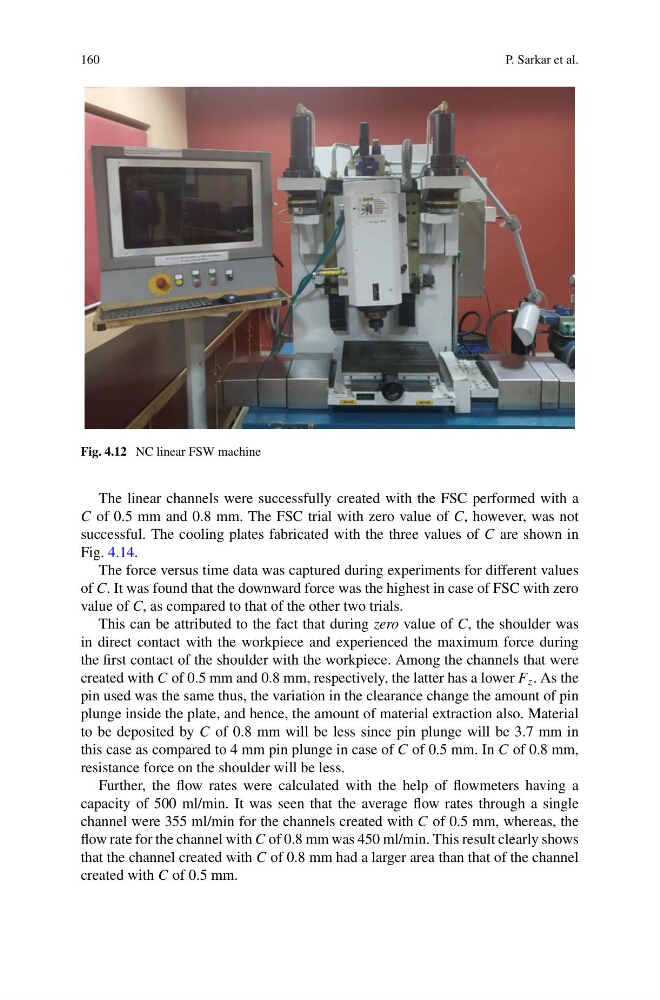
Fig. 4.12 NC linear FSW machine
The linear channels were successfully created with the FSC performed with a
C of 0.5 mm and 0.8 mm. The FSC trial with zero value of C, however, was not
successful. The cooling plates fabricated with the three values of C are shown in
Fig. 4.14.
The force versus time data was captured during experiments for different values
of C. It was found that the downward force was the highest in case of FSC with zero
value of C, as compared to that of the other two trials.
This can be attributed to the fact that during zero value of C, the shoulder was
in direct contact with the workpiece and experienced the maximum force during
the first contact of the shoulder with the workpiece. Among the channels that were
created with C of 0.5 mm and 0.8 mm, respectively, the latter has a lower F z . As the
pin used was the same thus, the variation in the clearance change the amount of pin
plunge inside the plate, and hence, the amount of material extraction also. Material
to be deposited by C of 0.8 mm will be less since pin plunge will be 3.7 mm in
this case as compared to 4 mm pin plunge in case of C of 0.5 mm. In C of 0.8 mm,
resistance force on the shoulder will be less.
Further, the flow rates were calculated with the help of flowmeters having a
capacity of 500 ml/min. It was seen that the average flow rates through a single
channel were 355 ml/min for the channels created with C of 0.5 mm, whereas, the
flow rate for the channel with C of 0.8 mm was 450 ml/min. This result clearly shows
that the channel created with C of 0.8 mm had a larger area than that of the channel
created with C of 0.5 mm.
P. Sarkar et al.
Fig. 4.12 NC linear FSW machine
The linear channels were successfully created with the FSC performed with a
C of 0.5 mm and 0.8 mm. The FSC trial with zero value of C, however, was not
successful. The cooling plates fabricated with the three values of C are shown in
Fig. 4.14.
The force versus time data was captured during experiments for different values
of C. It was found that the downward force was the highest in case of FSC with zero
value of C, as compared to that of the other two trials.
This can be attributed to the fact that during zero value of C, the shoulder was
in direct contact with the workpiece and experienced the maximum force during
the first contact of the shoulder with the workpiece. Among the channels that were
created with C of 0.5 mm and 0.8 mm, respectively, the latter has a lower F z . As the
pin used was the same thus, the variation in the clearance change the amount of pin
plunge inside the plate, and hence, the amount of material extraction also. Material
to be deposited by C of 0.8 mm will be less since pin plunge will be 3.7 mm in
this case as compared to 4 mm pin plunge in case of C of 0.5 mm. In C of 0.8 mm,
resistance force on the shoulder will be less.
Further, the flow rates were calculated with the help of flowmeters having a
capacity of 500 ml/min. It was seen that the average flow rates through a single
channel were 355 ml/min for the channels created with C of 0.5 mm, whereas, the
flow rate for the channel with C of 0.8 mm was 450 ml/min. This result clearly shows
that the channel created with C of 0.8 mm had a larger area than that of the channel
created with C of 0.5 mm.