

4 An Application from a Defect—A Friction …
159
the process parameters to the quality of the channels in different versions of the
process have been discussed earlier in the chapter.
One of the primary parameters of FSC is the C. It controls the channel height
which ultimately decides the channel area and its hydraulic diameter. The amount
of material excavated by the threaded pin depends on the dimension of the pin.
Therefore, one should be very careful in selecting the dimension of the pin (diameter
and height) and C. If the material excavated is less but the C is high, this may lead to
open channel. However, if the C is too small to accommodate the amount of material
pulled out by the pin, the channel produced may be discontinuous or even possibility
of no channel creation is also there. The authors of this chapter have done a few
experiments and tried to analyze the effect of C on the channel size and its fluid
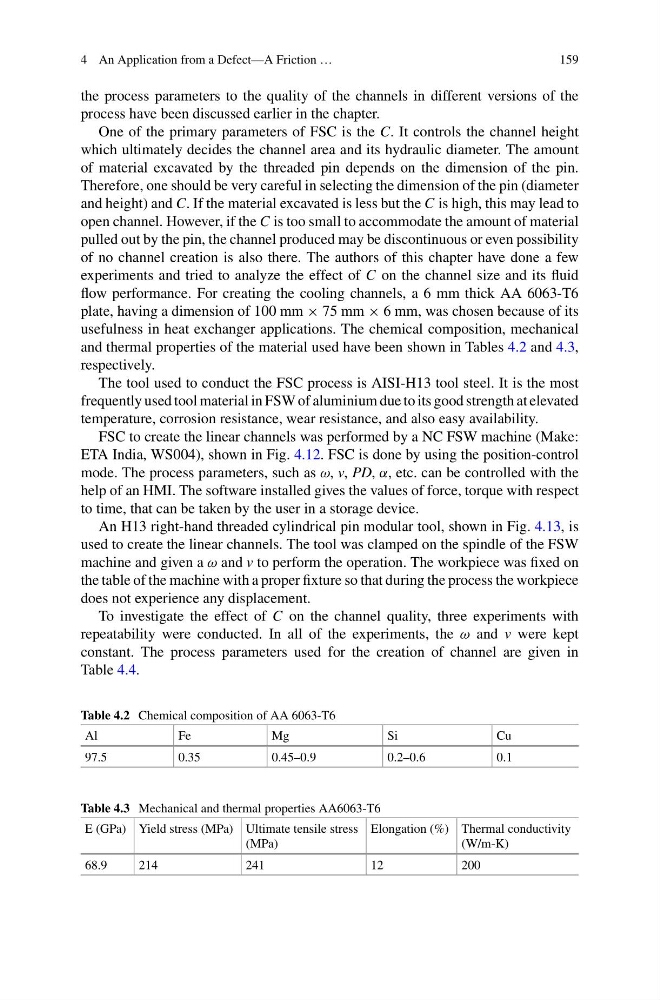
flow performance. For creating the cooling channels, a 6 mm thick AA 6063-T6
plate, having a dimension of 100 mm × 75 mm × 6 mm, was chosen because of its
usefulness in heat exchanger applications. The chemical composition, mechanical
and thermal properties of the material used have been shown in Tables 4.2 and 4.3,
respectively.
The tool used to conduct the FSC process is AISI-H13 tool steel. It is the most
frequently used tool material in FSW of aluminium due to its good strength at elevated
temperature, corrosion resistance, wear resistance, and also easy availability.
FSC to create the linear channels was performed by a NC FSW machine (Make:
ETA India, WS004), shown in Fig. 4.12. FSC is done by using the position-control
mode. The process parameters, such as ω, v, PD, α, etc. can be controlled with the
help of an HMI. The software installed gives the values of force, torque with respect
to time, that can be taken by the user in a storage device.
An H13 right-hand threaded cylindrical pin modular tool, shown in Fig. 4.13, is
used to create the linear channels. The tool was clamped on the spindle of the FSW
machine and given a ω and v to perform the operation. The workpiece was fixed on
the table of the machine with a proper fixture so that during the process the workpiece
does not experience any displacement.
To investigate the effect of C on the channel quality, three experiments with
repeatability were conducted. In all of the experiments, the ω and v were kept
constant. The process parameters used for the creation of channel are given in
Table 4.4.
Table 4.2 Chemical composition of AA 6063-T6
Al
Fe
Mg
Si
Cu
97.5
0.35
0.45–0.9
0.2–0.6
0.1
Table 4.3 Mechanical and thermal properties AA6063-T6
E (GPa) Yield stress (MPa) Ultimate tensile stress
(MPa)
Elongation (%) Thermal conductivity
(W/m-K)
68.9
214
241
12
200
159
the process parameters to the quality of the channels in different versions of the
process have been discussed earlier in the chapter.
One of the primary parameters of FSC is the C. It controls the channel height
which ultimately decides the channel area and its hydraulic diameter. The amount
of material excavated by the threaded pin depends on the dimension of the pin.
Therefore, one should be very careful in selecting the dimension of the pin (diameter
and height) and C. If the material excavated is less but the C is high, this may lead to
open channel. However, if the C is too small to accommodate the amount of material
pulled out by the pin, the channel produced may be discontinuous or even possibility
of no channel creation is also there. The authors of this chapter have done a few
experiments and tried to analyze the effect of C on the channel size and its fluid
flow performance. For creating the cooling channels, a 6 mm thick AA 6063-T6
plate, having a dimension of 100 mm × 75 mm × 6 mm, was chosen because of its
usefulness in heat exchanger applications. The chemical composition, mechanical
and thermal properties of the material used have been shown in Tables 4.2 and 4.3,
respectively.
The tool used to conduct the FSC process is AISI-H13 tool steel. It is the most
frequently used tool material in FSW of aluminium due to its good strength at elevated
temperature, corrosion resistance, wear resistance, and also easy availability.
FSC to create the linear channels was performed by a NC FSW machine (Make:
ETA India, WS004), shown in Fig. 4.12. FSC is done by using the position-control
mode. The process parameters, such as ω, v, PD, α, etc. can be controlled with the
help of an HMI. The software installed gives the values of force, torque with respect
to time, that can be taken by the user in a storage device.
An H13 right-hand threaded cylindrical pin modular tool, shown in Fig. 4.13, is
used to create the linear channels. The tool was clamped on the spindle of the FSW
machine and given a ω and v to perform the operation. The workpiece was fixed on
the table of the machine with a proper fixture so that during the process the workpiece
does not experience any displacement.
To investigate the effect of C on the channel quality, three experiments with
repeatability were conducted. In all of the experiments, the ω and v were kept
constant. The process parameters used for the creation of channel are given in
Table 4.4.
Table 4.2 Chemical composition of AA 6063-T6
Al
Fe
Mg
Si
Cu
97.5
0.35
0.45–0.9
0.2–0.6
0.1
Table 4.3 Mechanical and thermal properties AA6063-T6
E (GPa) Yield stress (MPa) Ultimate tensile stress
(MPa)
Elongation (%) Thermal conductivity
(W/m-K)
68.9
214
241
12
200