

156
P. Sarkar et al.
room temperature, while the tests were performed at 120 and 200 °C, a low value of
the fatigue strength of the channels were found. Generally, the yield strength of metal
decreases with the increase of temperature. At high temperature, due to the action of
the additional factors activated by thermal as well as time-dependent phenomenon
with fatigue loading, results in a reduced value of the fatigue strength of the material.
4.6.3 Modified FSC (MFSC)
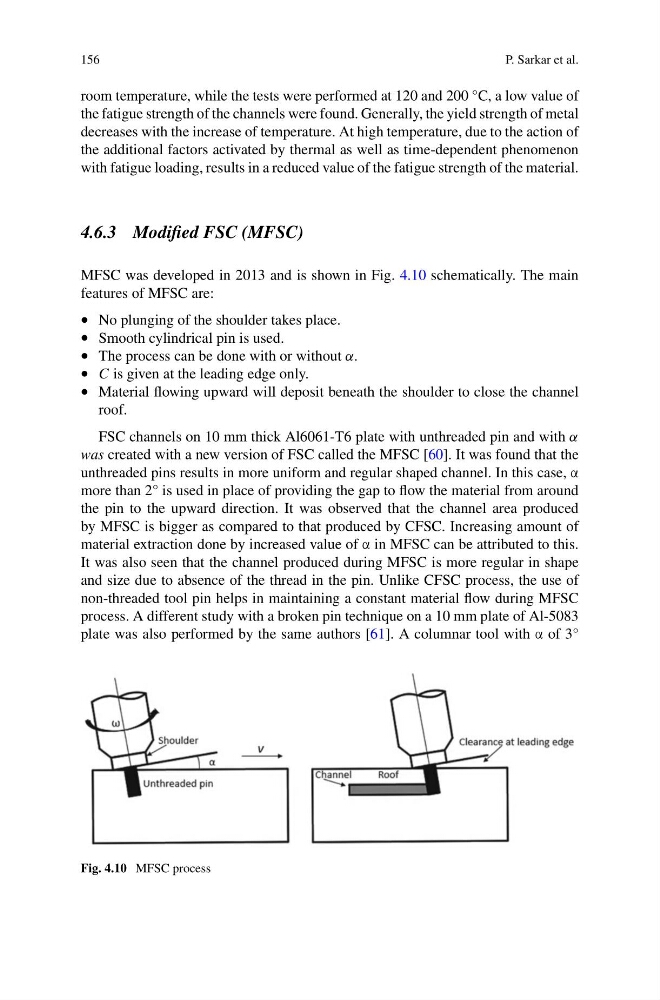
MFSC was developed in 2013 and is shown in Fig. 4.10 schematically. The main
features of MFSC are:
• No plunging of the shoulder takes place.
• Smooth cylindrical pin is used.
• The process can be done with or without α.
• C is given at the leading edge only.
• Material flowing upward will deposit beneath the shoulder to close the channel
roof.
FSC channels on 10 mm thick Al6061-T6 plate with unthreaded pin and with α
was created with a new version of FSC called the MFSC [60]. It was found that the
unthreaded pins results in more uniform and regular shaped channel. In this case, α
more than 2° is used in place of providing the gap to flow the material from around
the pin to the upward direction. It was observed that the channel area produced
by MFSC is bigger as compared to that produced by CFSC. Increasing amount of
material extraction done by increased value of α in MFSC can be attributed to this.
It was also seen that the channel produced during MFSC is more regular in shape
and size due to absence of the thread in the pin. Unlike CFSC process, the use of
non-threaded tool pin helps in maintaining a constant material flow during MFSC
process. A different study with a broken pin technique on a 10 mm plate of Al-5083
plate was also performed by the same authors [61]. A columnar tool with α of 3°
Fig. 4.10 MFSC process
P. Sarkar et al.
room temperature, while the tests were performed at 120 and 200 °C, a low value of
the fatigue strength of the channels were found. Generally, the yield strength of metal
decreases with the increase of temperature. At high temperature, due to the action of
the additional factors activated by thermal as well as time-dependent phenomenon
with fatigue loading, results in a reduced value of the fatigue strength of the material.
4.6.3 Modified FSC (MFSC)
MFSC was developed in 2013 and is shown in Fig. 4.10 schematically. The main
features of MFSC are:
• No plunging of the shoulder takes place.
• Smooth cylindrical pin is used.
• The process can be done with or without α.
• C is given at the leading edge only.
• Material flowing upward will deposit beneath the shoulder to close the channel
roof.
FSC channels on 10 mm thick Al6061-T6 plate with unthreaded pin and with α
was created with a new version of FSC called the MFSC [60]. It was found that the
unthreaded pins results in more uniform and regular shaped channel. In this case, α
more than 2° is used in place of providing the gap to flow the material from around
the pin to the upward direction. It was observed that the channel area produced
by MFSC is bigger as compared to that produced by CFSC. Increasing amount of
material extraction done by increased value of α in MFSC can be attributed to this.
It was also seen that the channel produced during MFSC is more regular in shape
and size due to absence of the thread in the pin. Unlike CFSC process, the use of
non-threaded tool pin helps in maintaining a constant material flow during MFSC
process. A different study with a broken pin technique on a 10 mm plate of Al-5083
plate was also performed by the same authors [61]. A columnar tool with α of 3°
Fig. 4.10 MFSC process