

4 An Application from a Defect—A Friction …
153
4.6.1 Conventional FSC (CFSC)
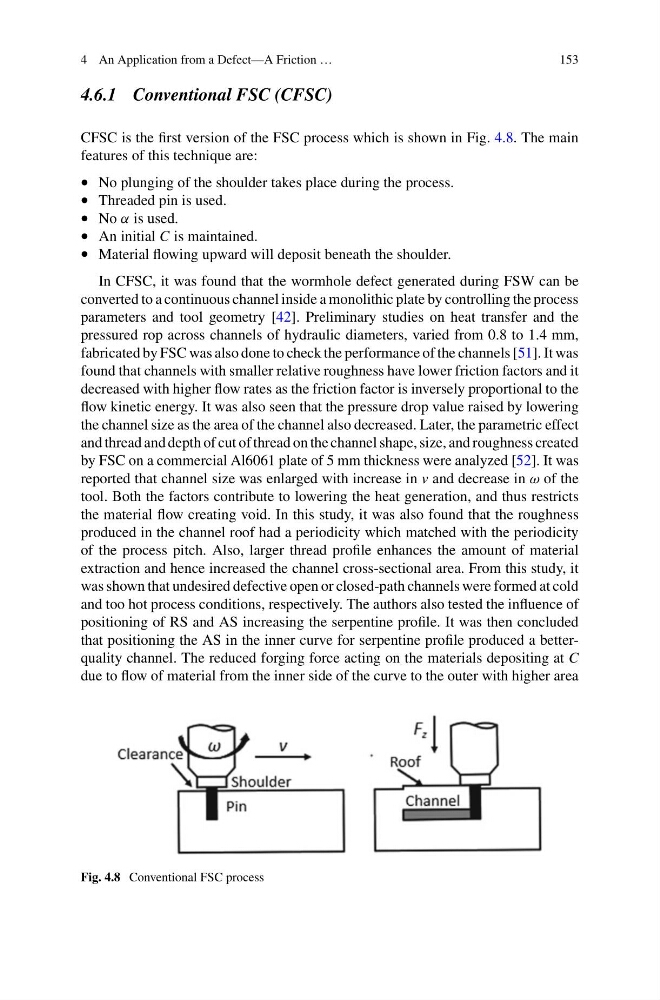
CFSC is the first version of the FSC process which is shown in Fig. 4.8. The main
features of this technique are:
• No plunging of the shoulder takes place during the process.
• Threaded pin is used.
• No α is used.
• An initial C is maintained.
• Material flowing upward will deposit beneath the shoulder.
In CFSC, it was found that the wormhole defect generated during FSW can be
converted to a continuous channel inside a monolithic plate by controlling the process
parameters and tool geometry [42]. Preliminary studies on heat transfer and the
pressured rop across channels of hydraulic diameters, varied from 0.8 to 1.4 mm,
fabricated by FSC was also done to check the performance of the channels [51]. It was
found that channels with smaller relative roughness have lower friction factors and it
decreased with higher flow rates as the friction factor is inversely proportional to the
flow kinetic energy. It was also seen that the pressure drop value raised by lowering
the channel size as the area of the channel also decreased. Later, the parametric effect
and thread and depth of cut of thread on the channel shape, size, and roughness created
by FSC on a commercial Al6061 plate of 5 mm thickness were analyzed [52]. It was
reported that channel size was enlarged with increase in v and decrease in ω of the
tool. Both the factors contribute to lowering the heat generation, and thus restricts
the material flow creating void. In this study, it was also found that the roughness
produced in the channel roof had a periodicity which matched with the periodicity
of the process pitch. Also, larger thread profile enhances the amount of material
extraction and hence increased the channel cross-sectional area. From this study, it
was shown that undesired defective open or closed-path channels were formed at cold
and too hot process conditions, respectively. The authors also tested the influence of
positioning of RS and AS increasing the serpentine profile. It was then concluded
that positioning the AS in the inner curve for serpentine profile produced a betterquality channel. The reduced forging force acting on the materials depositing at C
due to flow of material from the inner side of the curve to the outer with higher area
Fig. 4.8 Conventional FSC process
153
4.6.1 Conventional FSC (CFSC)
CFSC is the first version of the FSC process which is shown in Fig. 4.8. The main
features of this technique are:
• No plunging of the shoulder takes place during the process.
• Threaded pin is used.
• No α is used.
• An initial C is maintained.
• Material flowing upward will deposit beneath the shoulder.
In CFSC, it was found that the wormhole defect generated during FSW can be
converted to a continuous channel inside a monolithic plate by controlling the process
parameters and tool geometry [42]. Preliminary studies on heat transfer and the
pressured rop across channels of hydraulic diameters, varied from 0.8 to 1.4 mm,
fabricated by FSC was also done to check the performance of the channels [51]. It was
found that channels with smaller relative roughness have lower friction factors and it
decreased with higher flow rates as the friction factor is inversely proportional to the
flow kinetic energy. It was also seen that the pressure drop value raised by lowering
the channel size as the area of the channel also decreased. Later, the parametric effect
and thread and depth of cut of thread on the channel shape, size, and roughness created
by FSC on a commercial Al6061 plate of 5 mm thickness were analyzed [52]. It was
reported that channel size was enlarged with increase in v and decrease in ω of the
tool. Both the factors contribute to lowering the heat generation, and thus restricts
the material flow creating void. In this study, it was also found that the roughness
produced in the channel roof had a periodicity which matched with the periodicity
of the process pitch. Also, larger thread profile enhances the amount of material
extraction and hence increased the channel cross-sectional area. From this study, it
was shown that undesired defective open or closed-path channels were formed at cold
and too hot process conditions, respectively. The authors also tested the influence of
positioning of RS and AS increasing the serpentine profile. It was then concluded
that positioning the AS in the inner curve for serpentine profile produced a betterquality channel. The reduced forging force acting on the materials depositing at C
due to flow of material from the inner side of the curve to the outer with higher area
Fig. 4.8 Conventional FSC process