

1 Friction Stir Welding
5
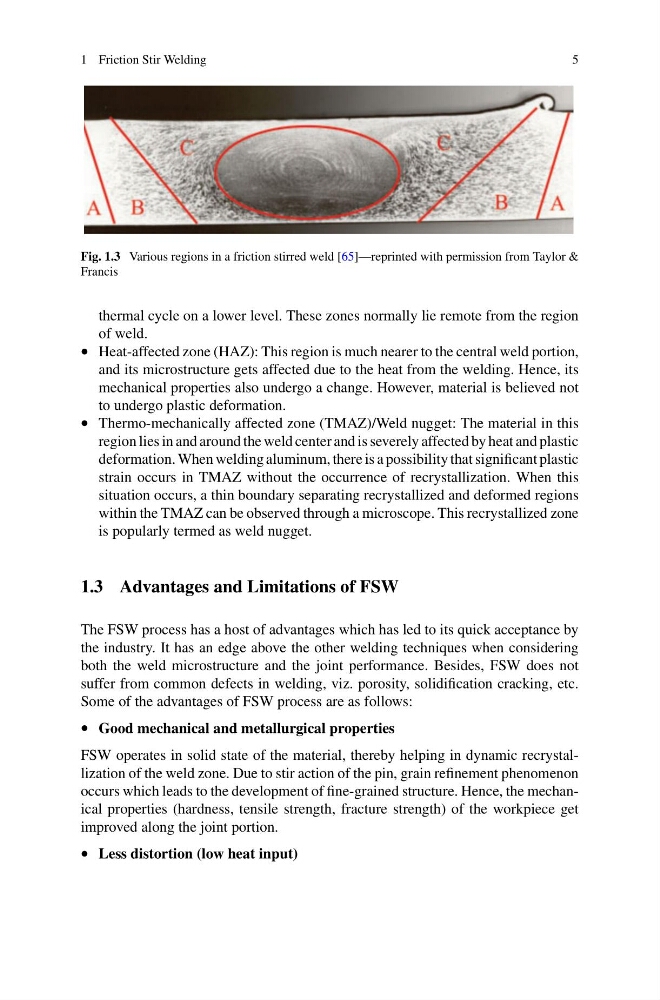
Fig. 1.3 Various regions in a friction stirred weld [65]—reprinted with permission from Taylor &
Francis
thermal cycle on a lower level. These zones normally lie remote from the region
of weld.
• Heat-affected zone (HAZ): This region is much nearer to the central weld portion,
and its microstructure gets affected due to the heat from the welding. Hence, its
mechanical properties also undergo a change. However, material is believed not
to undergo plastic deformation.
• Thermo-mechanically affected zone (TMAZ)/Weld nugget: The material in this
region lies in and around the weld center and is severely affected by heat and plastic
deformation. When welding aluminum, there is a possibility that significant plastic
strain occurs in TMAZ without the occurrence of recrystallization. When this
situation occurs, a thin boundary separating recrystallized and deformed regions
within the TMAZ can be observed through a microscope. This recrystallized zone
is popularly termed as weld nugget.
1.3 Advantages and Limitations of FSW
The FSW process has a host of advantages which has led to its quick acceptance by
the industry. It has an edge above the other welding techniques when considering
both the weld microstructure and the joint performance. Besides, FSW does not
suffer from common defects in welding, viz. porosity, solidification cracking, etc.
Some of the advantages of FSW process are as follows:
• Good mechanical and metallurgical properties
FSW operates in solid state of the material, thereby helping in dynamic recrystallization of the weld zone. Due to stir action of the pin, grain refinement phenomenon
occurs which leads to the development of fine-grained structure. Hence, the mechanical properties (hardness, tensile strength, fracture strength) of the workpiece get
improved along the joint portion.
• Less distortion (low heat input)
5
Fig. 1.3 Various regions in a friction stirred weld [65]—reprinted with permission from Taylor &
Francis
thermal cycle on a lower level. These zones normally lie remote from the region
of weld.
• Heat-affected zone (HAZ): This region is much nearer to the central weld portion,
and its microstructure gets affected due to the heat from the welding. Hence, its
mechanical properties also undergo a change. However, material is believed not
to undergo plastic deformation.
• Thermo-mechanically affected zone (TMAZ)/Weld nugget: The material in this
region lies in and around the weld center and is severely affected by heat and plastic
deformation. When welding aluminum, there is a possibility that significant plastic
strain occurs in TMAZ without the occurrence of recrystallization. When this
situation occurs, a thin boundary separating recrystallized and deformed regions
within the TMAZ can be observed through a microscope. This recrystallized zone
is popularly termed as weld nugget.
1.3 Advantages and Limitations of FSW
The FSW process has a host of advantages which has led to its quick acceptance by
the industry. It has an edge above the other welding techniques when considering
both the weld microstructure and the joint performance. Besides, FSW does not
suffer from common defects in welding, viz. porosity, solidification cracking, etc.
Some of the advantages of FSW process are as follows:
• Good mechanical and metallurgical properties
FSW operates in solid state of the material, thereby helping in dynamic recrystallization of the weld zone. Due to stir action of the pin, grain refinement phenomenon
occurs which leads to the development of fine-grained structure. Hence, the mechanical properties (hardness, tensile strength, fracture strength) of the workpiece get
improved along the joint portion.
• Less distortion (low heat input)