

3 Modeling of Friction Stir Welding Processes
125
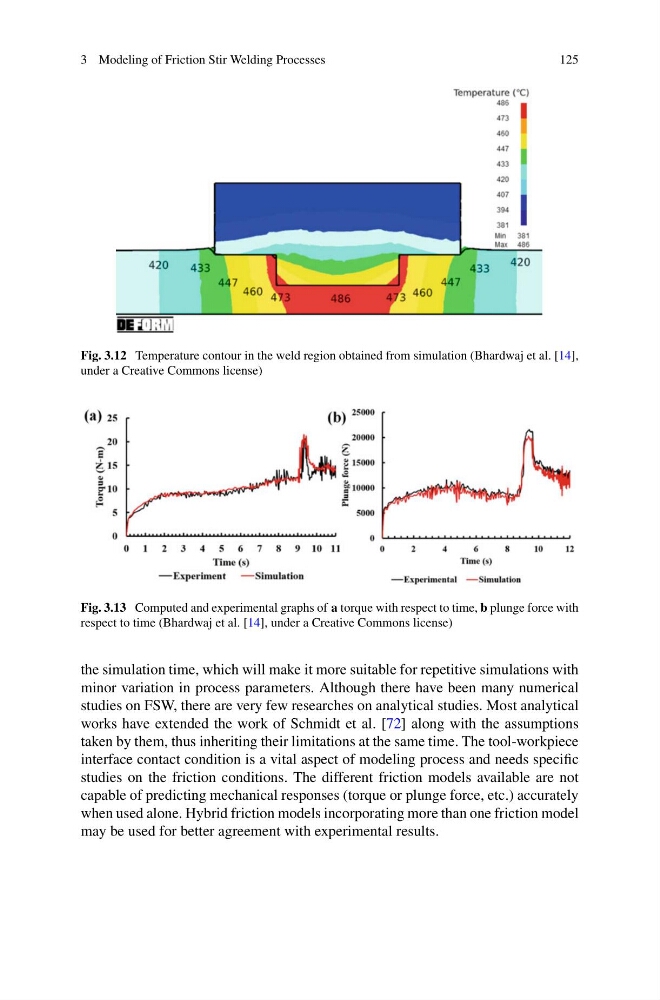
Fig. 3.12 Temperature contour in the weld region obtained from simulation (Bhardwaj et al. [14],
under a Creative Commons license)
Fig. 3.13 Computed and experimental graphs of a torque with respect to time, b plunge force with
respect to time (Bhardwaj et al. [14], under a Creative Commons license)
the simulation time, which will make it more suitable for repetitive simulations with
minor variation in process parameters. Although there have been many numerical
studies on FSW, there are very few researches on analytical studies. Most analytical
works have extended the work of Schmidt et al. [72] along with the assumptions
taken by them, thus inheriting their limitations at the same time. The tool-workpiece
interface contact condition is a vital aspect of modeling process and needs specific
studies on the friction conditions. The different friction models available are not
capable of predicting mechanical responses (torque or plunge force, etc.) accurately
when used alone. Hybrid friction models incorporating more than one friction model
may be used for better agreement with experimental results.
125
Fig. 3.12 Temperature contour in the weld region obtained from simulation (Bhardwaj et al. [14],
under a Creative Commons license)
Fig. 3.13 Computed and experimental graphs of a torque with respect to time, b plunge force with
respect to time (Bhardwaj et al. [14], under a Creative Commons license)
the simulation time, which will make it more suitable for repetitive simulations with
minor variation in process parameters. Although there have been many numerical
studies on FSW, there are very few researches on analytical studies. Most analytical
works have extended the work of Schmidt et al. [72] along with the assumptions
taken by them, thus inheriting their limitations at the same time. The tool-workpiece
interface contact condition is a vital aspect of modeling process and needs specific
studies on the friction conditions. The different friction models available are not
capable of predicting mechanical responses (torque or plunge force, etc.) accurately
when used alone. Hybrid friction models incorporating more than one friction model
may be used for better agreement with experimental results.