

3 Modeling of Friction Stir Welding Processes
123
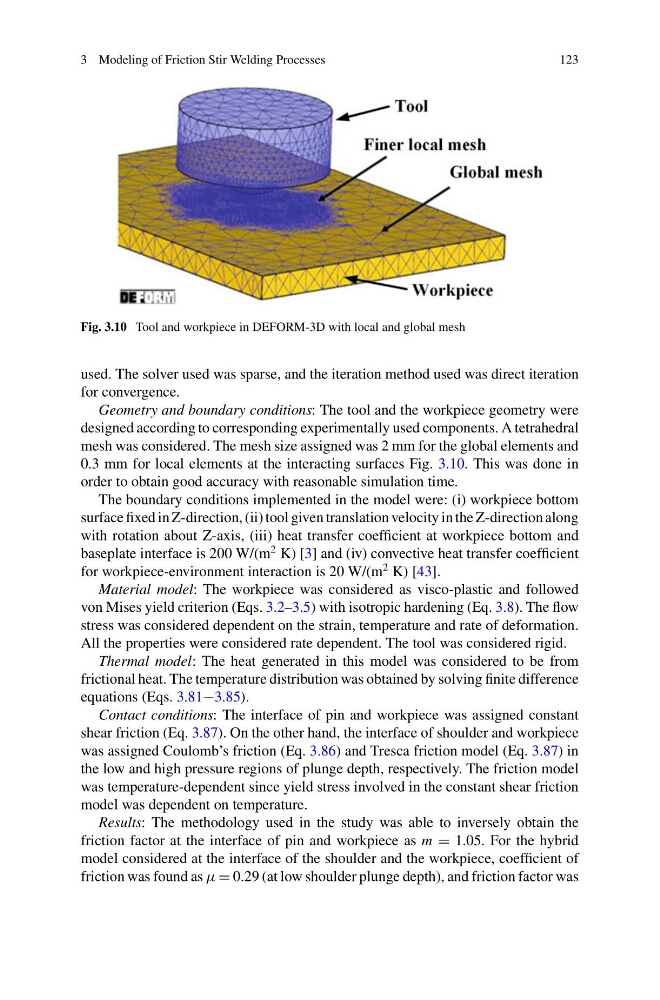
Fig. 3.10 Tool and workpiece in DEFORM-3D with local and global mesh
used. The solver used was sparse, and the iteration method used was direct iteration
for convergence.
Geometry and boundary conditions: The tool and the workpiece geometry were
designed according to corresponding experimentally used components. A tetrahedral
mesh was considered. The mesh size assigned was 2 mm for the global elements and
0.3 mm for local elements at the interacting surfaces Fig. 3.10. This was done in
order to obtain good accuracy with reasonable simulation time.
The boundary conditions implemented in the model were: (i) workpiece bottom
surface fixed in Z-direction, (ii) tool given translation velocity in the Z-direction along
with rotation about Z-axis, (iii) heat transfer coefficient at workpiece bottom and
baseplate interface is 200 W/(m
2 K) [3] and (iv) convective heat transfer coefficient
for workpiece-environment interaction is 20 W/(m
2 K) [43].
Material model: The workpiece was considered as visco-plastic and followed
von Mises yield criterion (Eqs. 3.2–3.5) with isotropic hardening (Eq. 3.8). The flow
stress was considered dependent on the strain, temperature and rate of deformation.
All the properties were considered rate dependent. The tool was considered rigid.
Thermal model: The heat generated in this model was considered to be from
frictional heat. The temperature distribution was obtained by solving finite difference
equations (Eqs. 3.81−3.85).
Contact conditions: The interface of pin and workpiece was assigned constant
shear friction (Eq. 3.87). On the other hand, the interface of shoulder and workpiece
was assigned Coulomb’s friction (Eq. 3.86) and Tresca friction model (Eq. 3.87) in
the low and high pressure regions of plunge depth, respectively. The friction model
was temperature-dependent since yield stress involved in the constant shear friction
model was dependent on temperature.
Results: The methodology used in the study was able to inversely obtain the
friction factor at the interface of pin and workpiece as m = 1.05. For the hybrid
model considered at the interface of the shoulder and the workpiece, coefficient of
friction was found as μ = 0.29 (at low shoulder plunge depth), and friction factor was
123
Fig. 3.10 Tool and workpiece in DEFORM-3D with local and global mesh
used. The solver used was sparse, and the iteration method used was direct iteration
for convergence.
Geometry and boundary conditions: The tool and the workpiece geometry were
designed according to corresponding experimentally used components. A tetrahedral
mesh was considered. The mesh size assigned was 2 mm for the global elements and
0.3 mm for local elements at the interacting surfaces Fig. 3.10. This was done in
order to obtain good accuracy with reasonable simulation time.
The boundary conditions implemented in the model were: (i) workpiece bottom
surface fixed in Z-direction, (ii) tool given translation velocity in the Z-direction along
with rotation about Z-axis, (iii) heat transfer coefficient at workpiece bottom and
baseplate interface is 200 W/(m
2 K) [3] and (iv) convective heat transfer coefficient
for workpiece-environment interaction is 20 W/(m
2 K) [43].
Material model: The workpiece was considered as visco-plastic and followed
von Mises yield criterion (Eqs. 3.2–3.5) with isotropic hardening (Eq. 3.8). The flow
stress was considered dependent on the strain, temperature and rate of deformation.
All the properties were considered rate dependent. The tool was considered rigid.
Thermal model: The heat generated in this model was considered to be from
frictional heat. The temperature distribution was obtained by solving finite difference
equations (Eqs. 3.81−3.85).
Contact conditions: The interface of pin and workpiece was assigned constant
shear friction (Eq. 3.87). On the other hand, the interface of shoulder and workpiece
was assigned Coulomb’s friction (Eq. 3.86) and Tresca friction model (Eq. 3.87) in
the low and high pressure regions of plunge depth, respectively. The friction model
was temperature-dependent since yield stress involved in the constant shear friction
model was dependent on temperature.
Results: The methodology used in the study was able to inversely obtain the
friction factor at the interface of pin and workpiece as m = 1.05. For the hybrid
model considered at the interface of the shoulder and the workpiece, coefficient of
friction was found as μ = 0.29 (at low shoulder plunge depth), and friction factor was