

118
N. Bhardwaj et al.
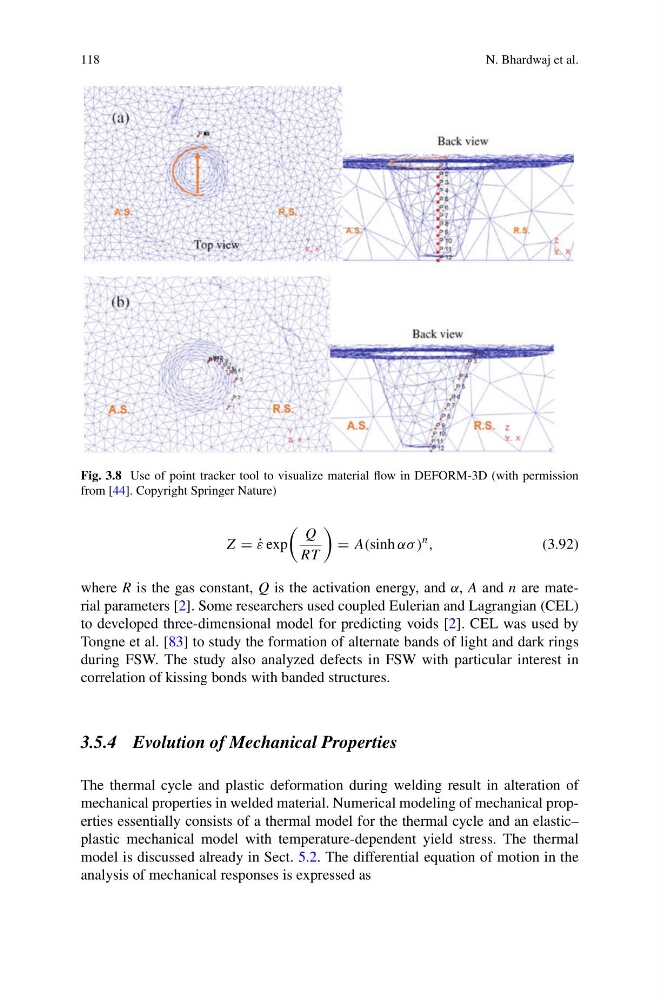
Fig. 3.8 Use of point tracker tool to visualize material flow in DEFORM-3D (with permission
from [44]. Copyright Springer Nature)
Z = ˙
ε exp
Q
RT
= A(sinh ασ )
n
,
(3.92)
where R is the gas constant, Q is the activation energy, and α, A and n are material parameters [2]. Some researchers used coupled Eulerian and Lagrangian (CEL)
to developed three-dimensional model for predicting voids [2]. CEL was used by
Tongne et al. [83] to study the formation of alternate bands of light and dark rings
during FSW. The study also analyzed defects in FSW with particular interest in
correlation of kissing bonds with banded structures.
3.5.4 Evolution of Mechanical Properties
The thermal cycle and plastic deformation during welding result in alteration of
mechanical properties in welded material. Numerical modeling of mechanical properties essentially consists of a thermal model for the thermal cycle and an elastic–
plastic mechanical model with temperature-dependent yield stress. The thermal
model is discussed already in Sect. 5.2. The differential equation of motion in the
analysis of mechanical responses is expressed as
N. Bhardwaj et al.
Fig. 3.8 Use of point tracker tool to visualize material flow in DEFORM-3D (with permission
from [44]. Copyright Springer Nature)
Z = ˙
ε exp
Q
RT
= A(sinh ασ )
n
,
(3.92)
where R is the gas constant, Q is the activation energy, and α, A and n are material parameters [2]. Some researchers used coupled Eulerian and Lagrangian (CEL)
to developed three-dimensional model for predicting voids [2]. CEL was used by
Tongne et al. [83] to study the formation of alternate bands of light and dark rings
during FSW. The study also analyzed defects in FSW with particular interest in
correlation of kissing bonds with banded structures.
3.5.4 Evolution of Mechanical Properties
The thermal cycle and plastic deformation during welding result in alteration of
mechanical properties in welded material. Numerical modeling of mechanical properties essentially consists of a thermal model for the thermal cycle and an elastic–
plastic mechanical model with temperature-dependent yield stress. The thermal
model is discussed already in Sect. 5.2. The differential equation of motion in the
analysis of mechanical responses is expressed as