

116
N. Bhardwaj et al.
velocity of workpiece material to velocity of its contact point on the tool. Based on
the contact state variable, the contact condition at the interface may be (i) sliding,
(ii) sticking or (iii) combination of both sticking and sliding. Another widely used
friction model is the constant shear (Tresca) friction model given as
τ = mk,
(3.87)
where k =
σ y
√
3
with σ y is the yield stress of a material following von Mises yield
criteria, and m is the friction factor. Apart from these two laws, Norton law of friction
is also used by a few researchers [31, 37, 38]. It is expressed as
τ = −μK |V |
q−1 V,
(3.88)
where K is the consistency, and V is the relative velocity [52]. Bhardwaj et al. [14]
gave a comprehensive method to inversely evaluate the contact condition during friction stir spot welding (FSSW). The contact condition (friction factor and coefficient
of friction) at the interface of tool and workpiece was evaluated by adjusting these
parameters to achieve close match between computed and experimentally obtain
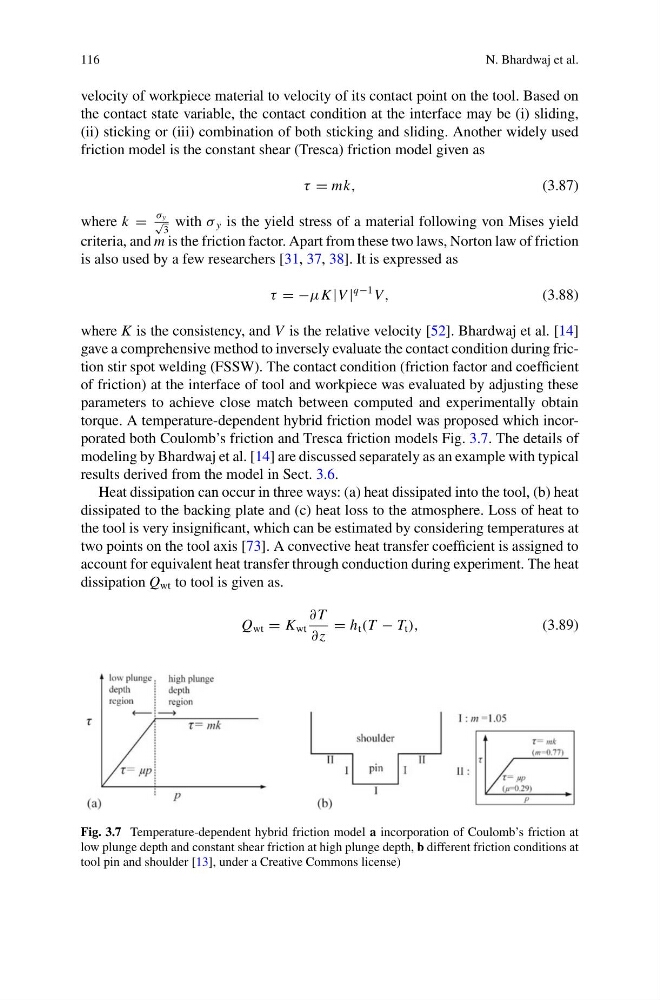
torque. A temperature-dependent hybrid friction model was proposed which incorporated both Coulomb’s friction and Tresca friction models Fig. 3.7. The details of
modeling by Bhardwaj et al. [14] are discussed separately as an example with typical
results derived from the model in Sect. 3.6.
Heat dissipation can occur in three ways: (a) heat dissipated into the tool, (b) heat
dissipated to the backing plate and (c) heat loss to the atmosphere. Loss of heat to
the tool is very insignificant, which can be estimated by considering temperatures at
two points on the tool axis [73]. A convective heat transfer coefficient is assigned to
account for equivalent heat transfer through conduction during experiment. The heat
dissipation Q wt to tool is given as.
Q wt = K wt
∂ T
∂z
= h t (T − T t ),
(3.89)
Fig. 3.7 Temperature-dependent hybrid friction model a incorporation of Coulomb’s friction at
low plunge depth and constant shear friction at high plunge depth, b different friction conditions at
tool pin and shoulder [13], under a Creative Commons license)
N. Bhardwaj et al.
velocity of workpiece material to velocity of its contact point on the tool. Based on
the contact state variable, the contact condition at the interface may be (i) sliding,
(ii) sticking or (iii) combination of both sticking and sliding. Another widely used
friction model is the constant shear (Tresca) friction model given as
τ = mk,
(3.87)
where k =
σ y
√
3
with σ y is the yield stress of a material following von Mises yield
criteria, and m is the friction factor. Apart from these two laws, Norton law of friction
is also used by a few researchers [31, 37, 38]. It is expressed as
τ = −μK |V |
q−1 V,
(3.88)
where K is the consistency, and V is the relative velocity [52]. Bhardwaj et al. [14]
gave a comprehensive method to inversely evaluate the contact condition during friction stir spot welding (FSSW). The contact condition (friction factor and coefficient
of friction) at the interface of tool and workpiece was evaluated by adjusting these
parameters to achieve close match between computed and experimentally obtain
torque. A temperature-dependent hybrid friction model was proposed which incorporated both Coulomb’s friction and Tresca friction models Fig. 3.7. The details of
modeling by Bhardwaj et al. [14] are discussed separately as an example with typical
results derived from the model in Sect. 3.6.
Heat dissipation can occur in three ways: (a) heat dissipated into the tool, (b) heat
dissipated to the backing plate and (c) heat loss to the atmosphere. Loss of heat to
the tool is very insignificant, which can be estimated by considering temperatures at
two points on the tool axis [73]. A convective heat transfer coefficient is assigned to
account for equivalent heat transfer through conduction during experiment. The heat
dissipation Q wt to tool is given as.
Q wt = K wt
∂ T
∂z
= h t (T − T t ),
(3.89)
Fig. 3.7 Temperature-dependent hybrid friction model a incorporation of Coulomb’s friction at
low plunge depth and constant shear friction at high plunge depth, b different friction conditions at
tool pin and shoulder [13], under a Creative Commons license)