

110
N. Bhardwaj et al.
g 2 (x, y, z, t) =
⎧
⎪ ⎪ ⎪ ⎪ ⎨
⎪ ⎪ ⎪ ⎪ ⎩
ωr τ c δ(z − h)
¯
x(t) −
R
2
pin − (y − ¯
y(t)) 2
< x
<
¯
x(t) +
R
2
pin − (y − ¯
y(t)) 2
,
¯
y(t) − R pin
< y <
¯
y(t) + R pin
;
0
otherwise.
(3.65)
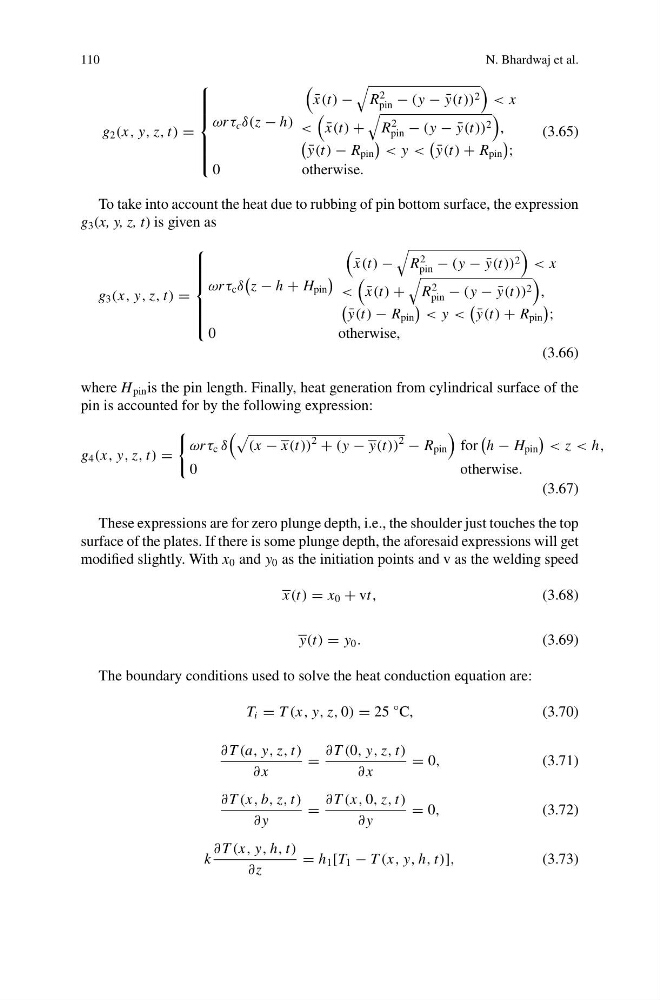
To take into account the heat due to rubbing of pin bottom surface, the expression
g 3 (x, y, z, t) is given as
g 3 (x, y, z, t) =
⎧
⎪ ⎪ ⎪ ⎪ ⎨
⎪ ⎪ ⎪ ⎪ ⎩
ωr τ c δ
z − h + H pin
¯
x(t) −
R
2
pin − (y − ¯
y(t)) 2
< x
<
¯
x(t) +
R
2
pin − (y − ¯
y(t)) 2
,
¯
y(t) − R pin
< y <
¯
y(t) + R pin
;
0
otherwise,
(3.66)
where H pin is the pin length. Finally, heat generation from cylindrical surface of the
pin is accounted for by the following expression:
g 4 (x, y, z, t) =
ωr τ c δ
(x − x(t))
2
+ (y − y(t))
2
− R pin
for
h − H pin
< z < h,
0
otherwise.
(3.67)
These expressions are for zero plunge depth, i.e., the shoulder just touches the top
surface of the plates. If there is some plunge depth, the aforesaid expressions will get
modified slightly. With x 0 and y 0 as the initiation points and v as the welding speed
x(t) = x 0 + vt,
(3.68)
y(t) = y 0 .
(3.69)
The boundary conditions used to solve the heat conduction equation are:
T i = T (x, y, z, 0) = 25
◦ C,
(3.70)
∂ T (a, y, z, t)
∂ x
=
∂ T (0, y, z, t)
∂ x
= 0,
(3.71)
∂ T (x, b, z, t)
∂ y
=
∂ T (x, 0, z, t)
∂ y
= 0,
(3.72)
k
∂ T (x, y, h, t)
∂z
= h 1 [T 1 − T (x, y, h, t)],
(3.73)
N. Bhardwaj et al.
g 2 (x, y, z, t) =
⎧
⎪ ⎪ ⎪ ⎪ ⎨
⎪ ⎪ ⎪ ⎪ ⎩
ωr τ c δ(z − h)
¯
x(t) −
R
2
pin − (y − ¯
y(t)) 2
< x
<
¯
x(t) +
R
2
pin − (y − ¯
y(t)) 2
,
¯
y(t) − R pin
< y <
¯
y(t) + R pin
;
0
otherwise.
(3.65)
To take into account the heat due to rubbing of pin bottom surface, the expression
g 3 (x, y, z, t) is given as
g 3 (x, y, z, t) =
⎧
⎪ ⎪ ⎪ ⎪ ⎨
⎪ ⎪ ⎪ ⎪ ⎩
ωr τ c δ
z − h + H pin
¯
x(t) −
R
2
pin − (y − ¯
y(t)) 2
< x
<
¯
x(t) +
R
2
pin − (y − ¯
y(t)) 2
,
¯
y(t) − R pin
< y <
¯
y(t) + R pin
;
0
otherwise,
(3.66)
where H pin is the pin length. Finally, heat generation from cylindrical surface of the
pin is accounted for by the following expression:
g 4 (x, y, z, t) =
ωr τ c δ
(x − x(t))
2
+ (y − y(t))
2
− R pin
for
h − H pin
< z < h,
0
otherwise.
(3.67)
These expressions are for zero plunge depth, i.e., the shoulder just touches the top
surface of the plates. If there is some plunge depth, the aforesaid expressions will get
modified slightly. With x 0 and y 0 as the initiation points and v as the welding speed
x(t) = x 0 + vt,
(3.68)
y(t) = y 0 .
(3.69)
The boundary conditions used to solve the heat conduction equation are:
T i = T (x, y, z, 0) = 25
◦ C,
(3.70)
∂ T (a, y, z, t)
∂ x
=
∂ T (0, y, z, t)
∂ x
= 0,
(3.71)
∂ T (x, b, z, t)
∂ y
=
∂ T (x, 0, z, t)
∂ y
= 0,
(3.72)
k
∂ T (x, y, h, t)
∂z
= h 1 [T 1 − T (x, y, h, t)],
(3.73)