

96
N. Bhardwaj et al.
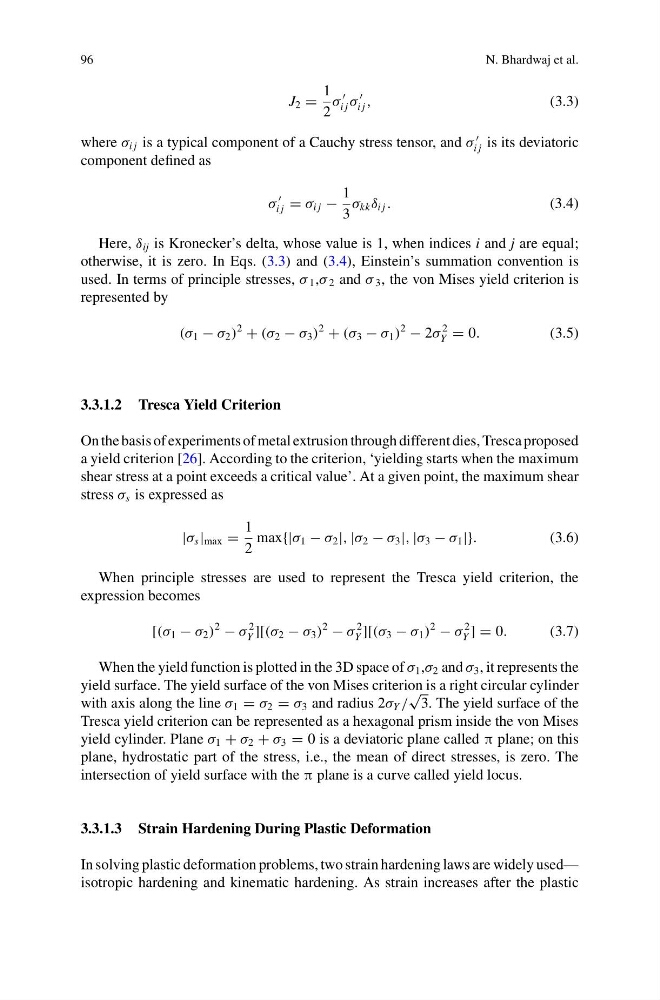
J 2 =
1
2
σ
i j σ
i j ,
(3.3)
where σ i j is a typical component of a Cauchy stress tensor, and σ
i j is its deviatoric
component defined as
σ
i j = σ i j −
1
3
σ kk δ i j .
(3.4)
Here, δ ij is Kronecker’s delta, whose value is 1, when indices i and j are equal;
otherwise, it is zero. In Eqs. (3.3) and (3.4), Einstein’s summation convention is
used. In terms of principle stresses, σ 1 ,σ 2 and σ 3 , the von Mises yield criterion is
represented by
(σ 1 − σ 2 )
2
+ (σ 2 − σ 3 )
2
+ (σ 3 − σ 1 )
2
− 2σ
2
Y = 0.
(3.5)
3.3.1.2 Tresca Yield Criterion
On the basis of experiments of metal extrusion through different dies, Tresca proposed
a yield criterion [26]. According to the criterion, ‘yielding starts when the maximum
shear stress at a point exceeds a critical value’. At a given point, the maximum shear
stress σ s is expressed as
|σ s | max =
1
2
max{|σ 1 − σ 2 |, |σ 2 − σ 3 |, |σ 3 − σ 1 |}.
(3.6)
When principle stresses are used to represent the Tresca yield criterion, the
expression becomes
[(σ 1 − σ 2 )
2
− σ
2
Y ][(σ 2 − σ 3 )
2
− σ
2
Y ][(σ 3 − σ 1 )
2
− σ
2
Y ] = 0.
(3.7)
When the yield function is plotted in the 3D space of σ 1 ,σ 2 and σ 3 , it represents the
yield surface. The yield surface of the von Mises criterion is a right circular cylinder
with axis along the line σ 1 = σ 2 = σ 3 and radius 2σ Y /
√
3. The yield surface of the
Tresca yield criterion can be represented as a hexagonal prism inside the von Mises
yield cylinder. Plane σ 1 + σ 2 + σ 3 = 0 is a deviatoric plane called π plane; on this
plane, hydrostatic part of the stress, i.e., the mean of direct stresses, is zero. The
intersection of yield surface with the π plane is a curve called yield locus.
3.3.1.3 Strain Hardening During Plastic Deformation
In solving plastic deformation problems, two strain hardening laws are widely used—
isotropic hardening and kinematic hardening. As strain increases after the plastic
N. Bhardwaj et al.
J 2 =
1
2
σ
i j σ
i j ,
(3.3)
where σ i j is a typical component of a Cauchy stress tensor, and σ
i j is its deviatoric
component defined as
σ
i j = σ i j −
1
3
σ kk δ i j .
(3.4)
Here, δ ij is Kronecker’s delta, whose value is 1, when indices i and j are equal;
otherwise, it is zero. In Eqs. (3.3) and (3.4), Einstein’s summation convention is
used. In terms of principle stresses, σ 1 ,σ 2 and σ 3 , the von Mises yield criterion is
represented by
(σ 1 − σ 2 )
2
+ (σ 2 − σ 3 )
2
+ (σ 3 − σ 1 )
2
− 2σ
2
Y = 0.
(3.5)
3.3.1.2 Tresca Yield Criterion
On the basis of experiments of metal extrusion through different dies, Tresca proposed
a yield criterion [26]. According to the criterion, ‘yielding starts when the maximum
shear stress at a point exceeds a critical value’. At a given point, the maximum shear
stress σ s is expressed as
|σ s | max =
1
2
max{|σ 1 − σ 2 |, |σ 2 − σ 3 |, |σ 3 − σ 1 |}.
(3.6)
When principle stresses are used to represent the Tresca yield criterion, the
expression becomes
[(σ 1 − σ 2 )
2
− σ
2
Y ][(σ 2 − σ 3 )
2
− σ
2
Y ][(σ 3 − σ 1 )
2
− σ
2
Y ] = 0.
(3.7)
When the yield function is plotted in the 3D space of σ 1 ,σ 2 and σ 3 , it represents the
yield surface. The yield surface of the von Mises criterion is a right circular cylinder
with axis along the line σ 1 = σ 2 = σ 3 and radius 2σ Y /
√
3. The yield surface of the
Tresca yield criterion can be represented as a hexagonal prism inside the von Mises
yield cylinder. Plane σ 1 + σ 2 + σ 3 = 0 is a deviatoric plane called π plane; on this
plane, hydrostatic part of the stress, i.e., the mean of direct stresses, is zero. The
intersection of yield surface with the π plane is a curve called yield locus.
3.3.1.3 Strain Hardening During Plastic Deformation
In solving plastic deformation problems, two strain hardening laws are widely used—
isotropic hardening and kinematic hardening. As strain increases after the plastic