

À
1
2
d
dη
fη À fη
ð Þ
À1 À f
À2 df=dη
À2 ¼ P f À 1
ð
Þ,
ð4:15Þ
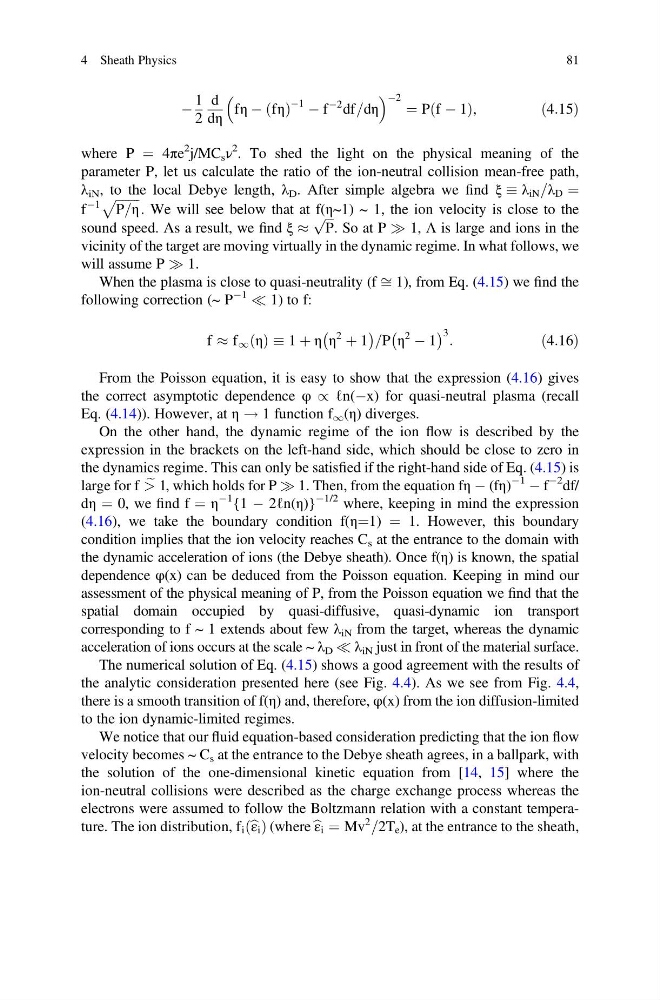
where P ¼ 4πe
2 j/MC s ν
2 . To shed the light on the physical meaning of the
parameter P, let us calculate the ratio of the ion-neutral collision mean-free path,
λ iN , to the local Debye length, λ D . After simple algebra we find ξ λ iN =λ D ¼
f
À1
ffiffiffiffiffiffiffiffi
P=η
p
. We will see below that at f(η~1) ~ 1, the ion velocity is close to the
sound speed. As a result, we find ξ %
ffiffiffi
P
p
. So at P ) 1, Λ is large and ions in the
vicinity of the target are moving virtually in the dynamic regime. In what follows, we
will assume P ) 1.
When the plasma is close to quasi-neutrality (f ffi 1), from Eq. (4.15) we find the
following correction (~ P
À1
( 1) to f:
f % f 1 η
ð Þ 1 þ η η
2
þ 1
À
Á =P η
2
À 1
À
Á 3 :
ð4:16Þ
From the Poisson equation, it is easy to show that the expression (4.16) gives
the correct asymptotic dependence φ / ℓn(Àx) for quasi-neutral plasma (recall
Eq. (4.14)). However, at η ! 1 function f 1 (η) diverges.
On the other hand, the dynamic regime of the ion flow is described by the
expression in the brackets on the left-hand side, which should be close to zero in
the dynamics regime. This can only be satisfied if the right-hand side of Eq. (4.15) is
large for f e
> 1, which holds for P ) 1. Then, from the equation fη À (fη)
À1
À f
À2 df/
dη ¼ 0, we find f ¼ η
À1 {1 À 2ℓn(η)}
À1/2 where, keeping in mind the expression
(4.16), we take the boundary condition f(η¼1) ¼ 1. However, this boundary
condition implies that the ion velocity reaches C s at the entrance to the domain with
the dynamic acceleration of ions (the Debye sheath). Once f(η) is known, the spatial
dependence φ(x) can be deduced from the Poisson equation. Keeping in mind our
assessment of the physical meaning of P, from the Poisson equation we find that the
spatial domain occupied by quasi-diffusive, quasi-dynamic ion transport
corresponding to f ~ 1 extends about few λ iN from the target, whereas the dynamic
acceleration of ions occurs at the scale ~ λ D ( λ iN just in front of the material surface.
The numerical solution of Eq. (4.15) shows a good agreement with the results of
the analytic consideration presented here (see Fig. 4.4). As we see from Fig. 4.4,
there is a smooth transition of f(η) and, therefore, φ(x) from the ion diffusion-limited
to the ion dynamic-limited regimes.
We notice that our fluid equation-based consideration predicting that the ion flow
velocity becomes ~ C s at the entrance to the Debye sheath agrees, in a ballpark, with
the solution of the one-dimensional kinetic equation from [14, 15] where the
ion-neutral collisions were described as the charge exchange process whereas the
electrons were assumed to follow the Boltzmann relation with a constant temperature. The ion distribution, f i b ε i
ð Þ (where b ε i ¼ Mv
2
=2T e ), at the entrance to the sheath,
4 Sheath Physics
81
1
2
d
dη
fη À fη
ð Þ
À1 À f
À2 df=dη
À2 ¼ P f À 1
ð
Þ,
ð4:15Þ
where P ¼ 4πe
2 j/MC s ν
2 . To shed the light on the physical meaning of the
parameter P, let us calculate the ratio of the ion-neutral collision mean-free path,
λ iN , to the local Debye length, λ D . After simple algebra we find ξ λ iN =λ D ¼
f
À1
ffiffiffiffiffiffiffiffi
P=η
p
. We will see below that at f(η~1) ~ 1, the ion velocity is close to the
sound speed. As a result, we find ξ %
ffiffiffi
P
p
. So at P ) 1, Λ is large and ions in the
vicinity of the target are moving virtually in the dynamic regime. In what follows, we
will assume P ) 1.
When the plasma is close to quasi-neutrality (f ffi 1), from Eq. (4.15) we find the
following correction (~ P
À1
( 1) to f:
f % f 1 η
ð Þ 1 þ η η
2
þ 1
À
Á =P η
2
À 1
À
Á 3 :
ð4:16Þ
From the Poisson equation, it is easy to show that the expression (4.16) gives
the correct asymptotic dependence φ / ℓn(Àx) for quasi-neutral plasma (recall
Eq. (4.14)). However, at η ! 1 function f 1 (η) diverges.
On the other hand, the dynamic regime of the ion flow is described by the
expression in the brackets on the left-hand side, which should be close to zero in
the dynamics regime. This can only be satisfied if the right-hand side of Eq. (4.15) is
large for f e
> 1, which holds for P ) 1. Then, from the equation fη À (fη)
À1
À f
À2 df/
dη ¼ 0, we find f ¼ η
À1 {1 À 2ℓn(η)}
À1/2 where, keeping in mind the expression
(4.16), we take the boundary condition f(η¼1) ¼ 1. However, this boundary
condition implies that the ion velocity reaches C s at the entrance to the domain with
the dynamic acceleration of ions (the Debye sheath). Once f(η) is known, the spatial
dependence φ(x) can be deduced from the Poisson equation. Keeping in mind our
assessment of the physical meaning of P, from the Poisson equation we find that the
spatial domain occupied by quasi-diffusive, quasi-dynamic ion transport
corresponding to f ~ 1 extends about few λ iN from the target, whereas the dynamic
acceleration of ions occurs at the scale ~ λ D ( λ iN just in front of the material surface.
The numerical solution of Eq. (4.15) shows a good agreement with the results of
the analytic consideration presented here (see Fig. 4.4). As we see from Fig. 4.4,
there is a smooth transition of f(η) and, therefore, φ(x) from the ion diffusion-limited
to the ion dynamic-limited regimes.
We notice that our fluid equation-based consideration predicting that the ion flow
velocity becomes ~ C s at the entrance to the Debye sheath agrees, in a ballpark, with
the solution of the one-dimensional kinetic equation from [14, 15] where the
ion-neutral collisions were described as the charge exchange process whereas the
electrons were assumed to follow the Boltzmann relation with a constant temperature. The ion distribution, f i b ε i
ð Þ (where b ε i ¼ Mv
2
=2T e ), at the entrance to the sheath,
4 Sheath Physics
81