

make quantitative estimates of the shape of the tail of the electron distribution
function and of the subsequent impact of developing of the whistler wave instability.
Usually, in the edge plasma transport codes it is assumed that the electrons impinging onto the target have the Maxwellian distribution.
So far we assumed that the plasma flowing onto the target is completely
collisionless within some proximity to the target. In practice, this is not the case
and collisions are always present. In particular, in the detached divertor regime, the
neutral density becomes high and ion-neutral collisions result in a very short
ion-neutral collision mean free path, λ iÀN . However, in a ballpark, they do not
change one of the key conclusions of the sheath physics: for the case of λ iÀN > λ D ,
the plasma flow velocity at the distance ~λ iÀN from the target should about C s (see
[3] for details).
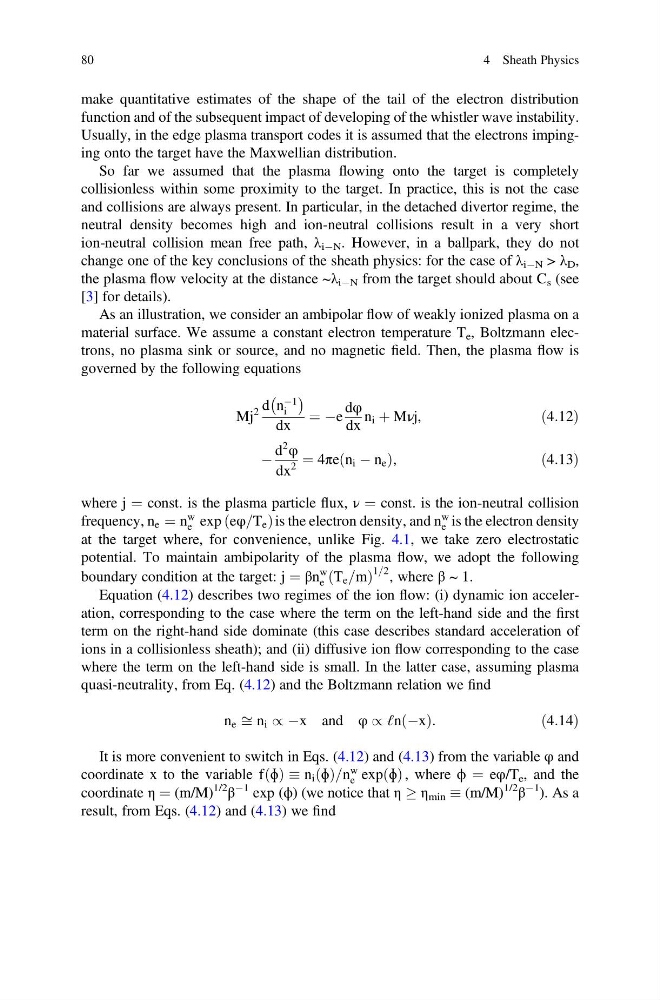
As an illustration, we consider an ambipolar flow of weakly ionized plasma on a
material surface. We assume a constant electron temperature T e , Boltzmann electrons, no plasma sink or source, and no magnetic field. Then, the plasma flow is
governed by the following equations
Mj
2 d n
À1
i
À Á
dx
¼ Àe
dφ
dx
n i þ Mνj,
ð4:12Þ
À
d
2
φ
dx
2
¼ 4πe n i À n e
ð
Þ,
ð4:13Þ
where j ¼ const. is the plasma particle flux, ν ¼ const. is the ion-neutral collision
frequency, n e ¼ n
w
e exp eφ=T e
ð
Þis the electron density, and n
w
e is the electron density
at the target where, for convenience, unlike Fig. 4.1, we take zero electrostatic
potential. To maintain ambipolarity of the plasma flow, we adopt the following
boundary condition at the target: j ¼ βn
w
e T e =m
ð
Þ
1=2 , where β ~ 1.
Equation (4.12) describes two regimes of the ion flow: (i) dynamic ion acceleration, corresponding to the case where the term on the left-hand side and the first
term on the right-hand side dominate (this case describes standard acceleration of
ions in a collisionless sheath); and (ii) diffusive ion flow corresponding to the case
where the term on the left-hand side is small. In the latter case, assuming plasma
quasi-neutrality, from Eq. (4.12) and the Boltzmann relation we find
n e ffi n i / Àx and φ / ℓnðÀxÞ:
ð4:14Þ
It is more convenient to switch in Eqs. (4.12) and (4.13) from the variable φ and
coordinate x to the variable fðɸÞ n i ðɸÞ=n
w
e expðɸÞ , where ϕ ¼ eφ/T e , and the
coordinate η ¼ (m/M)
1/2
β
À1 exp (ϕ) (we notice that η ! η min (m/M)
1/2
β
À1
). As a
result, from Eqs. (4.12) and (4.13) we find
80
4 Sheath Physics
function and of the subsequent impact of developing of the whistler wave instability.
Usually, in the edge plasma transport codes it is assumed that the electrons impinging onto the target have the Maxwellian distribution.
So far we assumed that the plasma flowing onto the target is completely
collisionless within some proximity to the target. In practice, this is not the case
and collisions are always present. In particular, in the detached divertor regime, the
neutral density becomes high and ion-neutral collisions result in a very short
ion-neutral collision mean free path, λ iÀN . However, in a ballpark, they do not
change one of the key conclusions of the sheath physics: for the case of λ iÀN > λ D ,
the plasma flow velocity at the distance ~λ iÀN from the target should about C s (see
[3] for details).
As an illustration, we consider an ambipolar flow of weakly ionized plasma on a
material surface. We assume a constant electron temperature T e , Boltzmann electrons, no plasma sink or source, and no magnetic field. Then, the plasma flow is
governed by the following equations
Mj
2 d n
À1
i
À Á
dx
¼ Àe
dφ
dx
n i þ Mνj,
ð4:12Þ
À
d
2
φ
dx
2
¼ 4πe n i À n e
ð
Þ,
ð4:13Þ
where j ¼ const. is the plasma particle flux, ν ¼ const. is the ion-neutral collision
frequency, n e ¼ n
w
e exp eφ=T e
ð
Þis the electron density, and n
w
e is the electron density
at the target where, for convenience, unlike Fig. 4.1, we take zero electrostatic
potential. To maintain ambipolarity of the plasma flow, we adopt the following
boundary condition at the target: j ¼ βn
w
e T e =m
ð
Þ
1=2 , where β ~ 1.
Equation (4.12) describes two regimes of the ion flow: (i) dynamic ion acceleration, corresponding to the case where the term on the left-hand side and the first
term on the right-hand side dominate (this case describes standard acceleration of
ions in a collisionless sheath); and (ii) diffusive ion flow corresponding to the case
where the term on the left-hand side is small. In the latter case, assuming plasma
quasi-neutrality, from Eq. (4.12) and the Boltzmann relation we find
n e ffi n i / Àx and φ / ℓnðÀxÞ:
ð4:14Þ
It is more convenient to switch in Eqs. (4.12) and (4.13) from the variable φ and
coordinate x to the variable fðɸÞ n i ðɸÞ=n
w
e expðɸÞ , where ϕ ¼ eφ/T e , and the
coordinate η ¼ (m/M)
1/2
β
À1 exp (ϕ) (we notice that η ! η min (m/M)
1/2
β
À1
). As a
result, from Eqs. (4.12) and (4.13) we find
80
4 Sheath Physics