

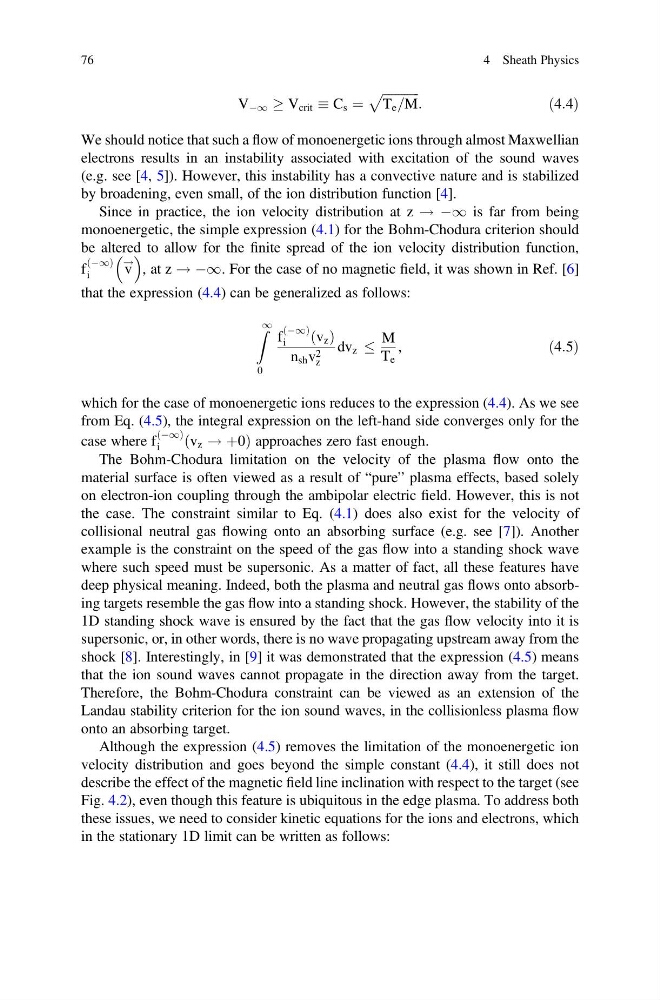
V À1 ! V crit C s ¼
ffiffiffiffiffiffiffiffiffiffiffi ffi
T e =M
p
:
ð4:4Þ
We should notice that such a flow of monoenergetic ions through almost Maxwellian
electrons results in an instability associated with excitation of the sound waves
(e.g. see [4, 5]). However, this instability has a convective nature and is stabilized
by broadening, even small, of the ion distribution function [4].
Since in practice, the ion velocity distribution at z ! À1 is far from being
monoenergetic, the simple expression (4.1) for the Bohm-Chodura criterion should
be altered to allow for the finite spread of the ion velocity distribution function,
f
À1
ð
Þ
i
v
!
, at z ! À1. For the case of no magnetic field, it was shown in Ref. [6]
that the expression (4.4) can be generalized as follows:
Z 1
0
f
À1
ð
Þ
i
v z
ð Þ
n sh v 2
z
dv z
M
T e
,
ð4:5Þ
which for the case of monoenergetic ions reduces to the expression (4.4). As we see
from Eq. (4.5), the integral expression on the left-hand side converges only for the
case where f
À1
ð
Þ
i
v z ! þ0
ð
Þapproaches zero fast enough.
The Bohm-Chodura limitation on the velocity of the plasma flow onto the
material surface is often viewed as a result of “pure” plasma effects, based solely
on electron-ion coupling through the ambipolar electric field. However, this is not
the case. The constraint similar to Eq. (4.1) does also exist for the velocity of
collisional neutral gas flowing onto an absorbing surface (e.g. see [7]). Another
example is the constraint on the speed of the gas flow into a standing shock wave
where such speed must be supersonic. As a matter of fact, all these features have
deep physical meaning. Indeed, both the plasma and neutral gas flows onto absorbing targets resemble the gas flow into a standing shock. However, the stability of the
1D standing shock wave is ensured by the fact that the gas flow velocity into it is
supersonic, or, in other words, there is no wave propagating upstream away from the
shock [8]. Interestingly, in [9] it was demonstrated that the expression (4.5) means
that the ion sound waves cannot propagate in the direction away from the target.
Therefore, the Bohm-Chodura constraint can be viewed as an extension of the
Landau stability criterion for the ion sound waves, in the collisionless plasma flow
onto an absorbing target.
Although the expression (4.5) removes the limitation of the monoenergetic ion
velocity distribution and goes beyond the simple constant (4.4), it still does not
describe the effect of the magnetic field line inclination with respect to the target (see
Fig. 4.2), even though this feature is ubiquitous in the edge plasma. To address both
these issues, we need to consider kinetic equations for the ions and electrons, which
in the stationary 1D limit can be written as follows:
76
4 Sheath Physics
ffiffiffiffiffiffiffiffiffiffiffi ffi
T e =M
p
:
ð4:4Þ
We should notice that such a flow of monoenergetic ions through almost Maxwellian
electrons results in an instability associated with excitation of the sound waves
(e.g. see [4, 5]). However, this instability has a convective nature and is stabilized
by broadening, even small, of the ion distribution function [4].
Since in practice, the ion velocity distribution at z ! À1 is far from being
monoenergetic, the simple expression (4.1) for the Bohm-Chodura criterion should
be altered to allow for the finite spread of the ion velocity distribution function,
f
À1
ð
Þ
i
v
!
, at z ! À1. For the case of no magnetic field, it was shown in Ref. [6]
that the expression (4.4) can be generalized as follows:
Z 1
0
f
À1
ð
Þ
i
v z
ð Þ
n sh v 2
z
dv z
M
T e
,
ð4:5Þ
which for the case of monoenergetic ions reduces to the expression (4.4). As we see
from Eq. (4.5), the integral expression on the left-hand side converges only for the
case where f
À1
ð
Þ
i
v z ! þ0
ð
Þapproaches zero fast enough.
The Bohm-Chodura limitation on the velocity of the plasma flow onto the
material surface is often viewed as a result of “pure” plasma effects, based solely
on electron-ion coupling through the ambipolar electric field. However, this is not
the case. The constraint similar to Eq. (4.1) does also exist for the velocity of
collisional neutral gas flowing onto an absorbing surface (e.g. see [7]). Another
example is the constraint on the speed of the gas flow into a standing shock wave
where such speed must be supersonic. As a matter of fact, all these features have
deep physical meaning. Indeed, both the plasma and neutral gas flows onto absorbing targets resemble the gas flow into a standing shock. However, the stability of the
1D standing shock wave is ensured by the fact that the gas flow velocity into it is
supersonic, or, in other words, there is no wave propagating upstream away from the
shock [8]. Interestingly, in [9] it was demonstrated that the expression (4.5) means
that the ion sound waves cannot propagate in the direction away from the target.
Therefore, the Bohm-Chodura constraint can be viewed as an extension of the
Landau stability criterion for the ion sound waves, in the collisionless plasma flow
onto an absorbing target.
Although the expression (4.5) removes the limitation of the monoenergetic ion
velocity distribution and goes beyond the simple constant (4.4), it still does not
describe the effect of the magnetic field line inclination with respect to the target (see
Fig. 4.2), even though this feature is ubiquitous in the edge plasma. To address both
these issues, we need to consider kinetic equations for the ions and electrons, which
in the stationary 1D limit can be written as follows:
76
4 Sheath Physics