

Interestingly, inequality (4.1) can be obtained from an analysis of the asymptotic
behavior of the solution of the Poisson equation with proper perturbation of the
electron and ion density by the sheath potential at z ! À1. To demonstrate this,
we consider an idealized case assuming no magnetic field and monoenergetic
ions streaming to the target with the velocity component perpendicular to the target
at z ! À1 equal to V À1 . We also assume that at z ! À1, the electrons with v Z > 0
are described by the Maxwellian distribution function f e v z > 0
ð
Þ/
exp Àmv
2
z =2T e
À
Á
.
Considering the case V À1 (
ffiffiffiffiffiffiffiffiffiffiffi
T e =m
p
and taking into account that at z ! À1
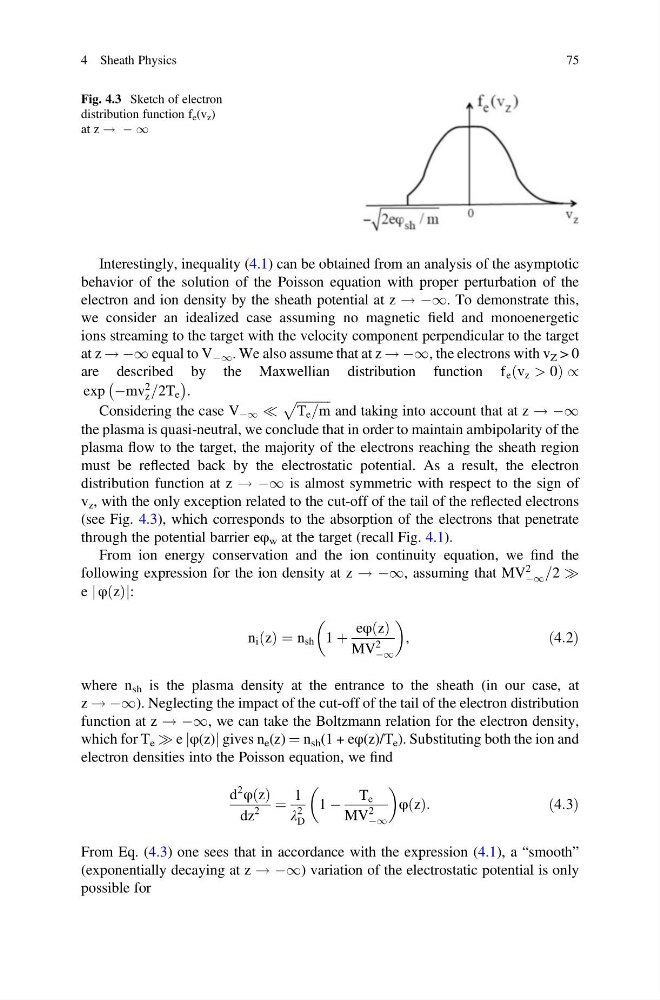
the plasma is quasi-neutral, we conclude that in order to maintain ambipolarity of the
plasma flow to the target, the majority of the electrons reaching the sheath region
must be reflected back by the electrostatic potential. As a result, the electron
distribution function at z ! À1 is almost symmetric with respect to the sign of
v z , with the only exception related to the cut-off of the tail of the reflected electrons
(see Fig. 4.3), which corresponds to the absorption of the electrons that penetrate
through the potential barrier eφ w at the target (recall Fig. 4.1).
From ion energy conservation and the ion continuity equation, we find the
following expression for the ion density at z ! À1, assuming that MV
2
À1 =2 )
e j φ z
ð Þj:
n i z
ð Þ ¼ n sh 1 þ
eφ z
ð Þ
MV
2
À1
,
ð4:2Þ
where n sh is the plasma density at the entrance to the sheath (in our case, at
z ! À1). Neglecting the impact of the cut-off of the tail of the electron distribution
function at z ! À1, we can take the Boltzmann relation for the electron density,
which for T e ) e jφ(z)j gives n e (z) ¼ n sh (1 + eφ(z)/T e ). Substituting both the ion and
electron densities into the Poisson equation, we find
d
2
φ z
ð Þ
dz
2
¼
1
λ
2
D
1 À
T e
MV
2
À1
φ z
ð Þ:
ð4:3Þ
From Eq. (4.3) one sees that in accordance with the expression (4.1), a “smooth”
(exponentially decaying at z ! À1) variation of the electrostatic potential is only
possible for
Fig. 4.3 Sketch of electron
distribution function f e (v z )
at z ! À 1
4 Sheath Physics
75
behavior of the solution of the Poisson equation with proper perturbation of the
electron and ion density by the sheath potential at z ! À1. To demonstrate this,
we consider an idealized case assuming no magnetic field and monoenergetic
ions streaming to the target with the velocity component perpendicular to the target
at z ! À1 equal to V À1 . We also assume that at z ! À1, the electrons with v Z > 0
are described by the Maxwellian distribution function f e v z > 0
ð
Þ/
exp Àmv
2
z =2T e
À
Á
.
Considering the case V À1 (
ffiffiffiffiffiffiffiffiffiffiffi
T e =m
p
and taking into account that at z ! À1
the plasma is quasi-neutral, we conclude that in order to maintain ambipolarity of the
plasma flow to the target, the majority of the electrons reaching the sheath region
must be reflected back by the electrostatic potential. As a result, the electron
distribution function at z ! À1 is almost symmetric with respect to the sign of
v z , with the only exception related to the cut-off of the tail of the reflected electrons
(see Fig. 4.3), which corresponds to the absorption of the electrons that penetrate
through the potential barrier eφ w at the target (recall Fig. 4.1).
From ion energy conservation and the ion continuity equation, we find the
following expression for the ion density at z ! À1, assuming that MV
2
À1 =2 )
e j φ z
ð Þj:
n i z
ð Þ ¼ n sh 1 þ
eφ z
ð Þ
MV
2
À1
,
ð4:2Þ
where n sh is the plasma density at the entrance to the sheath (in our case, at
z ! À1). Neglecting the impact of the cut-off of the tail of the electron distribution
function at z ! À1, we can take the Boltzmann relation for the electron density,
which for T e ) e jφ(z)j gives n e (z) ¼ n sh (1 + eφ(z)/T e ). Substituting both the ion and
electron densities into the Poisson equation, we find
d
2
φ z
ð Þ
dz
2
¼
1
λ
2
D
1 À
T e
MV
2
À1
φ z
ð Þ:
ð4:3Þ
From Eq. (4.3) one sees that in accordance with the expression (4.1), a “smooth”
(exponentially decaying at z ! À1) variation of the electrostatic potential is only
possible for
Fig. 4.3 Sketch of electron
distribution function f e (v z )
at z ! À 1
4 Sheath Physics
75