

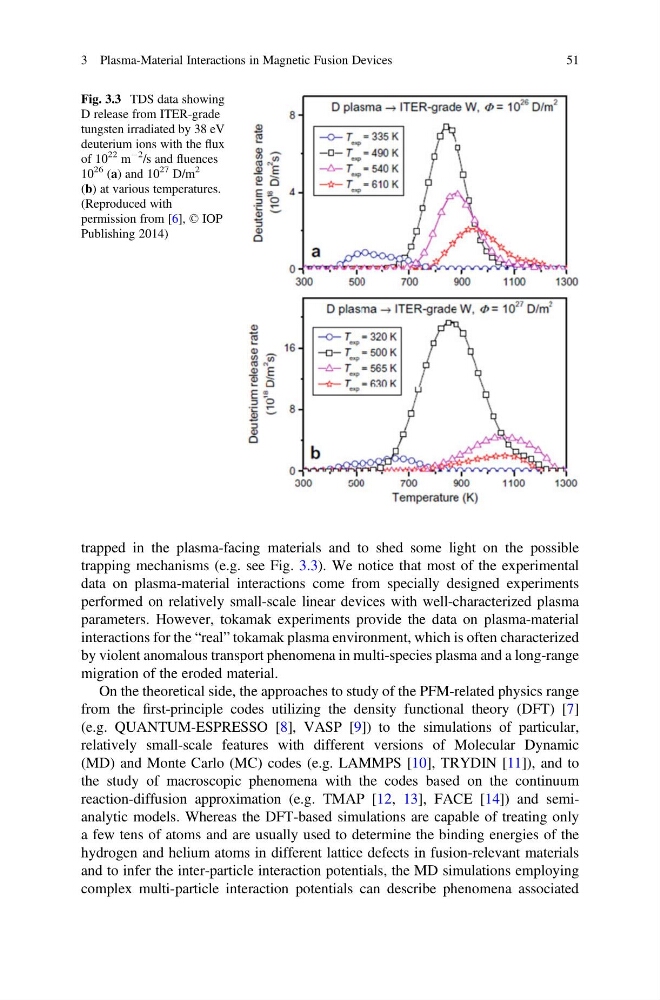
trapped in the plasma-facing materials and to shed some light on the possible
trapping mechanisms (e.g. see Fig. 3.3). We notice that most of the experimental
data on plasma-material interactions come from specially designed experiments
performed on relatively small-scale linear devices with well-characterized plasma
parameters. However, tokamak experiments provide the data on plasma-material
interactions for the “real” tokamak plasma environment, which is often characterized
by violent anomalous transport phenomena in multi-species plasma and a long-range
migration of the eroded material.
On the theoretical side, the approaches to study of the PFM-related physics range
from the first-principle codes utilizing the density functional theory (DFT) [7]
(e.g. QUANTUM-ESPRESSO [8], VASP [9]) to the simulations of particular,
relatively small-scale features with different versions of Molecular Dynamic
(MD) and Monte Carlo (MC) codes (e.g. LAMMPS [10], TRYDIN [11]), and to
the study of macroscopic phenomena with the codes based on the continuum
reaction-diffusion approximation (e.g. TMAP [12, 13], FACE [14]) and semianalytic models. Whereas the DFT-based simulations are capable of treating only
a few tens of atoms and are usually used to determine the binding energies of the
hydrogen and helium atoms in different lattice defects in fusion-relevant materials
and to infer the inter-particle interaction potentials, the MD simulations employing
complex multi-particle interaction potentials can describe phenomena associated
Fig. 3.3 TDS data showing
D release from ITER-grade
tungsten irradiated by 38 eV
deuterium ions with the flux
of 10
22 m
À2
/s and fluences
10
26 (a) and 10
27 D/m
2
(b) at various temperatures.
(Reproduced with
permission from [6], © IOP
Publishing 2014)
3 Plasma-Material Interactions in Magnetic Fusion Devices
51
trapping mechanisms (e.g. see Fig. 3.3). We notice that most of the experimental
data on plasma-material interactions come from specially designed experiments
performed on relatively small-scale linear devices with well-characterized plasma
parameters. However, tokamak experiments provide the data on plasma-material
interactions for the “real” tokamak plasma environment, which is often characterized
by violent anomalous transport phenomena in multi-species plasma and a long-range
migration of the eroded material.
On the theoretical side, the approaches to study of the PFM-related physics range
from the first-principle codes utilizing the density functional theory (DFT) [7]
(e.g. QUANTUM-ESPRESSO [8], VASP [9]) to the simulations of particular,
relatively small-scale features with different versions of Molecular Dynamic
(MD) and Monte Carlo (MC) codes (e.g. LAMMPS [10], TRYDIN [11]), and to
the study of macroscopic phenomena with the codes based on the continuum
reaction-diffusion approximation (e.g. TMAP [12, 13], FACE [14]) and semianalytic models. Whereas the DFT-based simulations are capable of treating only
a few tens of atoms and are usually used to determine the binding energies of the
hydrogen and helium atoms in different lattice defects in fusion-relevant materials
and to infer the inter-particle interaction potentials, the MD simulations employing
complex multi-particle interaction potentials can describe phenomena associated
Fig. 3.3 TDS data showing
D release from ITER-grade
tungsten irradiated by 38 eV
deuterium ions with the flux
of 10
22 m
À2
/s and fluences
10
26 (a) and 10
27 D/m
2
(b) at various temperatures.
(Reproduced with
permission from [6], © IOP
Publishing 2014)
3 Plasma-Material Interactions in Magnetic Fusion Devices
51