

modification of the surface morphology and the physical properties of the undersurface material, etc. Many of these processes depend not only on the particular
material but also on the temperature, the constituency of the plasma species and their
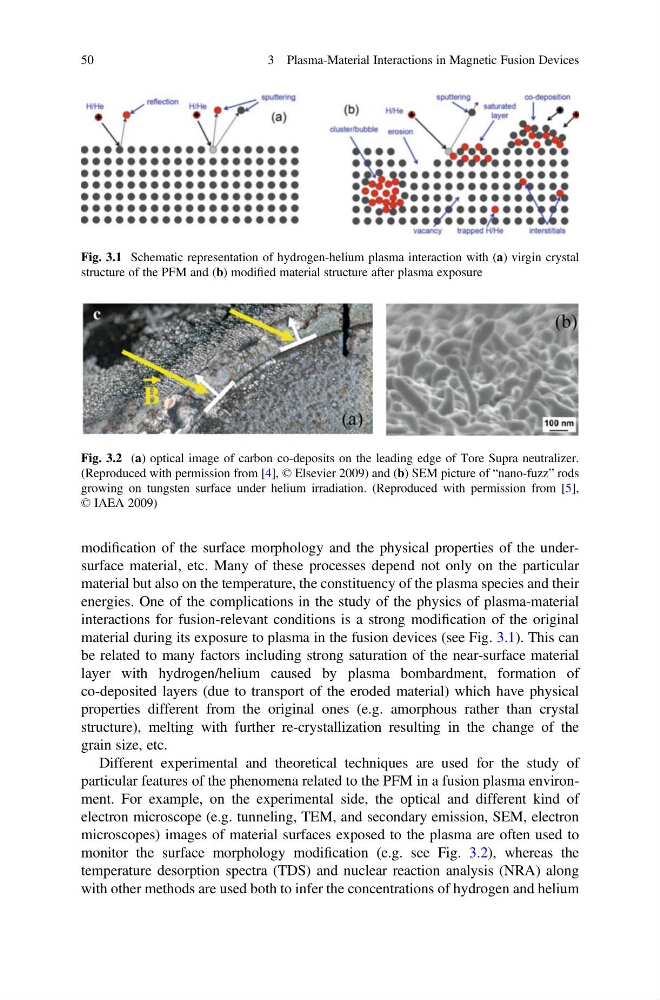
energies. One of the complications in the study of the physics of plasma-material
interactions for fusion-relevant conditions is a strong modification of the original
material during its exposure to plasma in the fusion devices (see Fig. 3.1). This can
be related to many factors including strong saturation of the near-surface material
layer with hydrogen/helium caused by plasma bombardment, formation of
co-deposited layers (due to transport of the eroded material) which have physical
properties different from the original ones (e.g. amorphous rather than crystal
structure), melting with further re-crystallization resulting in the change of the
grain size, etc.
Different experimental and theoretical techniques are used for the study of
particular features of the phenomena related to the PFM in a fusion plasma environment. For example, on the experimental side, the optical and different kind of
electron microscope (e.g. tunneling, TEM, and secondary emission, SEM, electron
microscopes) images of material surfaces exposed to the plasma are often used to
monitor the surface morphology modification (e.g. see Fig. 3.2), whereas the
temperature desorption spectra (TDS) and nuclear reaction analysis (NRA) along
with other methods are used both to infer the concentrations of hydrogen and helium
Fig. 3.1 Schematic representation of hydrogen-helium plasma interaction with (a) virgin crystal
structure of the PFM and (b) modified material structure after plasma exposure
Fig. 3.2 (a) optical image of carbon co-deposits on the leading edge of Tore Supra neutralizer.
(Reproduced with permission from [4], © Elsevier 2009) and (b) SEM picture of “nano-fuzz” rods
growing on tungsten surface under helium irradiation. (Reproduced with permission from [5],
© IAEA 2009)
50
3 Plasma-Material Interactions in Magnetic Fusion Devices
material but also on the temperature, the constituency of the plasma species and their
energies. One of the complications in the study of the physics of plasma-material
interactions for fusion-relevant conditions is a strong modification of the original
material during its exposure to plasma in the fusion devices (see Fig. 3.1). This can
be related to many factors including strong saturation of the near-surface material
layer with hydrogen/helium caused by plasma bombardment, formation of
co-deposited layers (due to transport of the eroded material) which have physical
properties different from the original ones (e.g. amorphous rather than crystal
structure), melting with further re-crystallization resulting in the change of the
grain size, etc.
Different experimental and theoretical techniques are used for the study of
particular features of the phenomena related to the PFM in a fusion plasma environment. For example, on the experimental side, the optical and different kind of
electron microscope (e.g. tunneling, TEM, and secondary emission, SEM, electron
microscopes) images of material surfaces exposed to the plasma are often used to
monitor the surface morphology modification (e.g. see Fig. 3.2), whereas the
temperature desorption spectra (TDS) and nuclear reaction analysis (NRA) along
with other methods are used both to infer the concentrations of hydrogen and helium
Fig. 3.1 Schematic representation of hydrogen-helium plasma interaction with (a) virgin crystal
structure of the PFM and (b) modified material structure after plasma exposure
Fig. 3.2 (a) optical image of carbon co-deposits on the leading edge of Tore Supra neutralizer.
(Reproduced with permission from [4], © Elsevier 2009) and (b) SEM picture of “nano-fuzz” rods
growing on tungsten surface under helium irradiation. (Reproduced with permission from [5],
© IAEA 2009)
50
3 Plasma-Material Interactions in Magnetic Fusion Devices