

field, E B ~ (V N /c)B, caused by neutral motion across the magnetic field (here B is the
magnetic field strength, c is the speed of light, and V N is the speed of the neutral).
As we see, the structure of the quantum states in a hydrogen-like ion/hydrogen
atom is rather simple. This “simplicity” is due to the peculiar degeneracy of quantum
states over electron orbital angular momentum. However, the situation quickly
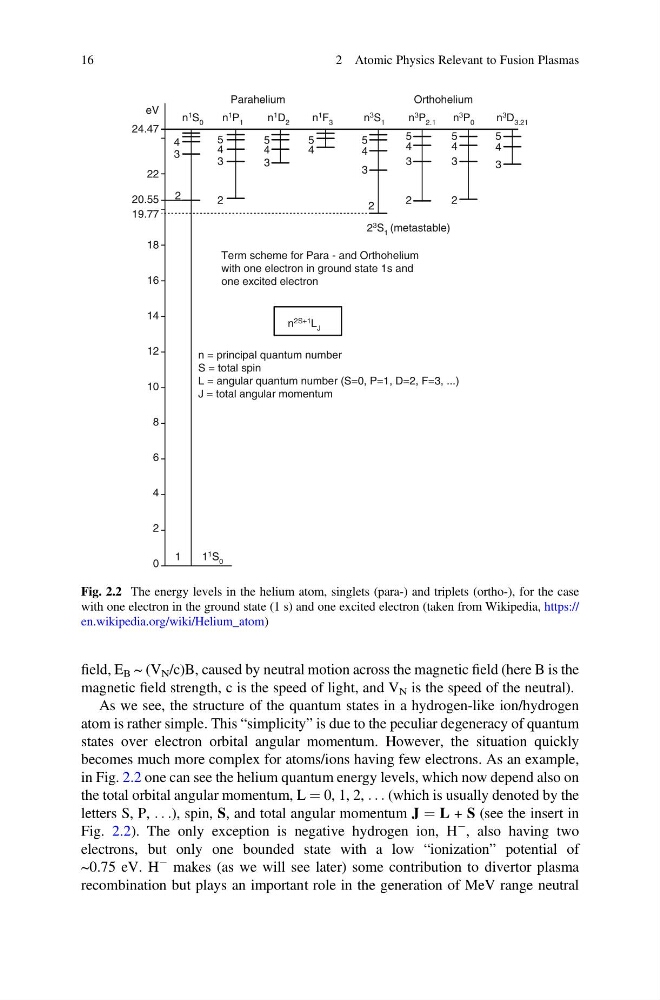
becomes much more complex for atoms/ions having few electrons. As an example,
in Fig. 2.2 one can see the helium quantum energy levels, which now depend also on
the total orbital angular momentum, L ¼ 0, 1, 2, . . . (which is usually denoted by the
letters S, P, . . .), spin, S, and total angular momentum J ¼ L + S (see the insert in
Fig. 2.2). The only exception is negative hydrogen ion, H
À , also having two
electrons, but only one bounded state with a low “ionization” potential of
~0.75 eV. H
À makes (as we will see later) some contribution to divertor plasma
recombination but plays an important role in the generation of MeV range neutral
Term scheme for Para - and Orthohelium
with one electron in ground state 1s and
one excited electron
eV
24.47
22
4
3
4
5
3
4
5
4
5
4
3
2
2
2
5
4
3
2
5
4
3
2
5
4
3
5
3
20.55
19.77
18
16
14
12
10
8
6
4
2
0
1
1
1 S 0
n
1
S 0
n
1
P 1
n
1
D 2
n
1 F 3
n
3 S 1
n
3 P 2.1
Orthohelium
Parahelium
n
3
P 0
n
3 D 3.21
n = principal quantum number
S = total spin
L = angular quantum number (S=0, P=1, D=2, F=3, ...)
J = total angular momentum
n
2S+1
L J
2
3
S 1 (metastable)
Fig. 2.2 The energy levels in the helium atom, singlets (para-) and triplets (ortho-), for the case
with one electron in the ground state (1 s) and one excited electron (taken from Wikipedia, https://
en.wikipedia.org/wiki/Helium_atom)
16
2 Atomic Physics Relevant to Fusion Plasmas
magnetic field strength, c is the speed of light, and V N is the speed of the neutral).
As we see, the structure of the quantum states in a hydrogen-like ion/hydrogen
atom is rather simple. This “simplicity” is due to the peculiar degeneracy of quantum
states over electron orbital angular momentum. However, the situation quickly
becomes much more complex for atoms/ions having few electrons. As an example,
in Fig. 2.2 one can see the helium quantum energy levels, which now depend also on
the total orbital angular momentum, L ¼ 0, 1, 2, . . . (which is usually denoted by the
letters S, P, . . .), spin, S, and total angular momentum J ¼ L + S (see the insert in
Fig. 2.2). The only exception is negative hydrogen ion, H
À , also having two
electrons, but only one bounded state with a low “ionization” potential of
~0.75 eV. H
À makes (as we will see later) some contribution to divertor plasma
recombination but plays an important role in the generation of MeV range neutral
Term scheme for Para - and Orthohelium
with one electron in ground state 1s and
one excited electron
eV
24.47
22
4
3
4
5
3
4
5
4
5
4
3
2
2
2
5
4
3
2
5
4
3
2
5
4
3
5
3
20.55
19.77
18
16
14
12
10
8
6
4
2
0
1
1
1 S 0
n
1
S 0
n
1
P 1
n
1
D 2
n
1 F 3
n
3 S 1
n
3 P 2.1
Orthohelium
Parahelium
n
3
P 0
n
3 D 3.21
n = principal quantum number
S = total spin
L = angular quantum number (S=0, P=1, D=2, F=3, ...)
J = total angular momentum
n
2S+1
L J
2
3
S 1 (metastable)
Fig. 2.2 The energy levels in the helium atom, singlets (para-) and triplets (ortho-), for the case
with one electron in the ground state (1 s) and one excited electron (taken from Wikipedia, https://
en.wikipedia.org/wiki/Helium_atom)
16
2 Atomic Physics Relevant to Fusion Plasmas