

A
H Z
n!k %
1:6 Â 10
10 Z
4
n 3 k n 2 À k
2
À
Ás
À1
:
ð2:2Þ
For a hydrogen atom, the inverse time of decay from the first excited state to
the ground one is A
H
2!1 % 6 Â 10
8 s
À1 . In some cases, it is important to have an
estimate of the decay time from the level n to all lower levels, which is given by
A
H Z
n ¼
P k¼nÀ1
k¼1 A n!k . Then from Eq. (2.2) we have
A
H Z
n % 1:6 Â 10
10 Z
4
n 5 ℓn
n
3
À n
2
s
À1
:
ð2:3Þ
For a single hydrogen atom in vacuum, the number of available quantum states
(the so-called Rydberg states) is not limited. However, in the magnetic fusion
environment, this is not the case. Even intuitively it is difficult to imagine hydrogen
atom with an effective radius of the electron orbit larger than the average inter-ion
distance $ n
À1=3
e
(e.g. the Inglis–Teller equation predicts that the highest observable
hydrogen quantum state n max $ n
À2=15
e
[7]). In practice, isolated high Rydberg states,
being affected by the plasma-induced micro-electric field, E micro $ en
2=3
e , eventually
disappear and merge with continuum, so that the number of states in Eq. (2.3)
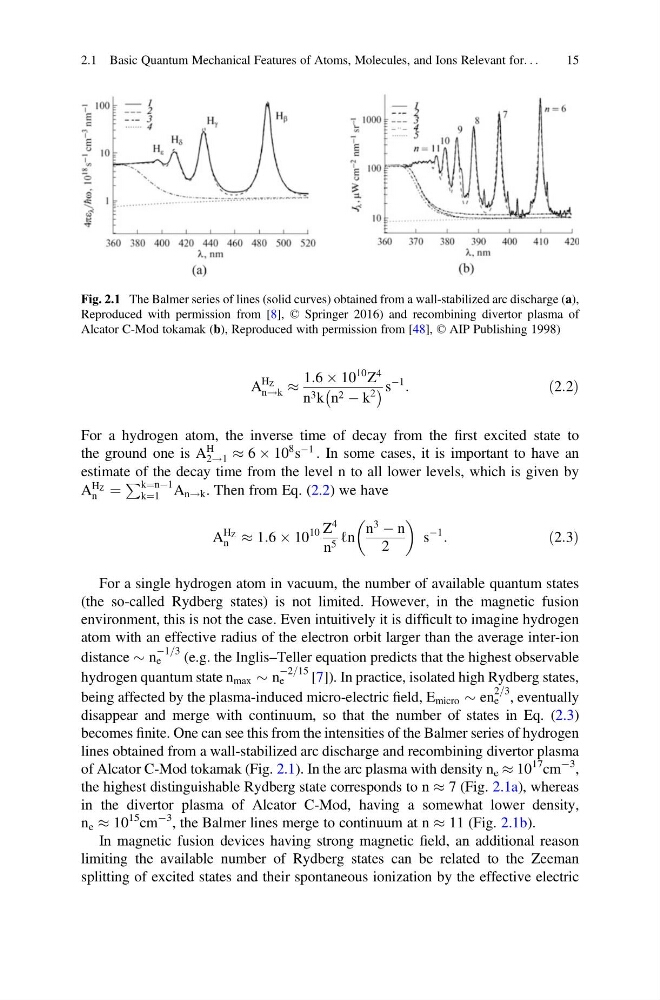
becomes finite. One can see this from the intensities of the Balmer series of hydrogen
lines obtained from a wall-stabilized arc discharge and recombining divertor plasma
of Alcator C-Mod tokamak (Fig. 2.1). In the arc plasma with density n e % 10
17 cm
À3 ,
the highest distinguishable Rydberg state corresponds to n % 7 (Fig. 2.1a), whereas
in the divertor plasma of Alcator C-Mod, having a somewhat lower density,
n e % 10
15 cm
À3 , the Balmer lines merge to continuum at n % 11 (Fig. 2.1b).
In magnetic fusion devices having strong magnetic field, an additional reason
limiting the available number of Rydberg states can be related to the Zeeman
splitting of excited states and their spontaneous ionization by the effective electric
Fig. 2.1 The Balmer series of lines (solid curves) obtained from a wall-stabilized arc discharge (a),
Reproduced with permission from [8], © Springer 2016) and recombining divertor plasma of
Alcator C-Mod tokamak (b), Reproduced with permission from [48], © AIP Publishing 1998)
2.1 Basic Quantum Mechanical Features of Atoms, Molecules, and Ions Relevant for. . .
15
H Z
n!k %
1:6 Â 10
10 Z
4
n 3 k n 2 À k
2
À
Ás
À1
:
ð2:2Þ
For a hydrogen atom, the inverse time of decay from the first excited state to
the ground one is A
H
2!1 % 6 Â 10
8 s
À1 . In some cases, it is important to have an
estimate of the decay time from the level n to all lower levels, which is given by
A
H Z
n ¼
P k¼nÀ1
k¼1 A n!k . Then from Eq. (2.2) we have
A
H Z
n % 1:6 Â 10
10 Z
4
n 5 ℓn
n
3
À n
2
s
À1
:
ð2:3Þ
For a single hydrogen atom in vacuum, the number of available quantum states
(the so-called Rydberg states) is not limited. However, in the magnetic fusion
environment, this is not the case. Even intuitively it is difficult to imagine hydrogen
atom with an effective radius of the electron orbit larger than the average inter-ion
distance $ n
À1=3
e
(e.g. the Inglis–Teller equation predicts that the highest observable
hydrogen quantum state n max $ n
À2=15
e
[7]). In practice, isolated high Rydberg states,
being affected by the plasma-induced micro-electric field, E micro $ en
2=3
e , eventually
disappear and merge with continuum, so that the number of states in Eq. (2.3)
becomes finite. One can see this from the intensities of the Balmer series of hydrogen
lines obtained from a wall-stabilized arc discharge and recombining divertor plasma
of Alcator C-Mod tokamak (Fig. 2.1). In the arc plasma with density n e % 10
17 cm
À3 ,
the highest distinguishable Rydberg state corresponds to n % 7 (Fig. 2.1a), whereas
in the divertor plasma of Alcator C-Mod, having a somewhat lower density,
n e % 10
15 cm
À3 , the Balmer lines merge to continuum at n % 11 (Fig. 2.1b).
In magnetic fusion devices having strong magnetic field, an additional reason
limiting the available number of Rydberg states can be related to the Zeeman
splitting of excited states and their spontaneous ionization by the effective electric
Fig. 2.1 The Balmer series of lines (solid curves) obtained from a wall-stabilized arc discharge (a),
Reproduced with permission from [8], © Springer 2016) and recombining divertor plasma of
Alcator C-Mod tokamak (b), Reproduced with permission from [48], © AIP Publishing 1998)
2.1 Basic Quantum Mechanical Features of Atoms, Molecules, and Ions Relevant for. . .
15