

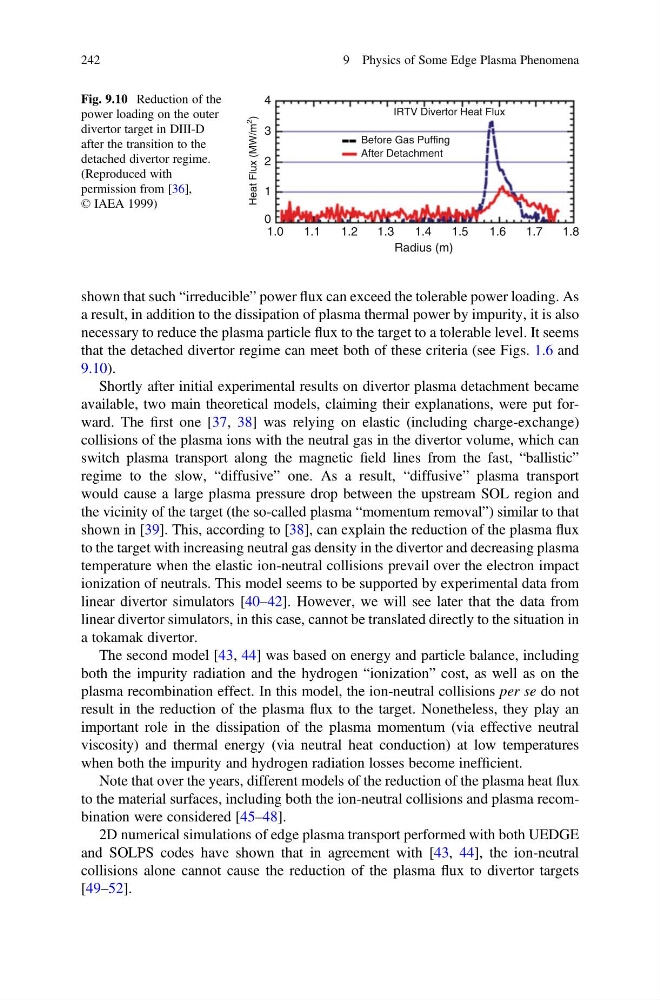
shown that such “irreducible” power flux can exceed the tolerable power loading. As
a result, in addition to the dissipation of plasma thermal power by impurity, it is also
necessary to reduce the plasma particle flux to the target to a tolerable level. It seems
that the detached divertor regime can meet both of these criteria (see Figs. 1.6 and
9.10).
Shortly after initial experimental results on divertor plasma detachment became
available, two main theoretical models, claiming their explanations, were put forward. The first one [37, 38] was relying on elastic (including charge-exchange)
collisions of the plasma ions with the neutral gas in the divertor volume, which can
switch plasma transport along the magnetic field lines from the fast, “ballistic”
regime to the slow, “diffusive” one. As a result, “diffusive” plasma transport
would cause a large plasma pressure drop between the upstream SOL region and
the vicinity of the target (the so-called plasma “momentum removal”) similar to that
shown in [39]. This, according to [38], can explain the reduction of the plasma flux
to the target with increasing neutral gas density in the divertor and decreasing plasma
temperature when the elastic ion-neutral collisions prevail over the electron impact
ionization of neutrals. This model seems to be supported by experimental data from
linear divertor simulators [40–42]. However, we will see later that the data from
linear divertor simulators, in this case, cannot be translated directly to the situation in
a tokamak divertor.
The second model [43, 44] was based on energy and particle balance, including
both the impurity radiation and the hydrogen “ionization” cost, as well as on the
plasma recombination effect. In this model, the ion-neutral collisions per se do not
result in the reduction of the plasma flux to the target. Nonetheless, they play an
important role in the dissipation of the plasma momentum (via effective neutral
viscosity) and thermal energy (via neutral heat conduction) at low temperatures
when both the impurity and hydrogen radiation losses become inefficient.
Note that over the years, different models of the reduction of the plasma heat flux
to the material surfaces, including both the ion-neutral collisions and plasma recombination were considered [45–48].
2D numerical simulations of edge plasma transport performed with both UEDGE
and SOLPS codes have shown that in agreement with [43, 44], the ion-neutral
collisions alone cannot cause the reduction of the plasma flux to divertor targets
[49–52].
4
3
2
1
0
1.0
1.1
1.2
1.3
1.4
1.5
1.6
1.7
1.8
Radius (m)
Before Gas Puffing
After Detachment
IRTV Divertor Heat Flux
Heat Flux (MW/m
2
)
Fig. 9.10 Reduction of the
power loading on the outer
divertor target in DIII-D
after the transition to the
detached divertor regime.
(Reproduced with
permission from [36],
© IAEA 1999)
242
9 Physics of Some Edge Plasma Phenomena
a result, in addition to the dissipation of plasma thermal power by impurity, it is also
necessary to reduce the plasma particle flux to the target to a tolerable level. It seems
that the detached divertor regime can meet both of these criteria (see Figs. 1.6 and
9.10).
Shortly after initial experimental results on divertor plasma detachment became
available, two main theoretical models, claiming their explanations, were put forward. The first one [37, 38] was relying on elastic (including charge-exchange)
collisions of the plasma ions with the neutral gas in the divertor volume, which can
switch plasma transport along the magnetic field lines from the fast, “ballistic”
regime to the slow, “diffusive” one. As a result, “diffusive” plasma transport
would cause a large plasma pressure drop between the upstream SOL region and
the vicinity of the target (the so-called plasma “momentum removal”) similar to that
shown in [39]. This, according to [38], can explain the reduction of the plasma flux
to the target with increasing neutral gas density in the divertor and decreasing plasma
temperature when the elastic ion-neutral collisions prevail over the electron impact
ionization of neutrals. This model seems to be supported by experimental data from
linear divertor simulators [40–42]. However, we will see later that the data from
linear divertor simulators, in this case, cannot be translated directly to the situation in
a tokamak divertor.
The second model [43, 44] was based on energy and particle balance, including
both the impurity radiation and the hydrogen “ionization” cost, as well as on the
plasma recombination effect. In this model, the ion-neutral collisions per se do not
result in the reduction of the plasma flux to the target. Nonetheless, they play an
important role in the dissipation of the plasma momentum (via effective neutral
viscosity) and thermal energy (via neutral heat conduction) at low temperatures
when both the impurity and hydrogen radiation losses become inefficient.
Note that over the years, different models of the reduction of the plasma heat flux
to the material surfaces, including both the ion-neutral collisions and plasma recombination were considered [45–48].
2D numerical simulations of edge plasma transport performed with both UEDGE
and SOLPS codes have shown that in agreement with [43, 44], the ion-neutral
collisions alone cannot cause the reduction of the plasma flux to divertor targets
[49–52].
4
3
2
1
0
1.0
1.1
1.2
1.3
1.4
1.5
1.6
1.7
1.8
Radius (m)
Before Gas Puffing
After Detachment
IRTV Divertor Heat Flux
Heat Flux (MW/m
2
)
Fig. 9.10 Reduction of the
power loading on the outer
divertor target in DIII-D
after the transition to the
detached divertor regime.
(Reproduced with
permission from [36],
© IAEA 1999)
242
9 Physics of Some Edge Plasma Phenomena