

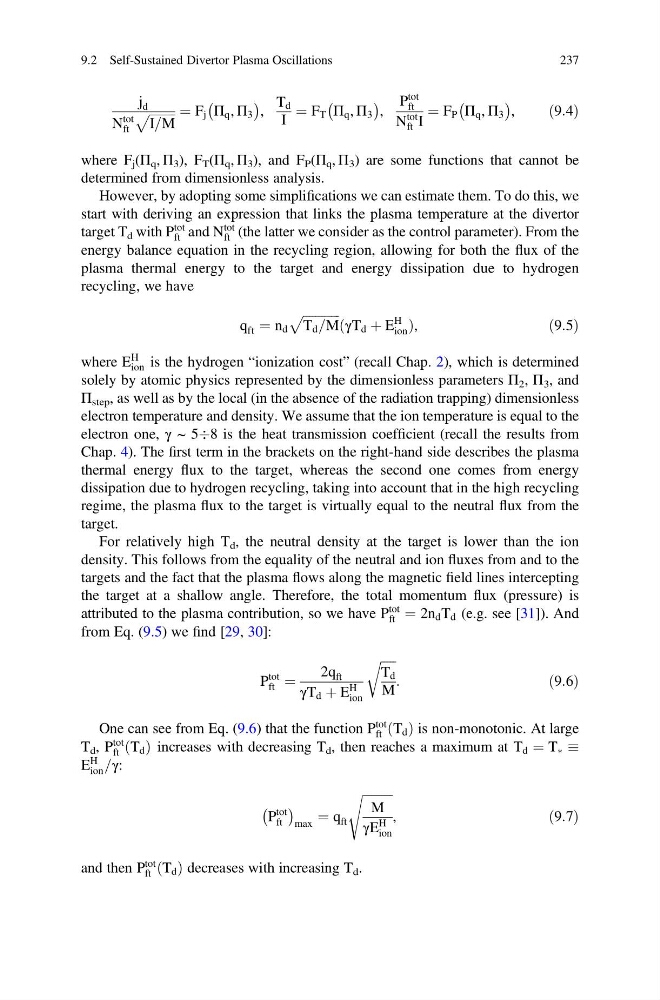
j d
N
tot
ft
ffiffiffiffiffiffiffiffi ffi
I=M
p
¼ F j Π q , Π 3
À
Á
,
T d
I
¼ F T Π q , Π 3
À
Á
,
P
tot
ft
N
tot
ft I
¼ F P Π q , Π 3
À
Á
,
ð9:4Þ
where F j (Π q , Π 3 ), F T (Π q , Π 3 ), and F P (Π q , Π 3 ) are some functions that cannot be
determined from dimensionless analysis.
However, by adopting some simplifications we can estimate them. To do this, we
start with deriving an expression that links the plasma temperature at the divertor
target T d with P
tot
ft and N
tot
ft (the latter we consider as the control parameter). From the
energy balance equation in the recycling region, allowing for both the flux of the
plasma thermal energy to the target and energy dissipation due to hydrogen
recycling, we have
q ft ¼ n d
ffiffiffiffiffiffiffiffiffiffiffi ffi
T d =M
p
ðγT d þ E
H
ion Þ,
ð9:5Þ
where E
H
ion is the hydrogen “ionization cost” (recall Chap. 2), which is determined
solely by atomic physics represented by the dimensionless parameters Π 2 , Π 3 , and
Π step , as well as by the local (in the absence of the radiation trapping) dimensionless
electron temperature and density. We assume that the ion temperature is equal to the
electron one, γ ~ 5Ä8 is the heat transmission coefficient (recall the results from
Chap. 4). The first term in the brackets on the right-hand side describes the plasma
thermal energy flux to the target, whereas the second one comes from energy
dissipation due to hydrogen recycling, taking into account that in the high recycling
regime, the plasma flux to the target is virtually equal to the neutral flux from the
target.
For relatively high T d , the neutral density at the target is lower than the ion
density. This follows from the equality of the neutral and ion fluxes from and to the
targets and the fact that the plasma flows along the magnetic field lines intercepting
the target at a shallow angle. Therefore, the total momentum flux (pressure) is
attributed to the plasma contribution, so we have P
tot
ft ¼ 2n d T d (e.g. see [31]). And
from Eq. (9.5) we find [29, 30]:
P
tot
ft ¼
2q ft
γT d þ E
H
ion
ffiffiffiffiffi
T d
M
r
:
ð9:6Þ
One can see from Eq. (9.6) that the function P
tot
ft T d
ð Þ is non-monotonic. At large
T d , P
tot
ft T d
ð Þ increases with decreasing T d , then reaches a maximum at T d ¼ T Ã
E
H
ion =γ:
P
tot
ft
À Á
max
¼ q ft
ffiffiffiffiffiffiffiffiffiffi
M
γE
H
ion
s
,
ð9:7Þ
and then P
tot
ft T d
ð Þ decreases with increasing T d .
9.2 Self-Sustained Divertor Plasma Oscillations
237
N
tot
ft
ffiffiffiffiffiffiffiffi ffi
I=M
p
¼ F j Π q , Π 3
À
Á
,
T d
I
¼ F T Π q , Π 3
À
Á
,
P
tot
ft
N
tot
ft I
¼ F P Π q , Π 3
À
Á
,
ð9:4Þ
where F j (Π q , Π 3 ), F T (Π q , Π 3 ), and F P (Π q , Π 3 ) are some functions that cannot be
determined from dimensionless analysis.
However, by adopting some simplifications we can estimate them. To do this, we
start with deriving an expression that links the plasma temperature at the divertor
target T d with P
tot
ft and N
tot
ft (the latter we consider as the control parameter). From the
energy balance equation in the recycling region, allowing for both the flux of the
plasma thermal energy to the target and energy dissipation due to hydrogen
recycling, we have
q ft ¼ n d
ffiffiffiffiffiffiffiffiffiffiffi ffi
T d =M
p
ðγT d þ E
H
ion Þ,
ð9:5Þ
where E
H
ion is the hydrogen “ionization cost” (recall Chap. 2), which is determined
solely by atomic physics represented by the dimensionless parameters Π 2 , Π 3 , and
Π step , as well as by the local (in the absence of the radiation trapping) dimensionless
electron temperature and density. We assume that the ion temperature is equal to the
electron one, γ ~ 5Ä8 is the heat transmission coefficient (recall the results from
Chap. 4). The first term in the brackets on the right-hand side describes the plasma
thermal energy flux to the target, whereas the second one comes from energy
dissipation due to hydrogen recycling, taking into account that in the high recycling
regime, the plasma flux to the target is virtually equal to the neutral flux from the
target.
For relatively high T d , the neutral density at the target is lower than the ion
density. This follows from the equality of the neutral and ion fluxes from and to the
targets and the fact that the plasma flows along the magnetic field lines intercepting
the target at a shallow angle. Therefore, the total momentum flux (pressure) is
attributed to the plasma contribution, so we have P
tot
ft ¼ 2n d T d (e.g. see [31]). And
from Eq. (9.5) we find [29, 30]:
P
tot
ft ¼
2q ft
γT d þ E
H
ion
ffiffiffiffiffi
T d
M
r
:
ð9:6Þ
One can see from Eq. (9.6) that the function P
tot
ft T d
ð Þ is non-monotonic. At large
T d , P
tot
ft T d
ð Þ increases with decreasing T d , then reaches a maximum at T d ¼ T Ã
E
H
ion =γ:
P
tot
ft
À Á
max
¼ q ft
ffiffiffiffiffiffiffiffiffiffi
M
γE
H
ion
s
,
ð9:7Þ
and then P
tot
ft T d
ð Þ decreases with increasing T d .
9.2 Self-Sustained Divertor Plasma Oscillations
237