

would be useful to find the dimensionless parameters governing the processes in the
flux tube. However, first, we should determine the relevant dimensional parameters.
Obviously, they include q ft , N
tot
ft and the length of the flux tube L ft . In addition, we
need to allow for dimensional parameters describing collisional interactions of both
the plasma and neutral particles. According to Chap. 2, they are the electron charge,
e, the Planck constant, ħ, the electron (or ion) mass m (M), and the speed of light,
c. However, it is more convenient to use dimensional parameters having clear
physical meaning. Therefore, without any loss of generality, we substitute e, ħ,
and c with the Bohr radius, R B , the hydrogen ionization potential, I, and the lifetime
of the first excited state of a hydrogen atom, τ lt , which is described by the Einstein
coefficient from Chap. 2. Thus, we have seven dimensional parameters (q ft , N
tot
ft , L ft ,
M (or m), R B , I, and τ lt ), which completely determine all processes in the flux tube.
Strictly speaking, the interactions of both the charged and neutral particles with
material surface should provide some additional dimensional parameters (e.g. wall
temperature, surface conditions, models describing hydrogen trapping, etc.). However, for simplicity, we assume that the interactions of both the charged and neutral
particles with the material surface are described by some dimensionless energy and
particle reflection coefficients which depend solely on the parameters of the species
impinging onto the surface. As a result, we still have only seven dimensional
parameters defining the transport properties of plasma and neutrals within the flux
tube and their interactions with the material surface. From these seven dimensional
parameters, we can form four dimensionless ones.
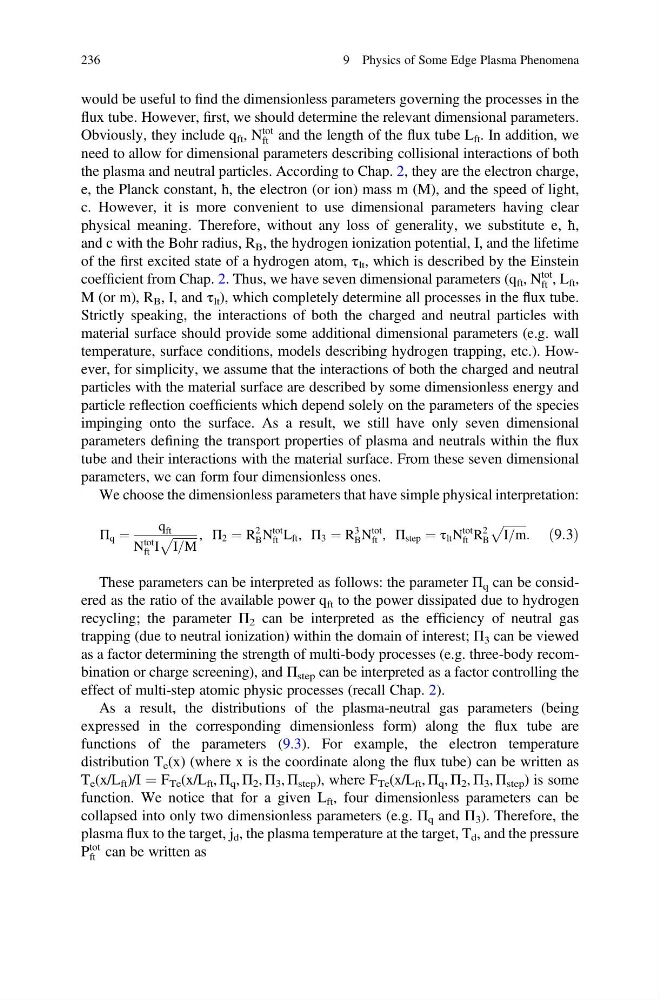
We choose the dimensionless parameters that have simple physical interpretation:
Π q ¼
q ft
N
tot
ft I
ffiffiffiffiffiffiffiffi ffi
I=M
p
, Π 2 ¼ R
2
B N
tot
ft L ft , Π 3 ¼ R
3
B N
tot
ft , Π step ¼ τ lt N
tot
ft R
2
B
ffiffiffiffiffiffiffiffi
I=m
p
: ð9:3Þ
These parameters can be interpreted as follows: the parameter Π q can be considered as the ratio of the available power q ft to the power dissipated due to hydrogen
recycling; the parameter Π 2 can be interpreted as the efficiency of neutral gas
trapping (due to neutral ionization) within the domain of interest; Π 3 can be viewed
as a factor determining the strength of multi-body processes (e.g. three-body recombination or charge screening), and Π step can be interpreted as a factor controlling the
effect of multi-step atomic physic processes (recall Chap. 2).
As a result, the distributions of the plasma-neutral gas parameters (being
expressed in the corresponding dimensionless form) along the flux tube are
functions of the parameters (9.3). For example, the electron temperature
distribution T e (x) (where x is the coordinate along the flux tube) can be written as
T e (x/L ft )/I ¼ F Te (x/L ft , Π q , Π 2 , Π 3 , Π step ), where F Te (x/L ft , Π q , Π 2 , Π 3 , Π step ) is some
function. We notice that for a given L ft , four dimensionless parameters can be
collapsed into only two dimensionless parameters (e.g. Π q and Π 3 ). Therefore, the
plasma flux to the target, j d , the plasma temperature at the target, T d , and the pressure
P
tot
ft can be written as
236
9 Physics of Some Edge Plasma Phenomena
flux tube. However, first, we should determine the relevant dimensional parameters.
Obviously, they include q ft , N
tot
ft and the length of the flux tube L ft . In addition, we
need to allow for dimensional parameters describing collisional interactions of both
the plasma and neutral particles. According to Chap. 2, they are the electron charge,
e, the Planck constant, ħ, the electron (or ion) mass m (M), and the speed of light,
c. However, it is more convenient to use dimensional parameters having clear
physical meaning. Therefore, without any loss of generality, we substitute e, ħ,
and c with the Bohr radius, R B , the hydrogen ionization potential, I, and the lifetime
of the first excited state of a hydrogen atom, τ lt , which is described by the Einstein
coefficient from Chap. 2. Thus, we have seven dimensional parameters (q ft , N
tot
ft , L ft ,
M (or m), R B , I, and τ lt ), which completely determine all processes in the flux tube.
Strictly speaking, the interactions of both the charged and neutral particles with
material surface should provide some additional dimensional parameters (e.g. wall
temperature, surface conditions, models describing hydrogen trapping, etc.). However, for simplicity, we assume that the interactions of both the charged and neutral
particles with the material surface are described by some dimensionless energy and
particle reflection coefficients which depend solely on the parameters of the species
impinging onto the surface. As a result, we still have only seven dimensional
parameters defining the transport properties of plasma and neutrals within the flux
tube and their interactions with the material surface. From these seven dimensional
parameters, we can form four dimensionless ones.
We choose the dimensionless parameters that have simple physical interpretation:
Π q ¼
q ft
N
tot
ft I
ffiffiffiffiffiffiffiffi ffi
I=M
p
, Π 2 ¼ R
2
B N
tot
ft L ft , Π 3 ¼ R
3
B N
tot
ft , Π step ¼ τ lt N
tot
ft R
2
B
ffiffiffiffiffiffiffiffi
I=m
p
: ð9:3Þ
These parameters can be interpreted as follows: the parameter Π q can be considered as the ratio of the available power q ft to the power dissipated due to hydrogen
recycling; the parameter Π 2 can be interpreted as the efficiency of neutral gas
trapping (due to neutral ionization) within the domain of interest; Π 3 can be viewed
as a factor determining the strength of multi-body processes (e.g. three-body recombination or charge screening), and Π step can be interpreted as a factor controlling the
effect of multi-step atomic physic processes (recall Chap. 2).
As a result, the distributions of the plasma-neutral gas parameters (being
expressed in the corresponding dimensionless form) along the flux tube are
functions of the parameters (9.3). For example, the electron temperature
distribution T e (x) (where x is the coordinate along the flux tube) can be written as
T e (x/L ft )/I ¼ F Te (x/L ft , Π q , Π 2 , Π 3 , Π step ), where F Te (x/L ft , Π q , Π 2 , Π 3 , Π step ) is some
function. We notice that for a given L ft , four dimensionless parameters can be
collapsed into only two dimensionless parameters (e.g. Π q and Π 3 ). Therefore, the
plasma flux to the target, j d , the plasma temperature at the target, T d , and the pressure
P
tot
ft can be written as
236
9 Physics of Some Edge Plasma Phenomena