

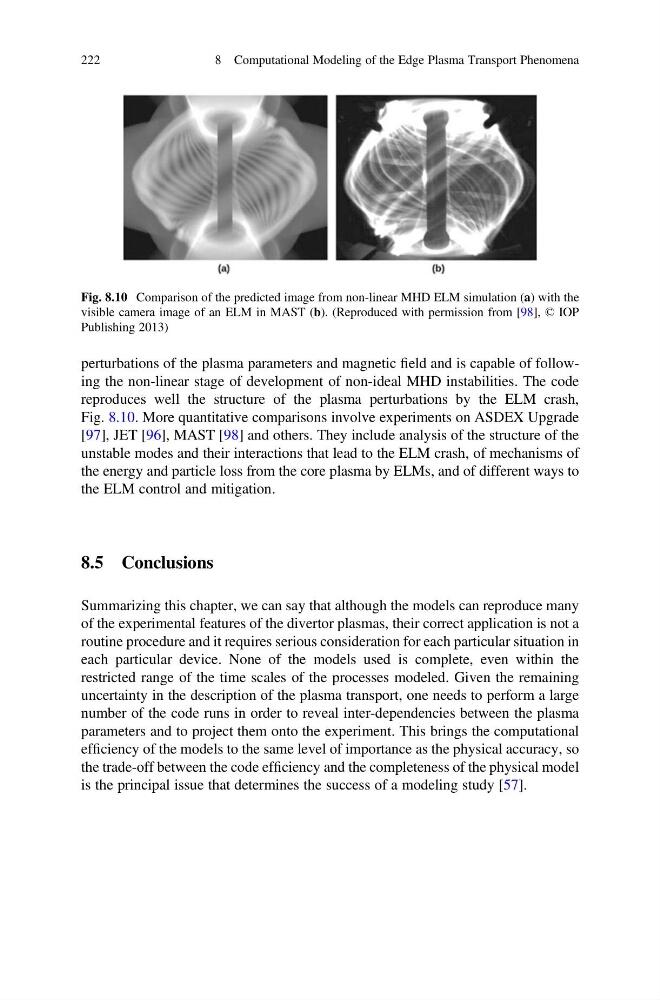
perturbations of the plasma parameters and magnetic field and is capable of following the non-linear stage of development of non-ideal MHD instabilities. The code
reproduces well the structure of the plasma perturbations by the ELM crash,
Fig. 8.10. More quantitative comparisons involve experiments on ASDEX Upgrade
[97], JET [96], MAST [98] and others. They include analysis of the structure of the
unstable modes and their interactions that lead to the ELM crash, of mechanisms of
the energy and particle loss from the core plasma by ELMs, and of different ways to
the ELM control and mitigation.
8.5 Conclusions
Summarizing this chapter, we can say that although the models can reproduce many
of the experimental features of the divertor plasmas, their correct application is not a
routine procedure and it requires serious consideration for each particular situation in
each particular device. None of the models used is complete, even within the
restricted range of the time scales of the processes modeled. Given the remaining
uncertainty in the description of the plasma transport, one needs to perform a large
number of the code runs in order to reveal inter-dependencies between the plasma
parameters and to project them onto the experiment. This brings the computational
efficiency of the models to the same level of importance as the physical accuracy, so
the trade-off between the code efficiency and the completeness of the physical model
is the principal issue that determines the success of a modeling study [57].
Fig. 8.10 Comparison of the predicted image from non-linear MHD ELM simulation (a) with the
visible camera image of an ELM in MAST (b). (Reproduced with permission from [98], © IOP
Publishing 2013)
222
8 Computational Modeling of the Edge Plasma Transport Phenomena
reproduces well the structure of the plasma perturbations by the ELM crash,
Fig. 8.10. More quantitative comparisons involve experiments on ASDEX Upgrade
[97], JET [96], MAST [98] and others. They include analysis of the structure of the
unstable modes and their interactions that lead to the ELM crash, of mechanisms of
the energy and particle loss from the core plasma by ELMs, and of different ways to
the ELM control and mitigation.
8.5 Conclusions
Summarizing this chapter, we can say that although the models can reproduce many
of the experimental features of the divertor plasmas, their correct application is not a
routine procedure and it requires serious consideration for each particular situation in
each particular device. None of the models used is complete, even within the
restricted range of the time scales of the processes modeled. Given the remaining
uncertainty in the description of the plasma transport, one needs to perform a large
number of the code runs in order to reveal inter-dependencies between the plasma
parameters and to project them onto the experiment. This brings the computational
efficiency of the models to the same level of importance as the physical accuracy, so
the trade-off between the code efficiency and the completeness of the physical model
is the principal issue that determines the success of a modeling study [57].
Fig. 8.10 Comparison of the predicted image from non-linear MHD ELM simulation (a) with the
visible camera image of an ELM in MAST (b). (Reproduced with permission from [98], © IOP
Publishing 2013)
222
8 Computational Modeling of the Edge Plasma Transport Phenomena