

core fueling. This would require adjusting the boundary values and re-running the
code until it converges to something reasonable.
8.3.1 Boundary Conditions at the Targets
At the targets, where the plasma flows onto the surface and is neutralized, the
electrostatic sheath is formed (see Chap. 4), which corresponds to the electrical
current closing through the surface (zero in the simplest case of the ambipolar flow).
The boundary conditions discussed in Chap. 4 are applicable here. Usually, one
specifies the flow Mach number of 1 or greater than 1 and the sheath transmission
factors γ i,e that relate the power and particle fluxes to the surface with the plasma
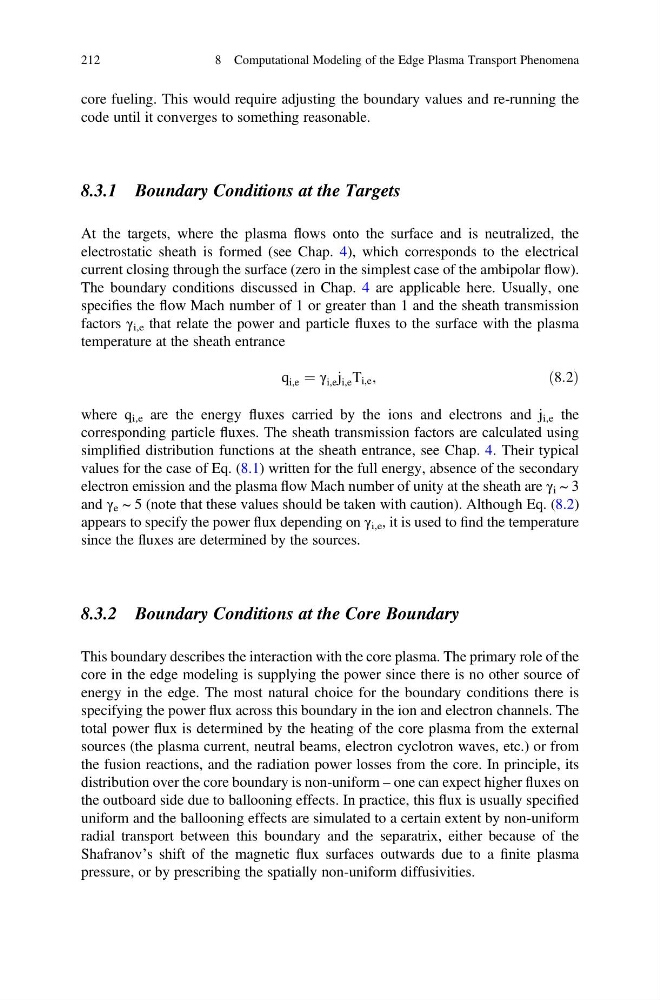
temperature at the sheath entrance
q i,e ¼ γ i,e j i,e T i,e ,
ð8:2Þ
where q i,e are the energy fluxes carried by the ions and electrons and j i,e the
corresponding particle fluxes. The sheath transmission factors are calculated using
simplified distribution functions at the sheath entrance, see Chap. 4. Their typical
values for the case of Eq. (8.1) written for the full energy, absence of the secondary
electron emission and the plasma flow Mach number of unity at the sheath are γ i ~ 3
and γ e ~ 5 (note that these values should be taken with caution). Although Eq. (8.2)
appears to specify the power flux depending on γ i,e , it is used to find the temperature
since the fluxes are determined by the sources.
8.3.2 Boundary Conditions at the Core Boundary
This boundary describes the interaction with the core plasma. The primary role of the
core in the edge modeling is supplying the power since there is no other source of
energy in the edge. The most natural choice for the boundary conditions there is
specifying the power flux across this boundary in the ion and electron channels. The
total power flux is determined by the heating of the core plasma from the external
sources (the plasma current, neutral beams, electron cyclotron waves, etc.) or from
the fusion reactions, and the radiation power losses from the core. In principle, its
distribution over the core boundary is non-uniform – one can expect higher fluxes on
the outboard side due to ballooning effects. In practice, this flux is usually specified
uniform and the ballooning effects are simulated to a certain extent by non-uniform
radial transport between this boundary and the separatrix, either because of the
Shafranov’s shift of the magnetic flux surfaces outwards due to a finite plasma
pressure, or by prescribing the spatially non-uniform diffusivities.
212
8 Computational Modeling of the Edge Plasma Transport Phenomena
code until it converges to something reasonable.
8.3.1 Boundary Conditions at the Targets
At the targets, where the plasma flows onto the surface and is neutralized, the
electrostatic sheath is formed (see Chap. 4), which corresponds to the electrical
current closing through the surface (zero in the simplest case of the ambipolar flow).
The boundary conditions discussed in Chap. 4 are applicable here. Usually, one
specifies the flow Mach number of 1 or greater than 1 and the sheath transmission
factors γ i,e that relate the power and particle fluxes to the surface with the plasma
temperature at the sheath entrance
q i,e ¼ γ i,e j i,e T i,e ,
ð8:2Þ
where q i,e are the energy fluxes carried by the ions and electrons and j i,e the
corresponding particle fluxes. The sheath transmission factors are calculated using
simplified distribution functions at the sheath entrance, see Chap. 4. Their typical
values for the case of Eq. (8.1) written for the full energy, absence of the secondary
electron emission and the plasma flow Mach number of unity at the sheath are γ i ~ 3
and γ e ~ 5 (note that these values should be taken with caution). Although Eq. (8.2)
appears to specify the power flux depending on γ i,e , it is used to find the temperature
since the fluxes are determined by the sources.
8.3.2 Boundary Conditions at the Core Boundary
This boundary describes the interaction with the core plasma. The primary role of the
core in the edge modeling is supplying the power since there is no other source of
energy in the edge. The most natural choice for the boundary conditions there is
specifying the power flux across this boundary in the ion and electron channels. The
total power flux is determined by the heating of the core plasma from the external
sources (the plasma current, neutral beams, electron cyclotron waves, etc.) or from
the fusion reactions, and the radiation power losses from the core. In principle, its
distribution over the core boundary is non-uniform – one can expect higher fluxes on
the outboard side due to ballooning effects. In practice, this flux is usually specified
uniform and the ballooning effects are simulated to a certain extent by non-uniform
radial transport between this boundary and the separatrix, either because of the
Shafranov’s shift of the magnetic flux surfaces outwards due to a finite plasma
pressure, or by prescribing the spatially non-uniform diffusivities.
212
8 Computational Modeling of the Edge Plasma Transport Phenomena