

Further studies of divertor performance have shown that with increasing plasma
density and divertor radiation loss, not only the heat load on the PFCs but also the
plasma particle flux to divertor targets starts to decrease (e.g. see [12] and the
references therein). In a way, it looks like the plasma detaches from the divertor
targets and these regimes are called the “detached divertor” regimes. The reduction
of the plasma flux to the targets allows the reduction of the power loading associated
with the release of the ionization potential energy, which, for a reactor, can be very
substantial and exceed the tolerable limit.
The examples of plasma flux reduction are shown in Fig. 1.5 where the ion
saturation currents, which give the specific plasma flux, measured on JET and
C-Mod tokamaks are shown. As one can see from Fig. 1.5a, the plasma fluxes on
both the inner and outer divertor targets increase, then saturate, and then, in the
detached regime, decrease (the so-called “rollover”) with increasing plasma density.
However, as seen in Fig. 1.5b, such a decrease can occur only on some (although
initially the most loaded) part of the divertor target.
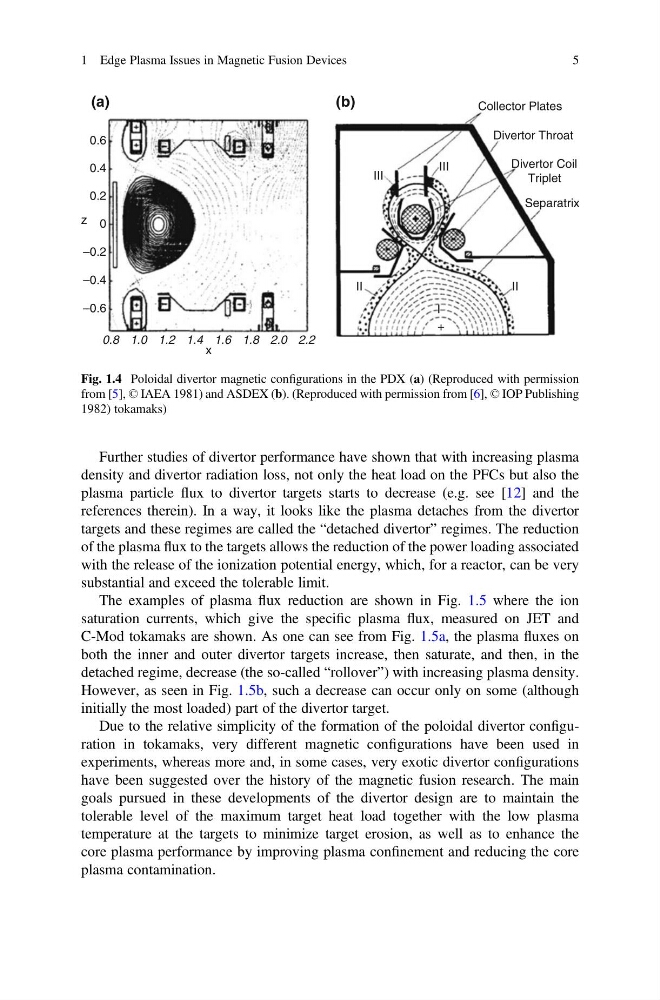
Due to the relative simplicity of the formation of the poloidal divertor configuration in tokamaks, very different magnetic configurations have been used in
experiments, whereas more and, in some cases, very exotic divertor configurations
have been suggested over the history of the magnetic fusion research. The main
goals pursued in these developments of the divertor design are to maintain the
tolerable level of the maximum target heat load together with the low plasma
temperature at the targets to minimize target erosion, as well as to enhance the
core plasma performance by improving plasma confinement and reducing the core
plasma contamination.
Collector Plates
0.6
0.4
0.2
II
II
III
III
I
+
z
–0.6
–0.4
–0.2
0
x
0.8 1.0 1.2 1.4 1.6 1.8 2.0 2.2
Divertor Throat
Divertor Coil
Triplet
Separatrix
(a)
(b)
Fig. 1.4 Poloidal divertor magnetic configurations in the PDX (a) (Reproduced with permission
from [5], © IAEA 1981) and ASDEX (b). (Reproduced with permission from [6], © IOP Publishing
1982) tokamaks)
1 Edge Plasma Issues in Magnetic Fusion Devices
5
density and divertor radiation loss, not only the heat load on the PFCs but also the
plasma particle flux to divertor targets starts to decrease (e.g. see [12] and the
references therein). In a way, it looks like the plasma detaches from the divertor
targets and these regimes are called the “detached divertor” regimes. The reduction
of the plasma flux to the targets allows the reduction of the power loading associated
with the release of the ionization potential energy, which, for a reactor, can be very
substantial and exceed the tolerable limit.
The examples of plasma flux reduction are shown in Fig. 1.5 where the ion
saturation currents, which give the specific plasma flux, measured on JET and
C-Mod tokamaks are shown. As one can see from Fig. 1.5a, the plasma fluxes on
both the inner and outer divertor targets increase, then saturate, and then, in the
detached regime, decrease (the so-called “rollover”) with increasing plasma density.
However, as seen in Fig. 1.5b, such a decrease can occur only on some (although
initially the most loaded) part of the divertor target.
Due to the relative simplicity of the formation of the poloidal divertor configuration in tokamaks, very different magnetic configurations have been used in
experiments, whereas more and, in some cases, very exotic divertor configurations
have been suggested over the history of the magnetic fusion research. The main
goals pursued in these developments of the divertor design are to maintain the
tolerable level of the maximum target heat load together with the low plasma
temperature at the targets to minimize target erosion, as well as to enhance the
core plasma performance by improving plasma confinement and reducing the core
plasma contamination.
Collector Plates
0.6
0.4
0.2
II
II
III
III
I
+
z
–0.6
–0.4
–0.2
0
x
0.8 1.0 1.2 1.4 1.6 1.8 2.0 2.2
Divertor Throat
Divertor Coil
Triplet
Separatrix
(a)
(b)
Fig. 1.4 Poloidal divertor magnetic configurations in the PDX (a) (Reproduced with permission
from [5], © IAEA 1981) and ASDEX (b). (Reproduced with permission from [6], © IOP Publishing
1982) tokamaks)
1 Edge Plasma Issues in Magnetic Fusion Devices
5