

V
!
B,q ¼ 2
cT q
qB
e
!
R Â b
!
R
:
ð7:43Þ
Here we use cylindrical coordinates (R, Z, ϕ) where the Z coordinate goes along
the major tokamak axis, whereas e
!
R is the unit vector along the R coordinate,
b
! ¼ B
!
=B, and assume B tor / 1/R.
We notice that the direction of V
!
B depends on the sign of the charge, so the
electrons and ions drift in opposite directions. As a result, a radial protrusion of the
plasma parameters can cause plasma polarization not only due to the electron motion
along the magnetic field as shown in Fig. 7.1, but also due to the magnetic fieldrelated drifts of the electrons and ions. As a result of such plasma polarization, new
types of instabilities become possible.
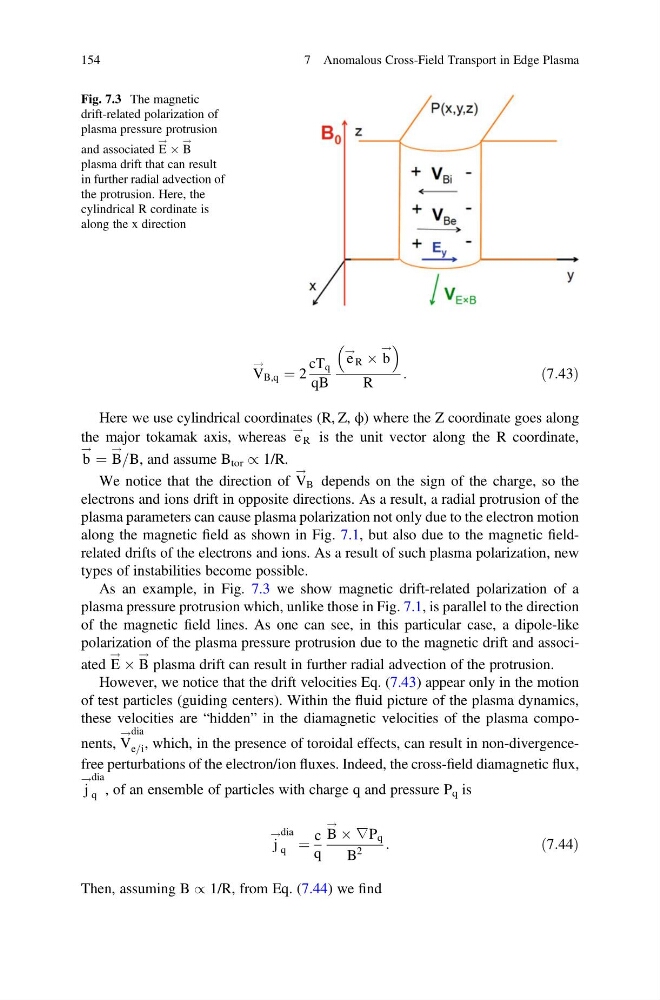
As an example, in Fig. 7.3 we show magnetic drift-related polarization of a
plasma pressure protrusion which, unlike those in Fig. 7.1, is parallel to the direction
of the magnetic field lines. As one can see, in this particular case, a dipole-like
polarization of the plasma pressure protrusion due to the magnetic drift and associated E
! Â B
!
plasma drift can result in further radial advection of the protrusion.
However, we notice that the drift velocities Eq. (7.43) appear only in the motion
of test particles (guiding centers). Within the fluid picture of the plasma dynamics,
these velocities are “hidden” in the diamagnetic velocities of the plasma components, V
! dia
e=i , which, in the presence of toroidal effects, can result in non-divergencefree perturbations of the electron/ion fluxes. Indeed, the cross-field diamagnetic flux,
j
! dia
q , of an ensemble of particles with charge q and pressure P q is
j
! dia
q ¼
c
q
B
! Â ∇P q
B
2
:
ð7:44Þ
Then, assuming B / 1/R, from Eq. (7.44) we find
Fig. 7.3 The magnetic
drift-related polarization of
plasma pressure protrusion
and associated E
! Â B
!
plasma drift that can result
in further radial advection of
the protrusion. Here, the
cylindrical R cordinate is
along the x direction
154
7 Anomalous Cross-Field Transport in Edge Plasma
!
B,q ¼ 2
cT q
qB
e
!
R Â b
!
R
:
ð7:43Þ
Here we use cylindrical coordinates (R, Z, ϕ) where the Z coordinate goes along
the major tokamak axis, whereas e
!
R is the unit vector along the R coordinate,
b
! ¼ B
!
=B, and assume B tor / 1/R.
We notice that the direction of V
!
B depends on the sign of the charge, so the
electrons and ions drift in opposite directions. As a result, a radial protrusion of the
plasma parameters can cause plasma polarization not only due to the electron motion
along the magnetic field as shown in Fig. 7.1, but also due to the magnetic fieldrelated drifts of the electrons and ions. As a result of such plasma polarization, new
types of instabilities become possible.
As an example, in Fig. 7.3 we show magnetic drift-related polarization of a
plasma pressure protrusion which, unlike those in Fig. 7.1, is parallel to the direction
of the magnetic field lines. As one can see, in this particular case, a dipole-like
polarization of the plasma pressure protrusion due to the magnetic drift and associated E
! Â B
!
plasma drift can result in further radial advection of the protrusion.
However, we notice that the drift velocities Eq. (7.43) appear only in the motion
of test particles (guiding centers). Within the fluid picture of the plasma dynamics,
these velocities are “hidden” in the diamagnetic velocities of the plasma components, V
! dia
e=i , which, in the presence of toroidal effects, can result in non-divergencefree perturbations of the electron/ion fluxes. Indeed, the cross-field diamagnetic flux,
j
! dia
q , of an ensemble of particles with charge q and pressure P q is
j
! dia
q ¼
c
q
B
! Â ∇P q
B
2
:
ð7:44Þ
Then, assuming B / 1/R, from Eq. (7.44) we find
Fig. 7.3 The magnetic
drift-related polarization of
plasma pressure protrusion
and associated E
! Â B
!
plasma drift that can result
in further radial advection of
the protrusion. Here, the
cylindrical R cordinate is
along the x direction
154
7 Anomalous Cross-Field Transport in Edge Plasma