

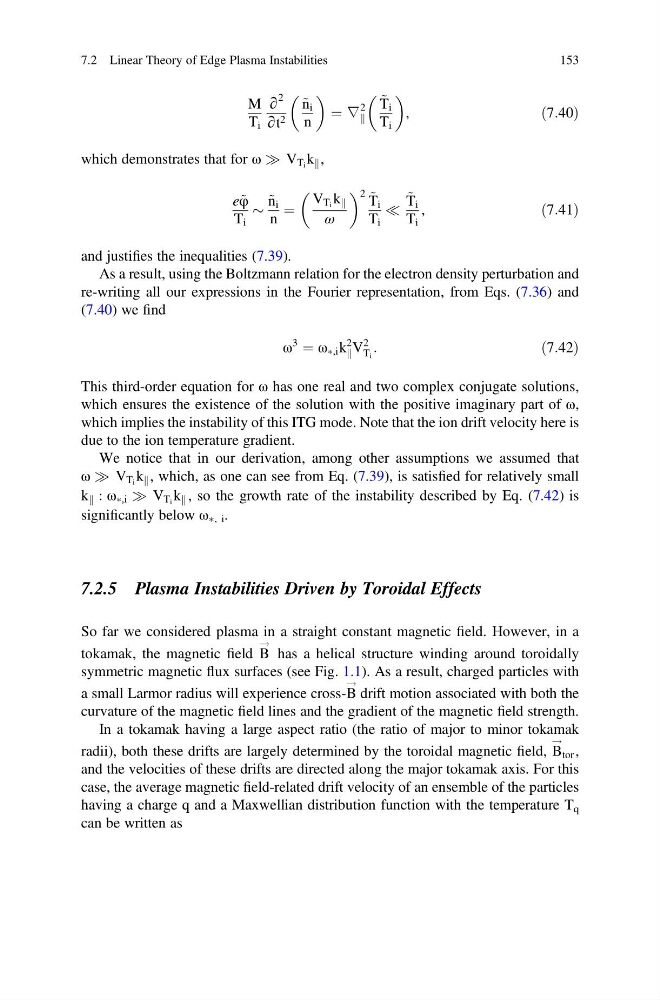
M
T i
∂
2
∂t 2
~ n i
n
¼ ∇
2
k
~
T i
T i
,
ð7:40Þ
which demonstrates that for ω ) V T i k k ,
e~ φ
T i
$
~ n i
n
¼
V T i k k
ω
2 ~
T i
T i
(
~
T i
T i
,
ð7:41Þ
and justifies the inequalities (7.39).
As a result, using the Boltzmann relation for the electron density perturbation and
re-writing all our expressions in the Fourier representation, from Eqs. (7.36) and
(7.40) we find
ω
3
¼ ω Ã,i k
2
k V
2
T i
:
ð7:42Þ
This third-order equation for ω has one real and two complex conjugate solutions,
which ensures the existence of the solution with the positive imaginary part of ω,
which implies the instability of this ITG mode. Note that the ion drift velocity here is
due to the ion temperature gradient.
We notice that in our derivation, among other assumptions we assumed that
ω ) V T i k k , which, as one can see from Eq. (7.39), is satisfied for relatively small
k k : ω Ã,i ) V T i k k , so the growth rate of the instability described by Eq. (7.42) is
significantly below ω Ã, i .
7.2.5 Plasma Instabilities Driven by Toroidal Effects
So far we considered plasma in a straight constant magnetic field. However, in a
tokamak, the magnetic field B
!
has a helical structure winding around toroidally
symmetric magnetic flux surfaces (see Fig. 1.1). As a result, charged particles with
a small Larmor radius will experience cross-B
!
drift motion associated with both the
curvature of the magnetic field lines and the gradient of the magnetic field strength.
In a tokamak having a large aspect ratio (the ratio of major to minor tokamak
radii), both these drifts are largely determined by the toroidal magnetic field, B
!
tor ,
and the velocities of these drifts are directed along the major tokamak axis. For this
case, the average magnetic field-related drift velocity of an ensemble of the particles
having a charge q and a Maxwellian distribution function with the temperature T q
can be written as
7.2 Linear Theory of Edge Plasma Instabilities
153
T i
∂
2
∂t 2
~ n i
n
¼ ∇
2
k
~
T i
T i
,
ð7:40Þ
which demonstrates that for ω ) V T i k k ,
e~ φ
T i
$
~ n i
n
¼
V T i k k
ω
2 ~
T i
T i
(
~
T i
T i
,
ð7:41Þ
and justifies the inequalities (7.39).
As a result, using the Boltzmann relation for the electron density perturbation and
re-writing all our expressions in the Fourier representation, from Eqs. (7.36) and
(7.40) we find
ω
3
¼ ω Ã,i k
2
k V
2
T i
:
ð7:42Þ
This third-order equation for ω has one real and two complex conjugate solutions,
which ensures the existence of the solution with the positive imaginary part of ω,
which implies the instability of this ITG mode. Note that the ion drift velocity here is
due to the ion temperature gradient.
We notice that in our derivation, among other assumptions we assumed that
ω ) V T i k k , which, as one can see from Eq. (7.39), is satisfied for relatively small
k k : ω Ã,i ) V T i k k , so the growth rate of the instability described by Eq. (7.42) is
significantly below ω Ã, i .
7.2.5 Plasma Instabilities Driven by Toroidal Effects
So far we considered plasma in a straight constant magnetic field. However, in a
tokamak, the magnetic field B
!
has a helical structure winding around toroidally
symmetric magnetic flux surfaces (see Fig. 1.1). As a result, charged particles with
a small Larmor radius will experience cross-B
!
drift motion associated with both the
curvature of the magnetic field lines and the gradient of the magnetic field strength.
In a tokamak having a large aspect ratio (the ratio of major to minor tokamak
radii), both these drifts are largely determined by the toroidal magnetic field, B
!
tor ,
and the velocities of these drifts are directed along the major tokamak axis. For this
case, the average magnetic field-related drift velocity of an ensemble of the particles
having a charge q and a Maxwellian distribution function with the temperature T q
can be written as
7.2 Linear Theory of Edge Plasma Instabilities
153