

V
!
D ¼ À
cT
e
B
! Â ∇
1
B
2
:
ð6:31Þ
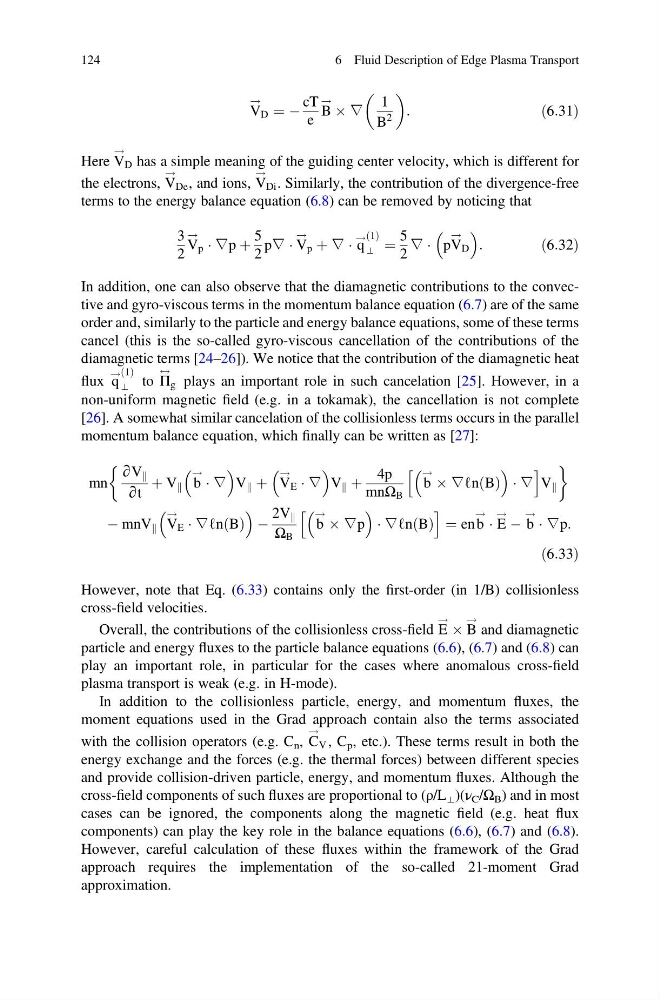
Here V
!
D has a simple meaning of the guiding center velocity, which is different for
the electrons, V
!
De , and ions, V
!
Di . Similarly, the contribution of the divergence-free
terms to the energy balance equation (6.8) can be removed by noticing that
3
2
V
!
p Á ∇p þ
5
2
p∇ Á V
!
p þ ∇ Á q
! 1
ð Þ
⊥ ¼
5
2
∇ Á pV
!
D
:
ð6:32Þ
In addition, one can also observe that the diamagnetic contributions to the convective and gyro-viscous terms in the momentum balance equation (6.7) are of the same
order and, similarly to the particle and energy balance equations, some of these terms
cancel (this is the so-called gyro-viscous cancellation of the contributions of the
diamagnetic terms [24–26]). We notice that the contribution of the diamagnetic heat
flux q
! 1
ð Þ
⊥ to Π
$
g plays an important role in such cancelation [25]. However, in a
non-uniform magnetic field (e.g. in a tokamak), the cancellation is not complete
[26]. A somewhat similar cancelation of the collisionless terms occurs in the parallel
momentum balance equation, which finally can be written as [27]:
mn
& ∂V k
∂t
þ V k
b
! Á ∇
V k þ
V
!
E Á ∇
V k þ
4p
mnΩ B
h
b
! Â ∇ℓnðBÞ
Á ∇
i
V k
'
À mnV k
V
!
E Á ∇ℓnðBÞ
À
2V k
Ω B
h
b
! Â ∇p
Á ∇ℓnðBÞ
i
¼ enb
! Á E
! À b
! Á ∇p:
ð6:33Þ
However, note that Eq. (6.33) contains only the first-order (in 1/B) collisionless
cross-field velocities.
Overall, the contributions of the collisionless cross-field E
! Â B
!
and diamagnetic
particle and energy fluxes to the particle balance equations (6.6), (6.7) and (6.8) can
play an important role, in particular for the cases where anomalous cross-field
plasma transport is weak (e.g. in H-mode).
In addition to the collisionless particle, energy, and momentum fluxes, the
moment equations used in the Grad approach contain also the terms associated
with the collision operators (e.g. C n , C
!
V , C p , etc.). These terms result in both the
energy exchange and the forces (e.g. the thermal forces) between different species
and provide collision-driven particle, energy, and momentum fluxes. Although the
cross-field components of such fluxes are proportional to (ρ/L ⊥ )(ν C /Ω B ) and in most
cases can be ignored, the components along the magnetic field (e.g. heat flux
components) can play the key role in the balance equations (6.6), (6.7) and (6.8).
However, careful calculation of these fluxes within the framework of the Grad
approach requires the implementation of the so-called 21-moment Grad
approximation.
124
6 Fluid Description of Edge Plasma Transport
!
D ¼ À
cT
e
B
! Â ∇
1
B
2
:
ð6:31Þ
Here V
!
D has a simple meaning of the guiding center velocity, which is different for
the electrons, V
!
De , and ions, V
!
Di . Similarly, the contribution of the divergence-free
terms to the energy balance equation (6.8) can be removed by noticing that
3
2
V
!
p Á ∇p þ
5
2
p∇ Á V
!
p þ ∇ Á q
! 1
ð Þ
⊥ ¼
5
2
∇ Á pV
!
D
:
ð6:32Þ
In addition, one can also observe that the diamagnetic contributions to the convective and gyro-viscous terms in the momentum balance equation (6.7) are of the same
order and, similarly to the particle and energy balance equations, some of these terms
cancel (this is the so-called gyro-viscous cancellation of the contributions of the
diamagnetic terms [24–26]). We notice that the contribution of the diamagnetic heat
flux q
! 1
ð Þ
⊥ to Π
$
g plays an important role in such cancelation [25]. However, in a
non-uniform magnetic field (e.g. in a tokamak), the cancellation is not complete
[26]. A somewhat similar cancelation of the collisionless terms occurs in the parallel
momentum balance equation, which finally can be written as [27]:
mn
& ∂V k
∂t
þ V k
b
! Á ∇
V k þ
V
!
E Á ∇
V k þ
4p
mnΩ B
h
b
! Â ∇ℓnðBÞ
Á ∇
i
V k
'
À mnV k
V
!
E Á ∇ℓnðBÞ
À
2V k
Ω B
h
b
! Â ∇p
Á ∇ℓnðBÞ
i
¼ enb
! Á E
! À b
! Á ∇p:
ð6:33Þ
However, note that Eq. (6.33) contains only the first-order (in 1/B) collisionless
cross-field velocities.
Overall, the contributions of the collisionless cross-field E
! Â B
!
and diamagnetic
particle and energy fluxes to the particle balance equations (6.6), (6.7) and (6.8) can
play an important role, in particular for the cases where anomalous cross-field
plasma transport is weak (e.g. in H-mode).
In addition to the collisionless particle, energy, and momentum fluxes, the
moment equations used in the Grad approach contain also the terms associated
with the collision operators (e.g. C n , C
!
V , C p , etc.). These terms result in both the
energy exchange and the forces (e.g. the thermal forces) between different species
and provide collision-driven particle, energy, and momentum fluxes. Although the
cross-field components of such fluxes are proportional to (ρ/L ⊥ )(ν C /Ω B ) and in most
cases can be ignored, the components along the magnetic field (e.g. heat flux
components) can play the key role in the balance equations (6.6), (6.7) and (6.8).
However, careful calculation of these fluxes within the framework of the Grad
approach requires the implementation of the so-called 21-moment Grad
approximation.
124
6 Fluid Description of Edge Plasma Transport