

V
!
Π ¼
1
Ω B
B
!
B
 ∇ Á Π
$ :
ð6:26Þ
Similar expansion for q
!
⊥ gives the following first-order expression.
q
! 1
ð Þ
⊥ ¼
5
2
cp
eB
2
B
! Â ∇T
:
ð6:27Þ
The first order term for collisionless (gyro-viscous) momentum flux Π
$
can be
found from the cross-field components of Eq. (6.21), which gives the following
equation
b
K Π
$
Π
$ Â Ω
!
B À Ω
!
B Â Π
$
¼ p ∇
*
V þ ∇
*
V
Tr À
2
3
I
$
∇ Á
*
V
&
'
þ ∇ q
! þ ∇ q
!
Tr À
2
3
I
$
∇ Á q
!
&
'
:
ð6:28Þ
The inversion of the operator b
K Π
$
gives the following expression for the gyroviscous momentum flux
Π
$
g ¼
1
4Ω B
b
! Â W
$ Á I
$ þ 3b
!
b
!
À I
$ þ 3b
!
b
!
Á W
$ Â b
!
n
o
,
ð6:29Þ
where b
! ¼ B
! =B and
W
$ ¼ p ∇V
! þ ∇V
!
Tr
&
'
þ
2
5
∇ q
! þ ∇ q
!
Tr
&
'
:
ð6:30Þ
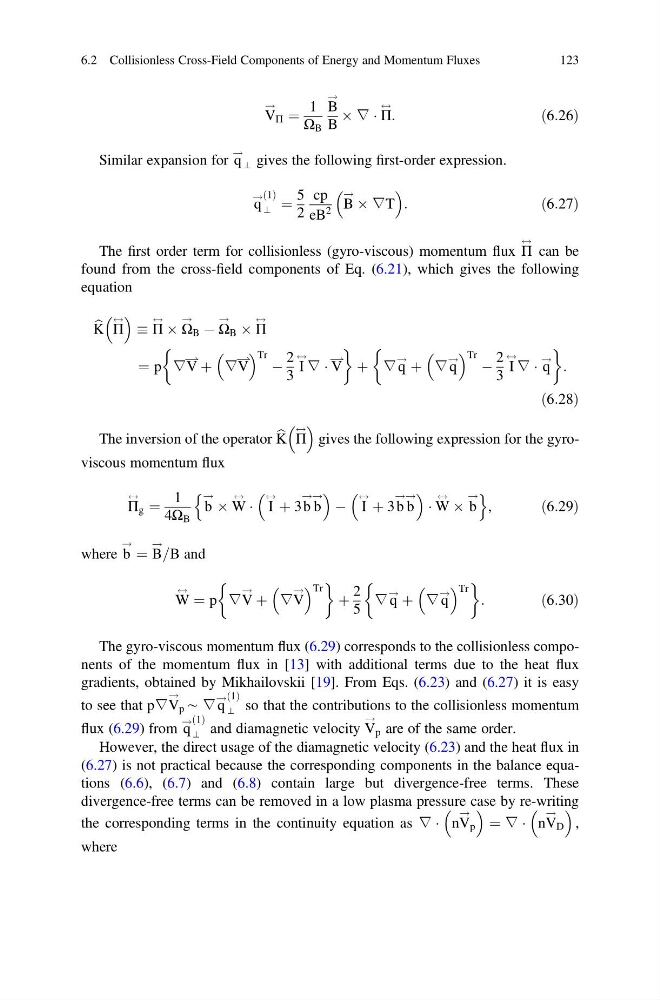
The gyro-viscous momentum flux (6.29) corresponds to the collisionless components of the momentum flux in [13] with additional terms due to the heat flux
gradients, obtained by Mikhailovskii [19]. From Eqs. (6.23) and (6.27) it is easy
to see that p∇V
!
p ∼ ∇ q
! 1
ð Þ
⊥ so that the contributions to the collisionless momentum
flux (6.29) from q
! 1
ð Þ
⊥ and diamagnetic velocity V
!
p are of the same order.
However, the direct usage of the diamagnetic velocity (6.23) and the heat flux in
(6.27) is not practical because the corresponding components in the balance equations (6.6), (6.7) and (6.8) contain large but divergence-free terms. These
divergence-free terms can be removed in a low plasma pressure case by re-writing
the corresponding terms in the continuity equation as ∇ Á nV
!
p
¼ ∇ Á nV
!
D
,
where
6.2 Collisionless Cross-Field Components of Energy and Momentum Fluxes
123
!
Π ¼
1
Ω B
B
!
B
 ∇ Á Π
$ :
ð6:26Þ
Similar expansion for q
!
⊥ gives the following first-order expression.
q
! 1
ð Þ
⊥ ¼
5
2
cp
eB
2
B
! Â ∇T
:
ð6:27Þ
The first order term for collisionless (gyro-viscous) momentum flux Π
$
can be
found from the cross-field components of Eq. (6.21), which gives the following
equation
b
K Π
$
Π
$ Â Ω
!
B À Ω
!
B Â Π
$
¼ p ∇
*
V þ ∇
*
V
Tr À
2
3
I
$
∇ Á
*
V
&
'
þ ∇ q
! þ ∇ q
!
Tr À
2
3
I
$
∇ Á q
!
&
'
:
ð6:28Þ
The inversion of the operator b
K Π
$
gives the following expression for the gyroviscous momentum flux
Π
$
g ¼
1
4Ω B
b
! Â W
$ Á I
$ þ 3b
!
b
!
À I
$ þ 3b
!
b
!
Á W
$ Â b
!
n
o
,
ð6:29Þ
where b
! ¼ B
! =B and
W
$ ¼ p ∇V
! þ ∇V
!
Tr
&
'
þ
2
5
∇ q
! þ ∇ q
!
Tr
&
'
:
ð6:30Þ
The gyro-viscous momentum flux (6.29) corresponds to the collisionless components of the momentum flux in [13] with additional terms due to the heat flux
gradients, obtained by Mikhailovskii [19]. From Eqs. (6.23) and (6.27) it is easy
to see that p∇V
!
p ∼ ∇ q
! 1
ð Þ
⊥ so that the contributions to the collisionless momentum
flux (6.29) from q
! 1
ð Þ
⊥ and diamagnetic velocity V
!
p are of the same order.
However, the direct usage of the diamagnetic velocity (6.23) and the heat flux in
(6.27) is not practical because the corresponding components in the balance equations (6.6), (6.7) and (6.8) contain large but divergence-free terms. These
divergence-free terms can be removed in a low plasma pressure case by re-writing
the corresponding terms in the continuity equation as ∇ Á nV
!
p
¼ ∇ Á nV
!
D
,
where
6.2 Collisionless Cross-Field Components of Energy and Momentum Fluxes
123