

developed, which aim to characterize nonlinear plasma fluctuations and transport at
the edge of the magnetic confinement devices, including 3D effects and open
magnetic field geometries [1–9]. Because of limitations noted above, such codes
are often based on fluid (moment) formulation and neglect interactions with neutrals
and many kinetic effects such as parallel transport.
In the alternative approach (e.g. see [10, 11], and Chap. 8), the emphasis is on the
characterization of large spatiotemporal scale equilibria and flows of particles and
energy in complex divertor geometries including coupling to neutrals, sheath boundaries, atomic physics, plasma surface interactions, etc. Such codes, conditionally
called here transport codes, include the effects of small-scale fluctuations and
anomalous transport by using mostly empirical anomalous transport coefficients.
The exact structure of anomalous transport, i.e. the form of the transport matrix and
thermodynamical forces responsible for anomalous transport, e. g. the pinch effects,
the role and the form of the residual stress, etc. is the subject of intense studies and
debates. The most common approach is to modify the classical coefficients for
perpendicular transport with some empirical anomalous values (see [10–12] and
Chap. 8).
In this chapter, we highlight the description of plasma dynamics based on the
fluid (moment) approach, the main assumptions, the validity limits, and the discussion of how the moment approach is used in the transport codes. The strong magnetic
field of fusion devices allows certain classification of the cross-field particle,
momentum and energy fluxes, as well as some simplifications of the resulting
equations governing these quantities. In particular, the collisionless cross-field fluxes
play an important role in defining the electric field, the parallel current and the flows
in edge plasmas and are currently included in the transport codes used to model the
plasma edge [10–12]. We discuss also plasma transport driven by the inhomogeneity
of the plasma parameters along the magnetic field, which are of particular importance in the SOL region where the magnetic field lines intersect material surfaces.
6.1 Hierarchy and Closure of the Fluid Equations
We introduce here the basic moment (fluid) equations to fix the notations and define
the relevant variables. In the most general form, the dynamics of electrons, ions, and
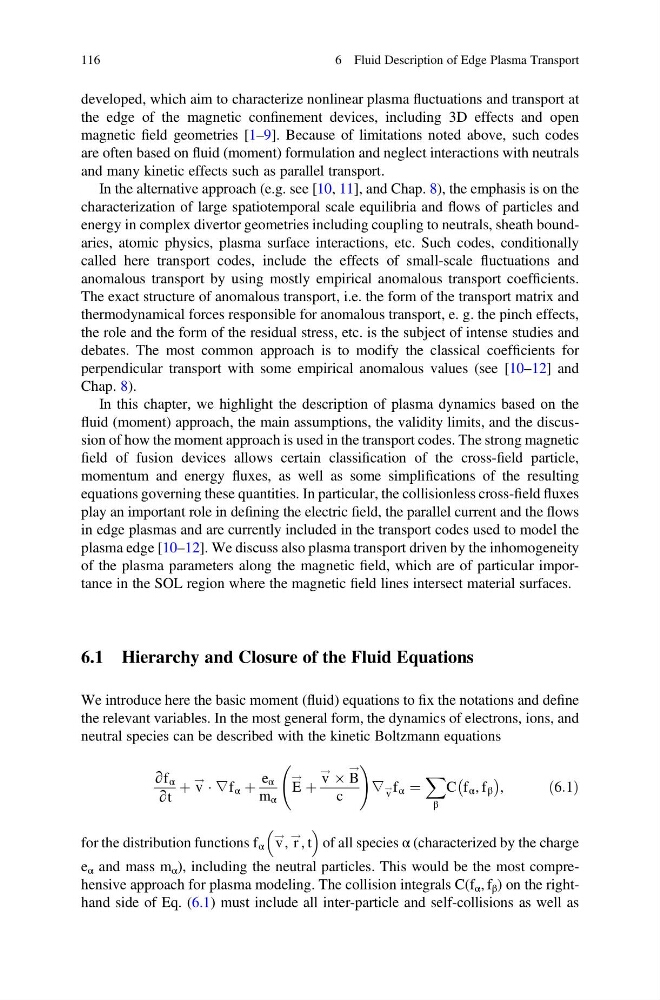
neutral species can be described with the kinetic Boltzmann equations
∂f α
∂t
þ v
! Á ∇f α þ
e α
m α
E
! þ
v
! Â B
!
c
!
∇ v
! f α ¼
X
β
C f α , f β
À
Á
,
ð6:1Þ
for the distribution functions f α v
!
, r
!
, t
of all species α (characterized by the charge
e α and mass m α ), including the neutral particles. This would be the most comprehensive approach for plasma modeling. The collision integrals C(f α , f β ) on the righthand side of Eq. (6.1) must include all inter-particle and self-collisions as well as
116
6 Fluid Description of Edge Plasma Transport
the edge of the magnetic confinement devices, including 3D effects and open
magnetic field geometries [1–9]. Because of limitations noted above, such codes
are often based on fluid (moment) formulation and neglect interactions with neutrals
and many kinetic effects such as parallel transport.
In the alternative approach (e.g. see [10, 11], and Chap. 8), the emphasis is on the
characterization of large spatiotemporal scale equilibria and flows of particles and
energy in complex divertor geometries including coupling to neutrals, sheath boundaries, atomic physics, plasma surface interactions, etc. Such codes, conditionally
called here transport codes, include the effects of small-scale fluctuations and
anomalous transport by using mostly empirical anomalous transport coefficients.
The exact structure of anomalous transport, i.e. the form of the transport matrix and
thermodynamical forces responsible for anomalous transport, e. g. the pinch effects,
the role and the form of the residual stress, etc. is the subject of intense studies and
debates. The most common approach is to modify the classical coefficients for
perpendicular transport with some empirical anomalous values (see [10–12] and
Chap. 8).
In this chapter, we highlight the description of plasma dynamics based on the
fluid (moment) approach, the main assumptions, the validity limits, and the discussion of how the moment approach is used in the transport codes. The strong magnetic
field of fusion devices allows certain classification of the cross-field particle,
momentum and energy fluxes, as well as some simplifications of the resulting
equations governing these quantities. In particular, the collisionless cross-field fluxes
play an important role in defining the electric field, the parallel current and the flows
in edge plasmas and are currently included in the transport codes used to model the
plasma edge [10–12]. We discuss also plasma transport driven by the inhomogeneity
of the plasma parameters along the magnetic field, which are of particular importance in the SOL region where the magnetic field lines intersect material surfaces.
6.1 Hierarchy and Closure of the Fluid Equations
We introduce here the basic moment (fluid) equations to fix the notations and define
the relevant variables. In the most general form, the dynamics of electrons, ions, and
neutral species can be described with the kinetic Boltzmann equations
∂f α
∂t
þ v
! Á ∇f α þ
e α
m α
E
! þ
v
! Â B
!
c
!
∇ v
! f α ¼
X
β
C f α , f β
À
Á
,
ð6:1Þ
for the distribution functions f α v
!
, r
!
, t
of all species α (characterized by the charge
e α and mass m α ), including the neutral particles. This would be the most comprehensive approach for plasma modeling. The collision integrals C(f α , f β ) on the righthand side of Eq. (6.1) must include all inter-particle and self-collisions as well as
116
6 Fluid Description of Edge Plasma Transport