

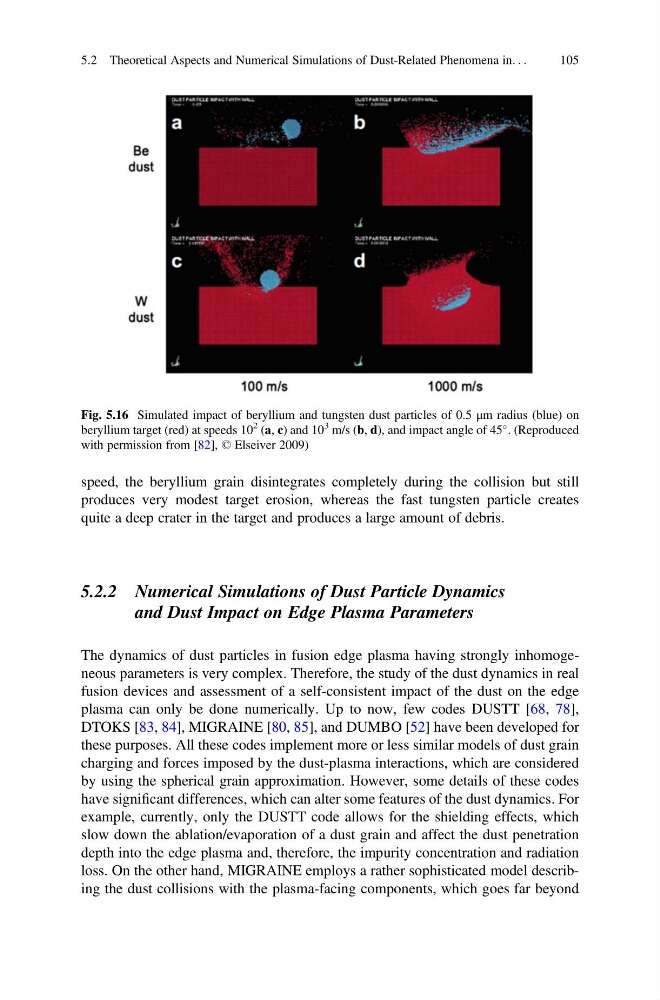
speed, the beryllium grain disintegrates completely during the collision but still
produces very modest target erosion, whereas the fast tungsten particle creates
quite a deep crater in the target and produces a large amount of debris.
5.2.2 Numerical Simulations of Dust Particle Dynamics
and Dust Impact on Edge Plasma Parameters
The dynamics of dust particles in fusion edge plasma having strongly inhomogeneous parameters is very complex. Therefore, the study of the dust dynamics in real
fusion devices and assessment of a self-consistent impact of the dust on the edge
plasma can only be done numerically. Up to now, few codes DUSTT [68, 78],
DTOKS [83, 84], MIGRAINE [80, 85], and DUMBO [52] have been developed for
these purposes. All these codes implement more or less similar models of dust grain
charging and forces imposed by the dust-plasma interactions, which are considered
by using the spherical grain approximation. However, some details of these codes
have significant differences, which can alter some features of the dust dynamics. For
example, currently, only the DUSTT code allows for the shielding effects, which
slow down the ablation/evaporation of a dust grain and affect the dust penetration
depth into the edge plasma and, therefore, the impurity concentration and radiation
loss. On the other hand, MIGRAINE employs a rather sophisticated model describing the dust collisions with the plasma-facing components, which goes far beyond
Fig. 5.16 Simulated impact of beryllium and tungsten dust particles of 0.5 μm radius (blue) on
beryllium target (red) at speeds 10
2 (a, c) and 10
3 m/s (b, d), and impact angle of 45
. (Reproduced
with permission from [82], © Elseiver 2009)
5.2 Theoretical Aspects and Numerical Simulations of Dust-Related Phenomena in. . .
105
produces very modest target erosion, whereas the fast tungsten particle creates
quite a deep crater in the target and produces a large amount of debris.
5.2.2 Numerical Simulations of Dust Particle Dynamics
and Dust Impact on Edge Plasma Parameters
The dynamics of dust particles in fusion edge plasma having strongly inhomogeneous parameters is very complex. Therefore, the study of the dust dynamics in real
fusion devices and assessment of a self-consistent impact of the dust on the edge
plasma can only be done numerically. Up to now, few codes DUSTT [68, 78],
DTOKS [83, 84], MIGRAINE [80, 85], and DUMBO [52] have been developed for
these purposes. All these codes implement more or less similar models of dust grain
charging and forces imposed by the dust-plasma interactions, which are considered
by using the spherical grain approximation. However, some details of these codes
have significant differences, which can alter some features of the dust dynamics. For
example, currently, only the DUSTT code allows for the shielding effects, which
slow down the ablation/evaporation of a dust grain and affect the dust penetration
depth into the edge plasma and, therefore, the impurity concentration and radiation
loss. On the other hand, MIGRAINE employs a rather sophisticated model describing the dust collisions with the plasma-facing components, which goes far beyond
Fig. 5.16 Simulated impact of beryllium and tungsten dust particles of 0.5 μm radius (blue) on
beryllium target (red) at speeds 10
2 (a, c) and 10
3 m/s (b, d), and impact angle of 45
. (Reproduced
with permission from [82], © Elseiver 2009)
5.2 Theoretical Aspects and Numerical Simulations of Dust-Related Phenomena in. . .
105