

by a factor ten [13]) but also on the type of the auxiliary heating (e.g. with the
electron- and ion- cyclotron waves, neutral beam injection, etc.) [17].
However, all available experimental data show that the largest amount of dust
particles inside the vacuum chamber is observed after disruptions (see [15] and the
references therein). For example, in the FTU tokamak, the dust particle density after
a disruption can reach 10
7 m
À3 , whereas before the disruption, the laser scattering
diagnostic detects no dust particles [23]. Moreover, the amount of dust remains
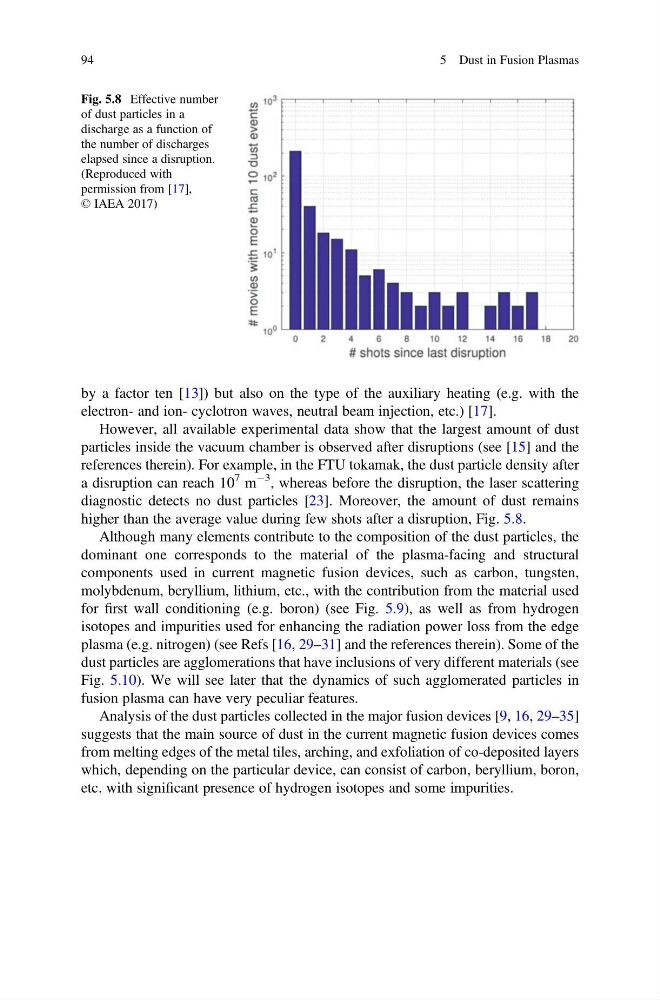
higher than the average value during few shots after a disruption, Fig. 5.8.
Although many elements contribute to the composition of the dust particles, the
dominant one corresponds to the material of the plasma-facing and structural
components used in current magnetic fusion devices, such as carbon, tungsten,
molybdenum, beryllium, lithium, etc., with the contribution from the material used
for first wall conditioning (e.g. boron) (see Fig. 5.9), as well as from hydrogen
isotopes and impurities used for enhancing the radiation power loss from the edge
plasma (e.g. nitrogen) (see Refs [16, 29–31] and the references therein). Some of the
dust particles are agglomerations that have inclusions of very different materials (see
Fig. 5.10). We will see later that the dynamics of such agglomerated particles in
fusion plasma can have very peculiar features.
Analysis of the dust particles collected in the major fusion devices [9, 16, 29–35]
suggests that the main source of dust in the current magnetic fusion devices comes
from melting edges of the metal tiles, arching, and exfoliation of co-deposited layers
which, depending on the particular device, can consist of carbon, beryllium, boron,
etc. with significant presence of hydrogen isotopes and some impurities.
Fig. 5.8 Effective number
of dust particles in a
discharge as a function of
the number of discharges
elapsed since a disruption.
(Reproduced with
permission from [17],
© IAEA 2017)
94
5 Dust in Fusion Plasmas
electron- and ion- cyclotron waves, neutral beam injection, etc.) [17].
However, all available experimental data show that the largest amount of dust
particles inside the vacuum chamber is observed after disruptions (see [15] and the
references therein). For example, in the FTU tokamak, the dust particle density after
a disruption can reach 10
7 m
À3 , whereas before the disruption, the laser scattering
diagnostic detects no dust particles [23]. Moreover, the amount of dust remains
higher than the average value during few shots after a disruption, Fig. 5.8.
Although many elements contribute to the composition of the dust particles, the
dominant one corresponds to the material of the plasma-facing and structural
components used in current magnetic fusion devices, such as carbon, tungsten,
molybdenum, beryllium, lithium, etc., with the contribution from the material used
for first wall conditioning (e.g. boron) (see Fig. 5.9), as well as from hydrogen
isotopes and impurities used for enhancing the radiation power loss from the edge
plasma (e.g. nitrogen) (see Refs [16, 29–31] and the references therein). Some of the
dust particles are agglomerations that have inclusions of very different materials (see
Fig. 5.10). We will see later that the dynamics of such agglomerated particles in
fusion plasma can have very peculiar features.
Analysis of the dust particles collected in the major fusion devices [9, 16, 29–35]
suggests that the main source of dust in the current magnetic fusion devices comes
from melting edges of the metal tiles, arching, and exfoliation of co-deposited layers
which, depending on the particular device, can consist of carbon, beryllium, boron,
etc. with significant presence of hydrogen isotopes and some impurities.
Fig. 5.8 Effective number
of dust particles in a
discharge as a function of
the number of discharges
elapsed since a disruption.
(Reproduced with
permission from [17],
© IAEA 2017)
94
5 Dust in Fusion Plasmas