

5.6 Spherical Geometry
61
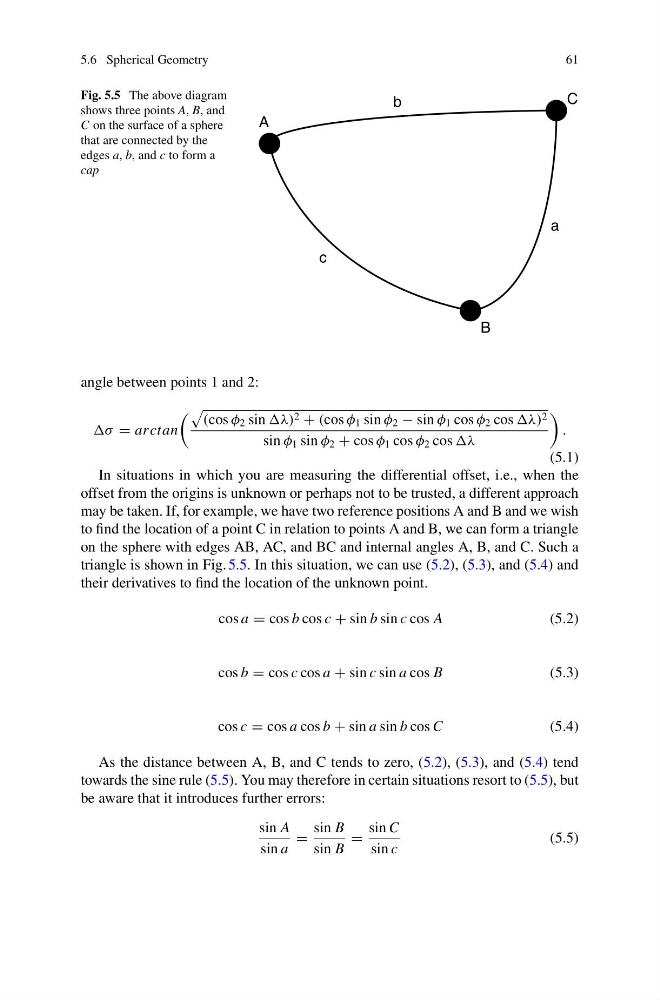
Fig. 5.5 The above diagram
shows three points A, B, and
C on the surface of a sphere
that are connected by the
edges a, b, and c to form a
cap
B
A
C
a
b
c
angle between points 1 and 2:
= arctan
(cos φ 2 sin 2 + (cos φ 1 sin φ 2 − sin φ 1 cos φ 2 cos 2
sin φ 1 sin φ 2 + cos φ 1 cos φ 2 cos λ
.
(5.1)
In situations in which you are measuring the differential offset, i.e., when the
offset from the origins is unknown or perhaps not to be trusted, a different approach
may be taken. If, for example, we have two reference positions A and B and we wish
to find the location of a point C in relation to points A and B, we can form a triangle
on the sphere with edges AB, AC, and BC and internal angles A, B, and C. Such a
triangle is shown in Fig. 5.5. In this situation, we can use (5.2), (5.3), and (5.4) and
their derivatives to find the location of the unknown point.
cos a = cos b cos c + sin b sin c cos A
(5.2)
cos b = cos c cos a + sin c sin a cos B
(5.3)
cos c = cos a cos b + sin a sin b cos C
(5.4)
As the distance between A, B, and C tends to zero, (5.2), (5.3), and (5.4) tend
towards the sine rule (5.5). You may therefore in certain situations resort to (5.5), but
be aware that it introduces further errors:
sin A
sin a
=
sin B
sin B
=
sin C
sin c
(5.5)
61
Fig. 5.5 The above diagram
shows three points A, B, and
C on the surface of a sphere
that are connected by the
edges a, b, and c to form a
cap
B
A
C
a
b
c
angle between points 1 and 2:
= arctan
(cos φ 2 sin 2 + (cos φ 1 sin φ 2 − sin φ 1 cos φ 2 cos 2
sin φ 1 sin φ 2 + cos φ 1 cos φ 2 cos λ
.
(5.1)
In situations in which you are measuring the differential offset, i.e., when the
offset from the origins is unknown or perhaps not to be trusted, a different approach
may be taken. If, for example, we have two reference positions A and B and we wish
to find the location of a point C in relation to points A and B, we can form a triangle
on the sphere with edges AB, AC, and BC and internal angles A, B, and C. Such a
triangle is shown in Fig. 5.5. In this situation, we can use (5.2), (5.3), and (5.4) and
their derivatives to find the location of the unknown point.
cos a = cos b cos c + sin b sin c cos A
(5.2)
cos b = cos c cos a + sin c sin a cos B
(5.3)
cos c = cos a cos b + sin a sin b cos C
(5.4)
As the distance between A, B, and C tends to zero, (5.2), (5.3), and (5.4) tend
towards the sine rule (5.5). You may therefore in certain situations resort to (5.5), but
be aware that it introduces further errors:
sin A
sin a
=
sin B
sin B
=
sin C
sin c
(5.5)