

60
5 Spheres and Coordinates
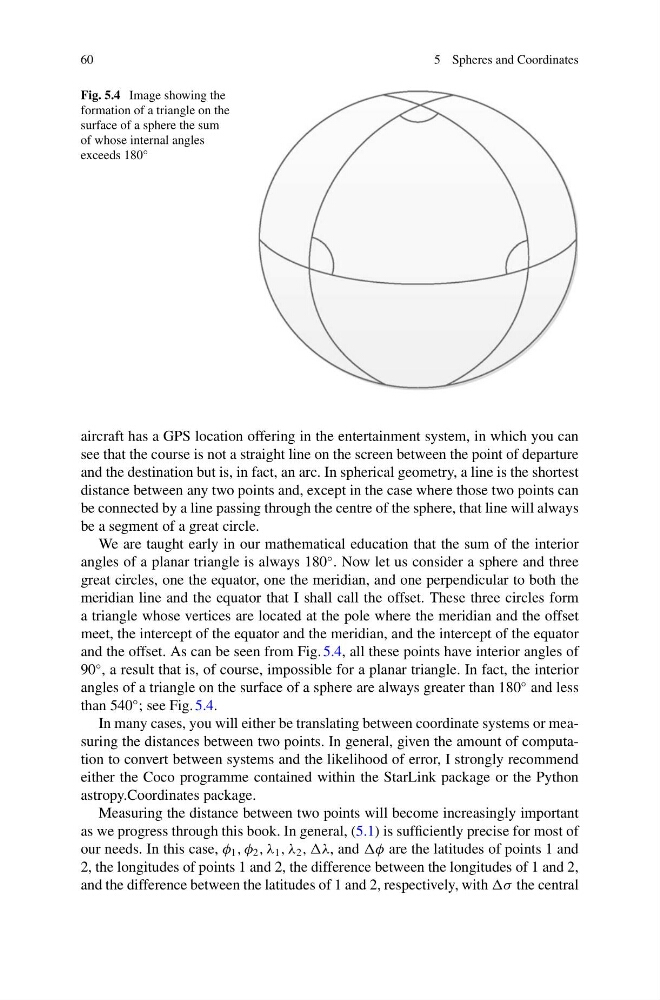
Fig. 5.4 Image showing the
formation of a triangle on the
surface of a sphere the sum
of whose internal angles
exceeds 180 ◦
aircraft has a GPS location offering in the entertainment system, in which you can
see that the course is not a straight line on the screen between the point of departure
and the destination but is, in fact, an arc. In spherical geometry, a line is the shortest
distance between any two points and, except in the case where those two points can
be connected by a line passing through the centre of the sphere, that line will always
be a segment of a great circle.
We are taught early in our mathematical education that the sum of the interior
angles of a planar triangle is always 180
◦ . Now let us consider a sphere and three
great circles, one the equator, one the meridian, and one perpendicular to both the
meridian line and the equator that I shall call the offset. These three circles form
a triangle whose vertices are located at the pole where the meridian and the offset
meet, the intercept of the equator and the meridian, and the intercept of the equator
and the offset. As can be seen from Fig. 5.4, all these points have interior angles of
90
◦ , a result that is, of course, impossible for a planar triangle. In fact, the interior
angles of a triangle on the surface of a sphere are always greater than 180
◦ and less
than 540
◦ ; see Fig. 5.4.
In many cases, you will either be translating between coordinate systems or measuring the distances between two points. In general, given the amount of computation to convert between systems and the likelihood of error, I strongly recommend
either the Coco programme contained within the StarLink package or the Python
astropy.Coordinates package.
Measuring the distance between two points will become increasingly important
as we progress through this book. In general, (5.1) is sufficiently precise for most of
our needs. In this case, φ 1 , φ 2 , λ 1 , λ 2 , ,λ, and φ are the latitudes of points 1 and
2, the longitudes of points 1 and 2, the difference between the longitudes of 1 and 2,
and the difference between the latitudes of 1 and 2, respectively, with σ the central
5 Spheres and Coordinates
Fig. 5.4 Image showing the
formation of a triangle on the
surface of a sphere the sum
of whose internal angles
exceeds 180 ◦
aircraft has a GPS location offering in the entertainment system, in which you can
see that the course is not a straight line on the screen between the point of departure
and the destination but is, in fact, an arc. In spherical geometry, a line is the shortest
distance between any two points and, except in the case where those two points can
be connected by a line passing through the centre of the sphere, that line will always
be a segment of a great circle.
We are taught early in our mathematical education that the sum of the interior
angles of a planar triangle is always 180
◦ . Now let us consider a sphere and three
great circles, one the equator, one the meridian, and one perpendicular to both the
meridian line and the equator that I shall call the offset. These three circles form
a triangle whose vertices are located at the pole where the meridian and the offset
meet, the intercept of the equator and the meridian, and the intercept of the equator
and the offset. As can be seen from Fig. 5.4, all these points have interior angles of
90
◦ , a result that is, of course, impossible for a planar triangle. In fact, the interior
angles of a triangle on the surface of a sphere are always greater than 180
◦ and less
than 540
◦ ; see Fig. 5.4.
In many cases, you will either be translating between coordinate systems or measuring the distances between two points. In general, given the amount of computation to convert between systems and the likelihood of error, I strongly recommend
either the Coco programme contained within the StarLink package or the Python
astropy.Coordinates package.
Measuring the distance between two points will become increasingly important
as we progress through this book. In general, (5.1) is sufficiently precise for most of
our needs. In this case, φ 1 , φ 2 , λ 1 , λ 2 , ,λ, and φ are the latitudes of points 1 and
2, the longitudes of points 1 and 2, the difference between the longitudes of 1 and 2,
and the difference between the latitudes of 1 and 2, respectively, with σ the central