

40
3 The Telescope
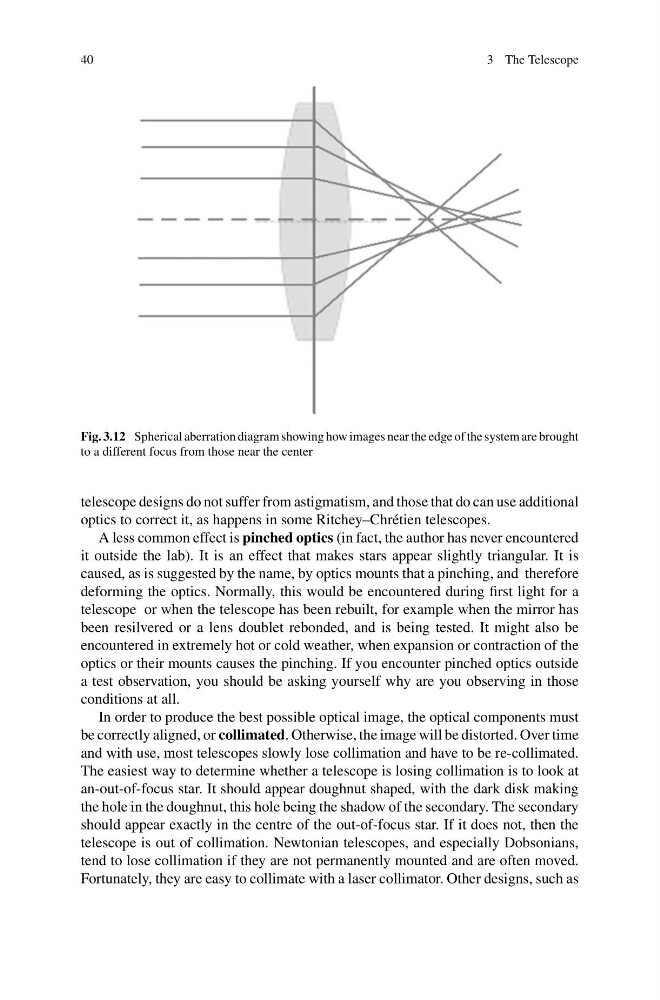
Fig. 3.12 Spherical aberration diagram showing how images near the edge of the system are brought
to a different focus from those near the center
telescope designs do not suffer from astigmatism, and those that do can use additional
optics to correct it, as happens in some Ritchey–Chrétien telescopes.
A less common effect is pinched optics (in fact, the author has never encountered
it outside the lab). It is an effect that makes stars appear slightly triangular. It is
caused, as is suggested by the name, by optics mounts that a pinching, and therefore
deforming the optics. Normally, this would be encountered during first light for a
telescope or when the telescope has been rebuilt, for example when the mirror has
been resilvered or a lens doublet rebonded, and is being tested. It might also be
encountered in extremely hot or cold weather, when expansion or contraction of the
optics or their mounts causes the pinching. If you encounter pinched optics outside
a test observation, you should be asking yourself why are you observing in those
conditions at all.
In order to produce the best possible optical image, the optical components must
be correctly aligned, or collimated. Otherwise, the image will be distorted. Over time
and with use, most telescopes slowly lose collimation and have to be re-collimated.
The easiest way to determine whether a telescope is losing collimation is to look at
an-out-of-focus star. It should appear doughnut shaped, with the dark disk making
the hole in the doughnut, this hole being the shadow of the secondary. The secondary
should appear exactly in the centre of the out-of-focus star. If it does not, then the
telescope is out of collimation. Newtonian telescopes, and especially Dobsonians,
tend to lose collimation if they are not permanently mounted and are often moved.
Fortunately, they are easy to collimate with a laser collimator. Other designs, such as
3 The Telescope
Fig. 3.12 Spherical aberration diagram showing how images near the edge of the system are brought
to a different focus from those near the center
telescope designs do not suffer from astigmatism, and those that do can use additional
optics to correct it, as happens in some Ritchey–Chrétien telescopes.
A less common effect is pinched optics (in fact, the author has never encountered
it outside the lab). It is an effect that makes stars appear slightly triangular. It is
caused, as is suggested by the name, by optics mounts that a pinching, and therefore
deforming the optics. Normally, this would be encountered during first light for a
telescope or when the telescope has been rebuilt, for example when the mirror has
been resilvered or a lens doublet rebonded, and is being tested. It might also be
encountered in extremely hot or cold weather, when expansion or contraction of the
optics or their mounts causes the pinching. If you encounter pinched optics outside
a test observation, you should be asking yourself why are you observing in those
conditions at all.
In order to produce the best possible optical image, the optical components must
be correctly aligned, or collimated. Otherwise, the image will be distorted. Over time
and with use, most telescopes slowly lose collimation and have to be re-collimated.
The easiest way to determine whether a telescope is losing collimation is to look at
an-out-of-focus star. It should appear doughnut shaped, with the dark disk making
the hole in the doughnut, this hole being the shadow of the secondary. The secondary
should appear exactly in the centre of the out-of-focus star. If it does not, then the
telescope is out of collimation. Newtonian telescopes, and especially Dobsonians,
tend to lose collimation if they are not permanently mounted and are often moved.
Fortunately, they are easy to collimate with a laser collimator. Other designs, such as